

17 Followers
840 Following
293 Posts
I'm playing my part to support #biomanufacturing #biofabrication #biofoundry(ies) and bear witness to the birth of an industry. Working with 2 novel compounds to grow bone, cartilage & other types of cells. Turns out they also work for growing hearts @organamet.
Med@tonic
Personal@tonic
Twitterhttps://twitter.com/josephpollack/
CCL5 also had effects on tumor #CellProliferation, invasive tumor #CellBehavior, and increased production of matrix #metalloproteinase s by tumor-associated macrophages. Finally, they found that CCR5 inhibition had an effect on key molecules of @epithelial to @mesenchymal transition ( #EMT ).

The microenvironment of the invasive margin of @liver metastases.

There was no relevant Th1, Th2, or Th17 #cytokine signature present in any of the samples. However, the authors did find that @chemokine s and @macrophage -related cytokines were significantly increased at the invasive margin. Chemokines are molecules that help to attract @immune cells to the area, and macrophage-related cytokines are molecules that help to regulate the activity of #macrophages, which are a type of immune cell.

To further test the #regenerative potential of the #hSkMO s, they added interleukin-4 (IL-4) to the medium to promote @muscleregeneration . After 14 days, they observed a significant increase in MYOG+ myocytes in the CTX-injured hSkMOs with the treatment of IL-4 compared to the CTX-injured hSkMOs without the treatment. This suggests that the hSkMOs have the potential to regenerate muscle tissue after damage.

This indicates that the hSkMOs contained mature skeletal muscle properties and had the potential for #regeneration .

The researchers wanted to see if the #hSkMO s (human #skeletal muscle @organoid s) had the ability to regenerate #muscle #tissue after damage. To test this, they treated the hSkMOs with a cardiotoxin (CTX) which is known to induce muscle inflammation and damage. They then observed a decrease in PAX7+ and MYOD+ cells in the hSkMOs.

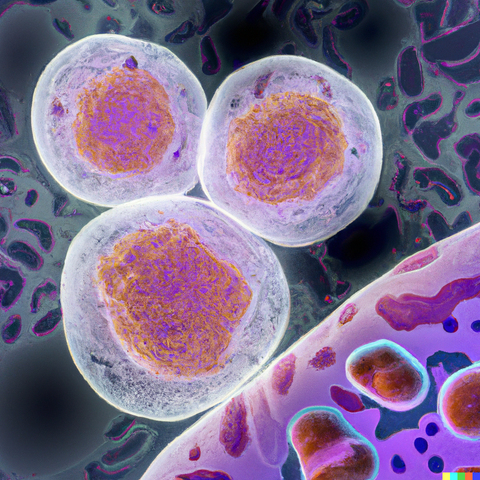
One method proposed is to transfer artificial healthy @mitochondria to remove damaged @mtdna without @genetic manipulation. Other studies have looked at the levels of @mtdna biomarkers in cancerous and non-cancerous samples, as well as the levels of mtDNA methylation and @mtrna in cancerous tissues.
The @mtdna copy number is the amount of @mtdna in each @cell . It is suggested that @mtdna copy number changes may lead to mitochondrial instability and regulate energy @metabolism , which can initiate @tumorigenesis . Studies have also shown that @mtdna copy number changes can be used as a predictive @biomarker for @chemotherapy response.
The communication between the @nucleus and @mitochondria of a cell is known as @intergenomic @crosstalk and it is bidirectional, meaning it can go both ways. It is important for regulating @energy @metabolism and @tumor suppression. The communication is achieved by pathways such as anterograde @signaling and retrograde signaling. Anterograde signaling is when the nucleus controls gene transcription and cytoplasmic @mrna translation in response to external signals.
They contain their own @genetic material, called @mtdna, which is made up of 16569 @nucleotide base pairs. @mtdna mutations can lead to mitochondrial dysfunction, which can cause @onco -genic events, such as @tumor @cell reprogramming and metabolic shifts. @mitoepigenetics is the study of how @epigenetics mechanisms regulate @mtdna transcription and replication, and it is believed to be involved in @cancer progression.

It was also found that calcium and pyrophosphate were key factors involved in the PPi-mediated catabolic response, and that CPPD crystals could potentially be endocytosed and elicit changes through a MAPK-dependent pathway.

#explainpaper

The Therapeutic Potential of Exogenous Adenosine Triphosphate (ATP) for Cartilage Tissue Engineering

authors : Jenna Usprech , Gavin Chu , Renata Giardini-Rosa , Kathleen Martin , and Stephen D. Waldman

In a recent study, it was demonstrated that direct stimulation of the ATP-purinergic receptor pathway through exogenous supplementation of ATP can elicit a comparable anabolic response and be used to improve both tissue growth and mechanical properties of the developed tissue. However, high doses of ATP (250 μM) resulted in a simultaneous catabolic response characterized by an increase in MMP-13 expression, potentially due to the accumulation of ePPi.