Interdisciplinary q: are there disciplines that conventionally model non-linguistic behaviors (in humans or otherwise) using CFGs?
I’m thinking some theory of the firm in Econ or of root structures in plant biology

| website | www.teddyroland.com |
Interdisciplinary q: are there disciplines that conventionally model non-linguistic behaviors (in humans or otherwise) using CFGs?
I’m thinking some theory of the firm in Econ or of root structures in plant biology
Hi friends, I'm looking for leads on fellowships or dissertation support, for the coming academic year. My weirdo Lit Studies project that has me training and testing LLMs during AY 2023-24.
If you know of any DH or DH-flavored linguistics/CS fellowships, HMU! Thanks!
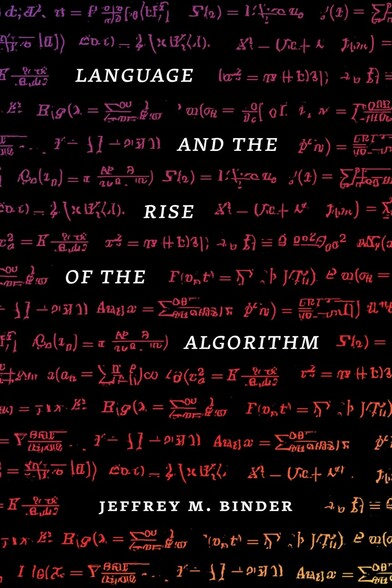
My first book, Language and the Rise of the Algorithm, is out now with U. Chicago Press!
Bringing together the histories of #mathematics, #computerscience, and #linguistics, Language and the Rise of the Algorithm offers a wide-ranging tour of the intellectual developments that produced the modern idea of the #algorithm, from Renaissance #algebra to recent advances in #machinelearning.
#histtech #histodons #histstm #Leibniz #algorithms #language
https://www.amazon.com/dp/0226822532
https://www.barnesandnoble.com/w/language-and-the-rise-of-the-algorithm-jeffrey-m-binder-phd/1141114947?ean=9780226822532
LRT (LB?) there’s a movement afoot in #DeepLearning to constrain model-space using prior knowledge of solutions’ structure. In mature fields like #NLP this makes a lot of sense, since it blends paradigms developed over decades.
But, over here, #Computational #LitStudies is young and born-statistical. Building up a deterministic paradigm — just identifying relationships of logical necessity, never mind a generative grammar! — would make a powerful complement.

Being able to identify and analyse reading impact expressed in online book reviews allows us to investigate how people read books and how books affect their readers. In this paper we investigate the feasibility of creating an English translation of a rule-based reading impact model for reviews of Dutch fiction. We extend the model with additional rules and categories to measure reading impact in terms of positive and negative feeling, narrative and stylistic impact, humour, surprise, attention, and reflection. We created ground truth annotations to evaluate the model and found that the translated rules and new impact categories are effective in identifying certain types of reading impact expressed in English book reviews. However, for some types of impact the rules are inaccurate, and for most categories they are incomplete. Additional rules are needed to improve recall, which could potentially be enhanced by incorporating Machine Learning. At the same time, we conclude that some impact aspects are hard to extract with a rule-based model. When applying the model to a large set of reviews, lists of the top-scoring books in the impact categories show the model's prima-facie validity. Correlations among the categories include some that make sense and others that require further research. Overall, the evidence suggests that for investigating the impact of books, manually formulated rules are partially successful, and are probably best used in a hybrid approach.

Over the last three decades, US government agencies have published hundreds of thousands, if not millions, of PowerPoint files on the web. Hundreds of thousands of these files have been captured and preserved in web archives. With that noted, it remains difficult to find and interact with these files. This paper analyzes a public dataset of 1,000 PowerPoints from US government websites in the Library of Congress web archives to explore the properties of these kinds of files. This publicly available dataset published in 2019 includes a random sample of a thousand files from the more than 300,000 files that purport a PowerPoint media type in the Library of Congress web archives. The study focuses on characterizing the nature of these publications, the extent to which embedded metadata in these documents could be used to improve access to them and exploring what properties of these files are likely to be important to future users. Exploring these data provides a means to begin to understand the value and nature of PowerPoint files as a format of government publishing and government records.

CALL FOR PROPOSALS: TextGenEd: Teaching with Text Generation Technologies Editors: Annette Vee, Assoc. Prof. of English and Dir. of Composition, University of Pittsburgh Tim Laquintano, Assoc. Prof. of English and Dir. of College Writing Program, Lafayette College Carly Schnitzler, Ph.D. Candi...
 Alex Saum
 Max Woolf
 Ted Underwood
 Jeffrey M. Binder
 JCLS
JCLS Euan Cochrane
 Ryan Cordell