 Paul Bassett Davies
The experience of deja vu occurs when someone in the future who's reading your biography loses their place, and flips back a few pages to reread them.

Sun Monkey
- 34 Followers
- 405 Following
- 109 Posts
 Scot Hacker
View from the inside of a cello, photograph by Charles Brooks.


 Andy Baio
An absolute kick in the teeth to all the indie devs who worked so hard to make Twitter a better experience for so many. Twitterrific was officially discontinued today and pulled off the App Store after 16 years of development. Among other firsts, they first used "tweet" to describe an update, first used a bird icon, and were the first native client on iPhone and Mac. https://blog.iconfactory.com/2023/01/twitterrific-end-of-an-era/

Twitterrific: End of an Era • The Breakroom
Twitterrific has been discontinued. A sentence that none of us wanted to write, but have long felt would need to be written someday. We didn’t expect to be writing it so soon, though, and certainly not without having had time to notify you that it was coming. We are sorry to say that the app’s […]
 Published papers at TMLR
Recognition Models to Learn Dynamics from Partial Observations with Neural ODEs
Mona Buisson-Fenet, Valery Morgenthaler, Sebastian Trimpe, Florent Di Meglio

 Aran Komatsuzaki
Decoding of PaLM is only ~2x as costly as that of encoding seqs (in terms of per-token TPU-hours).
Kinda neat autoregressive decoding isn't as inefficient as people think. While latency can be improved further, humans can't read too fast anyways lol

Efficiently Scaling Transformer Inference
We study the problem of efficient generative inference for Transformer models, in one of its most challenging settings: large deep models, with tight latency targets and long sequence lengths. Better understanding of the engineering tradeoffs for inference for large Transformer-based models is important as use cases of these models are growing rapidly throughout application areas. We develop a simple analytical model for inference efficiency to select the best multi-dimensional partitioning techniques optimized for TPU v4 slices based on the application requirements. We combine these with a suite of low-level optimizations to achieve a new Pareto frontier on the latency and model FLOPS utilization (MFU) tradeoffs on 500B+ parameter models that outperforms the FasterTransformer suite of benchmarks. We further show that with appropriate partitioning, the lower memory requirements of multiquery attention (i.e. multiple query heads share single key/value head) enables scaling up to 32x larger context lengths. Finally, we achieve a low-batch-size latency of 29ms per token during generation (using int8 weight quantization) and a 76% MFU during large-batch-size processing of input tokens, while supporting a long 2048-token context length on the PaLM 540B parameter model.
 stephen judkins
Anyone else here feeling fairly unimpressed by how mastodon is working out? For its strengths, there really are not very many interesting discussions going on and the ones that do tend to fizzle out too quickly. Important events from the real world aren't just delayed here, they're often completely ignored. I really wonder what's missing
 Carlos E. Perez @IntuitMachine
Interesting that Plato (just like Socrates) also was suspicious about the technology known as writing. https://theapeiron.co.uk/platos-surprising-argument-against-writing-6d14eaff7cee

 Mark Riedl
 Gowthami Somepalli
StructureDiffusion: Improve the compositional generation capabilities of text-to-image #diffusion models by modifying the text guidance by using a constituency tree or a scene graph.
A 🧵

Training-Free Structured Diffusion Guidance for Compositional Text-to-Image Synthesis
Large-scale diffusion models have achieved state-of-the-art results on text-to-image synthesis (T2I) tasks. Despite their ability to generate high-quality yet creative images, we observe that attribution-binding and compositional capabilities are still considered major challenging issues, especially when involving multiple objects. In this work, we improve the compositional skills of T2I models, specifically more accurate attribute binding and better image compositions. To do this, we incorporate linguistic structures with the diffusion guidance process based on the controllable properties of manipulating cross-attention layers in diffusion-based T2I models. We observe that keys and values in cross-attention layers have strong semantic meanings associated with object layouts and content. Therefore, we can better preserve the compositional semantics in the generated image by manipulating the cross-attention representations based on linguistic insights. Built upon Stable Diffusion, a SOTA T2I model, our structured cross-attention design is efficient that requires no additional training samples. We achieve better compositional skills in qualitative and quantitative results, leading to a 5-8% advantage in head-to-head user comparison studies. Lastly, we conduct an in-depth analysis to reveal potential causes of incorrect image compositions and justify the properties of cross-attention layers in the generation process.
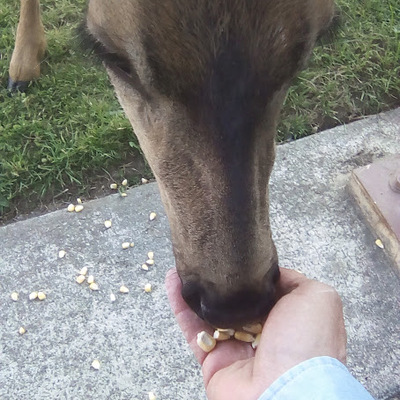 The Deer Whisperer 🦌⚓
Lenticular clouds over Mt Rainier (Tahoma), Washington last fall.