181 Followers
143 Following
20 Posts
Sleep Research, Machine Learning and Data Science using mainly MEG data. Researching memory replay in humans. Python enthusiast. PhD candidate @ CIMH Mannheim with @GordonFeld
GitHubhttps://github.com/skjerns
Websitehttps://skjerns.de
ResearchGatehttps://www.researchgate.net/profile/Simon-Kern-4

[preprint alert 🚨 link below] How do we search for elements within a cognitive map? How does the brain perform search, are elements reactivated in sequence or simultaneously? We set out to answer this question using MEG and decoding

We let participants learn associations that were embedded into a hidden graph structure. After a short consolidation (8 min.) we asked them to retrieve triplets from the hidden graph.
We trained a machine learning classifiers to extract representations from #MEG recordings of the individual items per participant. Using these classifiers, we assessed during retrieval whether items were replayed in short sequence or were reactivated simultaneously.

We confirmed that near items are stronger reactivated than items further away. Looking at this relationship in detail revealed that there was a grading of items on the graph by their decoded reactivation strength, only present for correct answers. (4/7)

Additionally, we also looked into sequential replay using #TDLM. We found that overall there was no significant sequential replay detected (5/7)

However, there was a significant correlation between replay and memory performance with low-performing participants relying more on sequential replay. This is in line with previous results from
gelliott_wimmer

If you want to know more about the study and read our conclusion and don't want to wait for the final publication, here is the preprint https://doi.org/10.1101/2023.07.31.551234 (7/7)
biorxiv.org
Reactivation strength during cued recall is modulated by graph distance within cognitive maps
Declarative memory retrieval is thought to involve reinstatement of the neuronal activity patterns elicited and encoded during a prior learning episode. Recently, it has been suggested that two...

Thanks to all co-authors (Juli Nagel, Fungi Gerchen, Cagatay Guersoy @caggursoy, Andreas Meyer- Lindenberg, Peter Kirsch, Ray Dolan, Steffen Gais) and specially my supervisor Gordon (@GordonFeld), @studienstiftung & @DGSchlafmedizin for funding and @zi_mannheim for hosting me

AI:Why did the neural network reinitialize all of its parameters?
It wanted to achieve rapid weight loss!

https://astralcodexten.substack.com/p/turing-test

Turing Test

...

Astral Codex Ten

NumPy is SLOW on M1/M2 Macs (ARM64 Apple Silicon)! The reason is that it ships with OpenBLAS, which unfortunately is not optimized for this architecture.

So, instead of

pip install numpy

you can use the Apple-provided Accelerate framework, which is MUCH faster:

pip install cython pybind11
pip install --no-binary :all: --no-use-pep517 numpy

#Python #MacOS

these ones are slightly better! tbh quite impressive, but far from good
Asking ChatGPT to create code for SVG images is fun.
Tweet / Twitter

Twitter

This is huge. The German science foundation requests publicly accessible final reports of all funded studies to enhance the visibility of null results.

RT @[email protected]

Projekt-#Abschlussberichte: Einheitliche Grundlagen sollen #DFG-Projekte besser erschließen, die Verwendung d. Gelder und (auch negative) #Forschungsergebnisse transparenter machen. Entspr. Muster gelten für die meisten ab 1.1.23 bewilligten Anträge. Mehr:
https://www.dfg.de/foerderung/info_wissenschaft/info_wissenschaft_23_01

🐦🔗: https://twitter.com/dfg_public/status/1609863489757093889

Deutsche Forschungsgemeinschaft schafft Grundlagen für die Veröffentlichung von Absch

Um die wissenschaftliche Informationsbasis zu verbreitern und einen Beitrag zum notwendigen Kulturwandel im wissenschaftlichen Publikationswesen zu leisten, hat das DFG-Präsidium beschlossen, Ab

www.dfg.de

Can we see entirely new colors without being on drugs? This seems intriguing, somebody wants to try it out?

[...] and the colors flowed into each other in the brain's visual cortex, overriding the opponency mechanisms and producing not the color expected from mixing paints or from mixing lights on a screen, but new colors entirely, which are not in the CIE 1931 color space, either in its real part or in its imaginary parts. For red-and-green, some saw an even field of the new color; some saw a regular pattern of just-visible green dots and red dots; some saw islands of one color on a background of the other color. Some of the volunteers for the experiment reported that afterward, they could still imagine the new colors for a period of time.

https://www.science.org/doi/10.1126/science.221.4615.1078

https://en.wikipedia.org/wiki/Impossible_color

(thanks to astralcodexten)

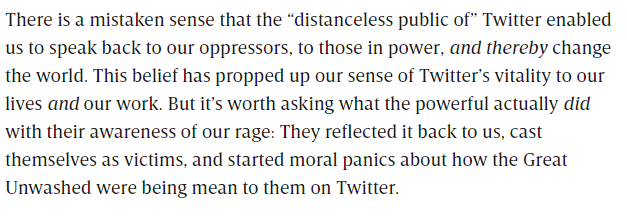
A lot of discussions on here take for granted the fact that certain affordances--like quote-tweets--meaningfully contributed to anti-oppression work because they allow us to talk back to the powerful, to tell some elite wanker to fuck off, or otherwise correct their disinformation or counteract their bigotry or propaganda.

But I've become very skeptical of that argument lately.

As I wrote in Wired:

Interesting pi positions in Tübingen https://ellis.eu/PI2023
6 Principal Investigators (m/f/d) as Hector Endowed ELLIS Fellows in Tübingen

The ELLIS mission is to create a diverse European network that promotes research excellence and advances breakthroughs in AI, as well as a pan-European PhD program to educate the next generation of AI researchers. ELLIS also aims to boost economic growth in Europe by leveraging AI technologies.

European Lab for Learning & Intelligent Systems