For a more general look at foundation models and their application in science. Check out this brand new podcast interview with Ian Foster of Argonne National Laboratory and the University of Chicago. Full episode available here: https://scienceinparallel.org/2025/02/ian-foster-exploring-and-evaluating-foundation-models/ or on your favorite 🎙️ platform. #HPC #AI

Science Machines
- 70 Followers
- 74 Following
- 88 Posts
Covering computational science, high performance computing and the DOE national laboratories. Managed by the Krell Institute. Banner info: http://bit.ly/3VdoeqR

Foundation models, an AI type that includes LLMs, could help researchers fortify defenses against infectious diseases. Arvind Ramanathan of Argonne National Laboratory and his team are applying their award-winning strategy for modeling SARS-CoV-2 evolution toward a more general approach for understanding viruses and bacteria. https://ascr-discovery.org/2025/02/disease-watch/ #HPC #LLM #infectious_disease


Disease watch - ASCR Discovery
The COVID-19 response demonstrated how computational biology could enhance public health research. Though the pandemic has waned, public health researchers remain vigilant about catching dangerous disease strains early and speeding vaccine development. The combination of today’s artificial intelligence tools with … Continue reading →
Superdiamonds could represent a novel, harder form of carbon that might exist in the cores of exoplanets. Ivan Oleynik and his University of South Florida colleagues have used Oak Ridge National Laboratory's Frontier supercomputer to study how this structure could form. The work is supporting experiments at Lawrence Livermore National Laboratory's National Ignition Facility. https://ascr-discovery.org/2025/02/hard-target-2/ #HPC

Hard target - ASCR Discovery
Diamonds aren’t just beautiful sparkly rocks or a girl’s best friend; they’re also the hardest material on Earth. Formed when planetary interior forces exert immense pressure on carbon atoms, they compress into a crystal structure so strong that only another … Continue reading →
Fourth-year #DOECSGF recipient Rahul Sahay of Harvard University is using #quantum behavior to understand matter's phases and develop strategies to create new ones in the laboratory. https://deixismagazine.org/2025/02/sculpting-nature/


Cosmic rays—accelerated atomic nuclei driven by astrophysical phenomena—provide ways to study how galaxies evolved. Using exascale computing power and an #INCITE award researchers are modeling both large- and small-scale behavior in these systems and developing a new model that accounts for unexplained turbulence. https://ascr-discovery.org/2025/02/untangling-the-cosmos/ #HPC #OLCF #ALCF
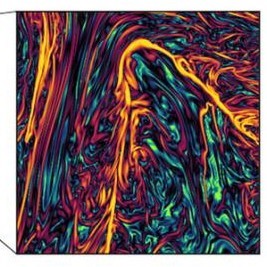

Untangling the cosmos - ASCR Discovery
More than a century ago, scientists pondered how evolution might be driven by mutations caused in part by cosmic rays that bombard Earth after the explosive demise of faraway stars. Yet how cosmic rays move through space has been an … Continue reading →
Simulations to study new ways to catalyze hydrogen production could help with energy storage. Harvard University's Boris Kozinsky and his team are using machine learning to accelerate these complex calculations. https://ascr-discovery.org/2025/01/carbon-free-hydrogen/ Their #INCITE award includes allocations at both #ALCF and #OLCF. #HPC


Putting hydrogen to work - ASCR Discovery
Scientists, industries and policymakers have been working for years to find energy storage technologies that will help meet peak demand for transportation, power generation and other energy-hungry activities. Take, for instance, hydrogen, a promising option for energy storage that is … Continue reading →
New 🎙️ episode: the Science in Parallel podcast is wrapping up Season 5 with computational scientists Mansi Sakarvadia of the University of Chicago and Josh Vermaas of the MSU-DOE Plant Research Laboratory discussing how AI and the recent Nobel Prizes are shaping science. https://scienceinparallel.org/2025/01/computational-scientists-discuss-the-2024-nobel-prizes/ #DOECSGF #HPC


Alex Ballow of Montana State University-Bozeman uses category theory, a form of universal mathematical language, to probe patterns in physics that could advance #quantum computing, condensed matter physics and more.
https://deixismagazine.org/2025/01/categorical-imperative/# The #DOECSGF recipient completed practicum research at Oak Ridge National Laboratory.
https://deixismagazine.org/2025/01/categorical-imperative/# The #DOECSGF recipient completed practicum research at Oak Ridge National Laboratory.


New on the Science in Parallel podcast 🎙️ : @anil talks about AI's Nobel Prize year and his book Why Machines Learn. Listen on your favorite platform or here: https://scienceinparallel.org/2024/12/anil-ananthaswamy-ais-nobel-moment/ #HPC #AI #nobel2024

The human brain's trillions of connections remain largely uncharted. But a team from Argonne National Laboratory and Harvard University is using advanced electron microscopy and #ALCF's hardware and machine learning tools to map neurons' links to better understand how they interact https://ascr-discovery.org/2024/12/connecting-the-neurodots/ #HPC
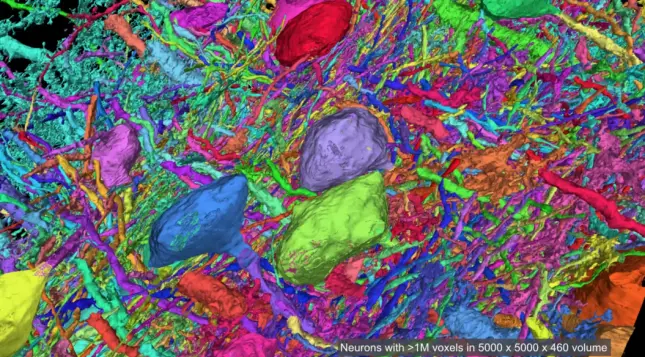

Connecting the neurodots - ASCR Discovery
The human brain contains a vast expanse of unmapped territory. An adult brain measures only about 1,300 cubic centimeters — less than 80 cubic inches — but it holds 86 billion neurons. Mapping the largely uncharted 100 trillion connections among … Continue reading →