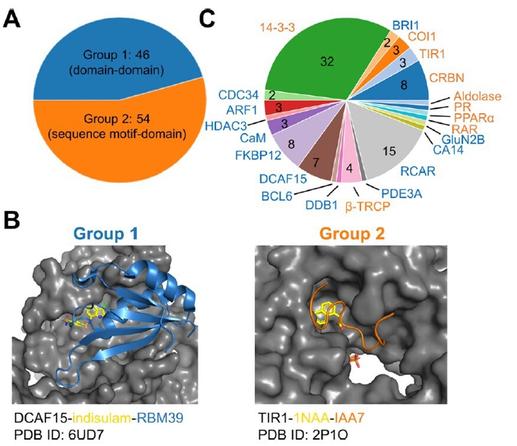
Analysis of molecular glue-induced ternary structures indicate that there are 2 main pathways of how ternary structure is formed; Path 1) a protein–protein binary interface is formed first and then the complex incorporates a small molecule ligand at the interface or Path 2) small molecule binds to a protein partner first, which leads to altered protein surface properties, much like the effects of post-translational modification, making this surface available for association with another protein
We summarize >100 molecular glue-induced ternary complexes, Group 1) features interactions between proteins with well-folded domains, Group 2) one of the binding partners is a stretch of residues that contains a specific pattern for binding based on interaction mode.
New Today! Induced Proximity group at @Amgen publish in @rsc_chembio on Protein–protein interfaces in molecular glue-induced ternary complexes: classification, characterization, and prediction.
https://tinyurl.com/5n95hz79. Main conclusions… 1/thread
… 26S proteasome to recruit targets. PSMD2 is natural receptor of ubiquitinated proteins and close to ATPase pore for unraveling substrates. 2) Very impressive use of mRNA display to identify macrocyclic peptides that bind PSMD2. 3) As expected, macrocycles are not very…
Targeted Protein Degradation independent of ubiquitin ligases? Tour de force study from @genentech provides proof of concept through discover of macrocyclic peptide binding PSMD2 and degrading BRD4. Few take aways. 1) Smart choice of where on the…
https://www.nature.com/articles/s41589-022-01218-w … 1/n

Targeted degradation via direct 26S proteasome recruitment - Nature Chemical Biology
Discovery of macrocyclic ligands to the 19S regulatory particle protein PSMD2 enables the synthesis of heterobifunctional molecules that demonstrate proof-of-concept, targeted degradation of BRD4 through direct engagement of the 26S proteasome.
… permeable. So activity is modest (Dmax 69%) over extended time courses. 4) Degradation only shown with BRD4. Whether more challenging targets will also be degraded is yet to be determined. The importance of polyubiquitination for proteasome-mediated destruction can be…
The authors identify a role for IFITMs proteins in transport of large small molecules into cells. My quick take aways: 1) IFITMs most important for really big SM, beyond PROTAC, 2) effect size is <10 fold, so not the smoking gun, 3) mechanistic studies needed to leverage findings.
Size matters…when it comes to small molecules & cell permeability. But larger small molecules (like bifunctional PROTACs) are still able to get into cells. How you ask? @ScienceMagazine report from @kevansf et al shed some light.
My thoughts on results….
https://www.science.org/doi/10.1126/science.abl5829Where will the next breakthrough come in Proximity-based, multi-specific small molecules? Use of phosphatase recruiters (PHORCs) got a significant proof of concept nod in recent JACS article describing PP5 recruiting bi-functional molecule to control ASK1 phosphorylation. Key will be target selection where you can win the battle against kinase.
https://pubs.acs.org/doi/10.1021/jacs.2c10759Nice article from Ingo Hartung et al on today's evolution of Lipinski's 25yr old 'rule of 5'. They illustrate how the complexity of oral small molecules has been increasing over the last decade and a new way of thinking is emerging. I thought these lines summed it up brilliantly..."Playing by the rules is thus not always advisable when pushing for success in drug discovery. Rather, successful drug hunters must follow a mindset of pushing the limits of what is possible."
https://www.nature.com/articles/s41570-022-00451-0Rules were made to be broken - Nature Reviews Chemistry
Twenty five years ago, Christopher Lipinski and colleagues published arguably the most influential sentence in small-molecule drug discovery. Their cleverly crafted ‘rule of 5’ (Ro5) mnemonic was adopted into everyday medicinal chemistry practice and has influenced a generation of small-molecule drug discovery scientists. Five times five years later, we consider the impact of the Ro5 and ask to what extent it should still guide today’s medicinal chemistry efforts.