How China's invasion of Taiwan could destroy the global economy
| https://www.linkedin.com/in/rmnl/ |

| https://www.linkedin.com/in/rmnl/ |
How China's invasion of Taiwan could destroy the global economy
Investments in new projects will be limited due to the risk of escalating conflict.
BUT IMHO if your company works in defense tech, alternative/renewable energy, or cybersecurity, you're probably cool 😎.
Please add, if I forgot something.
About the impact of the next conflict in the Middle East on IT companies.
Looks like this conflict won't be a short military operation. For now, I would expect that rising energy costs will drive up the cost of energy-intensive services (AI services, cloud computing, etc.). The disruption of shipping routes will increase the cost and time required to deliver hardware components from Asia.
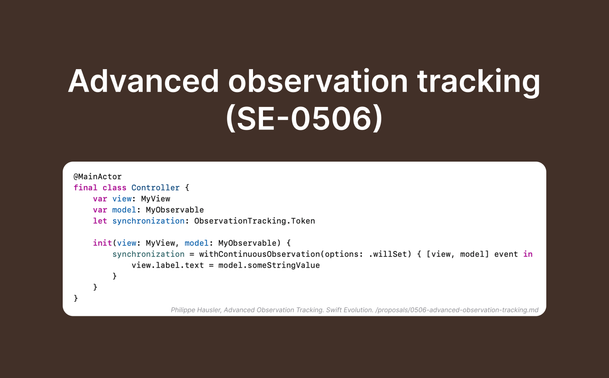
About Advanced observation tracking (SE-0506).
It looks like an improved version of the withObservationTracking function will be available in the near future, making it possible to more easily bind view models to UIKit objects (see example below). The lifetime of the observation can be controlled using ObservationTracking.Token. I like it.
Pull request in the swiftlang/swift repository - https://github.com/swiftlang/swift/pull/86719
Proposal - https://github.com/swiftlang/swift-evolution/blob/main/proposals/0506-advanced-observation-tracking.md
I think we really need the ability to report AI-generated non-sense and to flag AI-generated responses on stackoverflow as "AI-generated".
I don't blame those who write such responses. But in large numbers, it's very harmful to the developer community, especially to beginners.
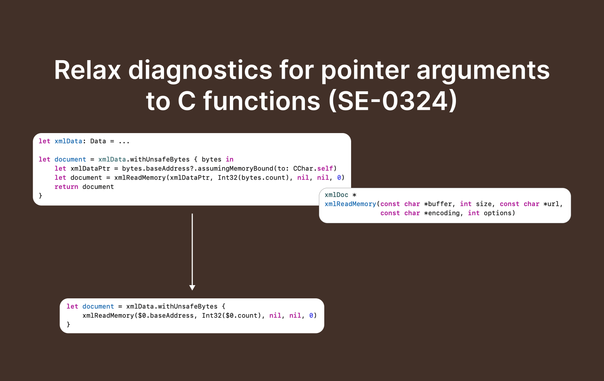
... In the example, an implicit conversion occurs from 'UnsafeRawPointer?' to 'UnsafePointer<CChar>!', so 'assumingMemoryBound(to:)' can be removed and the code can be simplified to three clear lines.
The list of all possible conversions: https://github.com/swiftlang/swift-evolution/blob/main/proposals/0324-c-lang-pointer-arg-conversion.md#detailed-design
About Swift and Relax diagnostics for pointer arguments to C functions (SE-0324).
In my opinion, SE-0324 is often overlooked or underestimated. But it significantly simplifies working with the C API thanks to implicit pointer conversions. For example, it's acceptable in many cases to pass an argument of type 'UnsafeRawPointer' to a C function. Before SE-0324, we were required to use 'assumingMemoryBound(to:)' (see example below).
Post continues below.
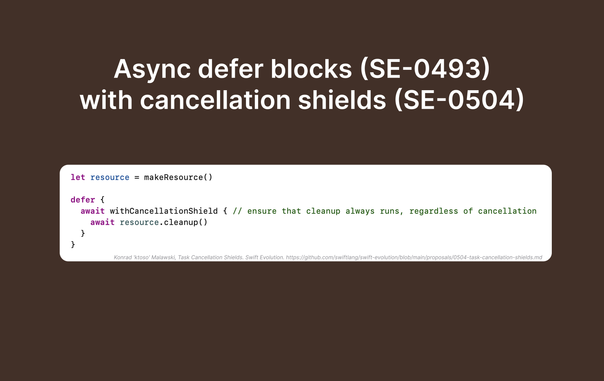
About Swift and the upcoming async defer blocks (SE-0493) with cancellation shields (SE-0504).
If they don't change the cancellation shields API, the example below will likely become a common pattern for asynchronous resource clean-up. And we'll say goodbye to '''try await Task { try await cleanup() }.value'''.
I'm not sure about the name 'withCancellationShield' though. But in any case, I think it's gonna be a pretty significant improvement.