Until a project led by my lab's first postdoc, Alex Jaramillo, & stellar RA Kyra Taylor, my thoughts on the inoculum effect (IE) - the more bacteria there are, the greater the conc of antibiotic required to kill them - were fuzzy.

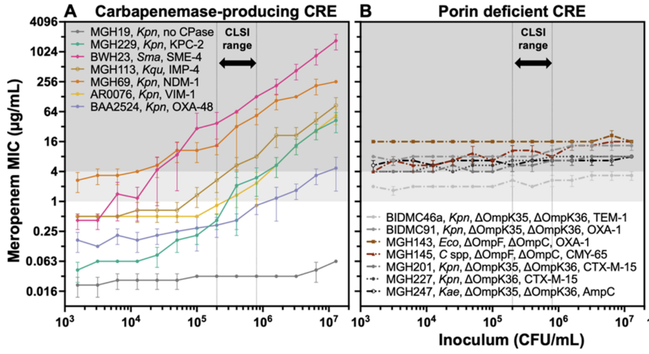
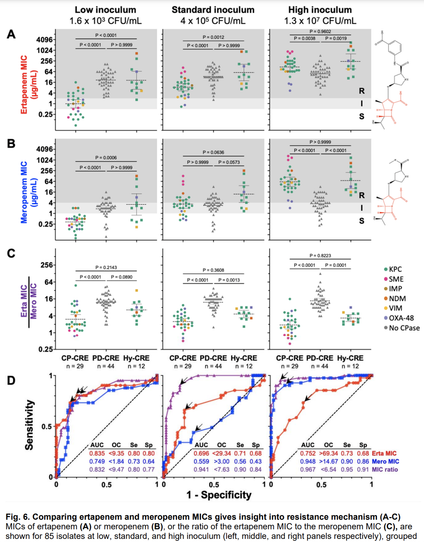
In a new preprint, imo we clarified the carbapenem IE: carbapenemases act as shared goods for bacterial communities. All carbapenemase-producing strains had a strong IE; those resistant due to porin deficiency had no IE at all.

This has key consequences…

đź§µ 1/n

(2/n)
…because carbapenems are a really important class of antibiotics (the broadest spectrum abx we use in clinical practice), and this is a huge effect: MICs (the amt of antibiotic that prevents bacterial growth) can vary by up to 1000x in some strains as cell density increases, and not change at all in others.

We found that this difference is a predictable consequence of mechanism of resistance.

Preprint here: https://www.biorxiv.org/content/10.1101/2023.05.23.541813v2

(3/n)
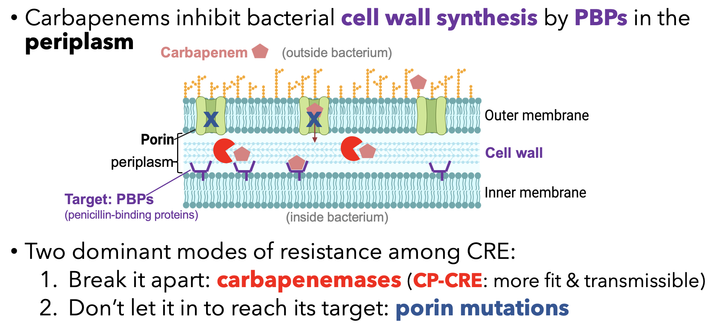
Some background: there are two main mechanisms of resistance to carbapenems, which (like penicillin) inhibit bacterial cell wall synthesis (focusing here on carbapenem resistant Enterobacterales, aka CRE):

1. carbapenemase production ("CP-CRE") - break the drug down

2. porin deficiency - don't let the drug into the periplasm where it can act

Because carbapenems act outside the cytoplasm (in the periplasm, where the cell wall is made), carbapenemases need to act outside the cell…

4/n
…which means these carbapenemases end up shared with neighbors. (In theory they could be constrained to the periplasm, but at least above a certain cell density, this doesn't seem to be the case: all CP-CRE have a strong IE.

By contrast, porin deficiency, which prevents carbapenems from getting into the periplasm, is a cell-autonomous resistance mechanism that has no effect on neighbors, hence no IE.

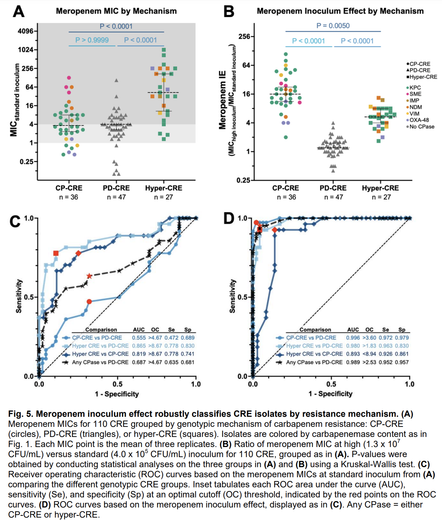
We verified this in >100 clinical CRE: 63 CP-CRE all had an IE; none of 47 non-CP-CRE did.

5/n
So why is this important? We thought of diagnostic, clinical, and mechanistic implications.

1. Clinical diagnostics: we measure resistance at a certain cell density to guide antibiotic use, so having MICs that vary widely is a problem. The IE is known, so guidance is given on acceptable inoculum range ("CLSI range" in figs) - but even in this range, MICs can vary widely. In fact, 1/3 of CP-CRE changed meropenem resistance class in the allowed range, and 25% tested S at an approved inoculum.

6/n
…1. Diagnostic implications (cont'd): These "unstable" MICs in the approved inoculum range mean that we're most likely to misclassify carbapenemase-producing isolates - just the ones we worry about most, bc they can share carbapenemases on plasmids, and tend to be more fit than porin-deficient strains. Our strain collection was selected to be mero-R, yet many of them "could have" tested mero-I or even mero-S in appropriately-done diagnostic testing… implies we're missing some CP-CRE
7/n
…1. Diagnostic implications (cont'd): so what can we do to find CP-CRE better? It turns out meropenem MIC is lousy at distinguishing CP-CRE from non-CP-CRE - almost literally a coin flip, since MIC distributions of CP-CRE and non-CP-CRE cross in the CLSI inoculum range. Measuring the IE does an excellent job at finding CP-CRE, but requires an unacceptable amount of extra work for already-too-busy clin micro labs.
8/n
…1. Diagnostic implications (cont'd): we realized that ertapenem, which is bulkier, is more affected by porin deficiency than meropenem, whereas both are ~equivalently hydrolyzed by carbapenemases. So we checked, and sure enough, the ratio of ertapenem to meropenem MICs at standard inoculum performs almost as well as the IE at identifying CP-CRE - and since we always measure both erta & mero MICs, this is "free" info that can help flag CP-CRE that might otherwise be missed.

9/n
That's most of the story. A couple other reflections (see preprint for more):

2. Clinical implications: Porin-deficient strains take up carbapenems less well, but also nutrients, making them less fit. Yet studies haven't shown a consistent difference in outcomes in CP-CRE vs non-CP-CRE, despite this fitness difference. Most bacteremias have v low cell density (<10 cfu/mL), where CP-CRE MICs are << non-CP-CRE. Maybe greater resistance at low cell density offsets fitness cost in non-CP-CRE?

10/n
3. Mechanistic implications, & musings: thinking this through made me reflect on periplasmic dynamics in beta-lactam resistance. It's all about preventing beta-lactams from reaching their PBP targets, by hydrolysis or low import or both. The IE has felt nebulous to me for years; I think we got clarity bc there are relatively few carbapenemases - ~7 major families - vs a bewildering array of beta-lactamases (>600 OXAs alone!) w different hydrolysis rates etc… so we could generalize better.

11/n
Anyway, the clearest way I can summarize what I learned from this project is: the carbapenem inoculum effect depends on the mechanism of resistance of the isolate, not the mechanism of action of the antibiotic. (So we should perhaps call it the carbapenemase inoculum effect?)

In some ways I feel like I should have known that. Maybe you already did? Happy to hear anyone's input - this is still under peer review, and I'm sure there's more to learn from it.

https://www.biorxiv.org/content/10.1101/2023.05.23.541813v2

12/12
Great pleasure working with Alex and Kyra on this; they both did an INCREDIBLE amount of hard work to get this story where it was. I think I learned more from the writing & revising process on this project than on any prior paper I've written. And none of this would have been possible w/o wonderful collaborators: Virginia Pierce (MGH Clin Micro, now at UMich), Ashlee Earl (Broad bacterial genomics) & her colleagues Abby Manson & Josh Smith, plus my lab members who helped kick around ideas.