 (moving) APOD
The Tadpole Galaxy from Hubble
Image Credit: Hubble Legacy Archive, ESA, NASA; Processing: Harshwardhan Pathak

Still tangled in a twitter mindset (https://mastodon.help), but converting into a weakly interacting mastodon person as a consequence of that place's decay.
Pretty quiet. That may change here as I adapt to Mastodon culture.
Pseudonymous, but it's a decades-old nom de guerre (give or take translations into various languages). From at least 2008, I generally avoided linking my twitter account with my other online things, cf. "tangled in a twitter mindset" above.
| Portrait | https://www.clock.org/~smd/ |
| https://twitter.com/ratpoison | |
| Joined | 2022-11-17 |
The Tadpole Galaxy from Hubble
Image Credit: Hubble Legacy Archive, ESA, NASA; Processing: Harshwardhan Pathak
#JWST is often cited for its amazing work with galaxies, BUT LOOK AT IT DISSECTING UP THE CRAB NEBULA AND SHOWING US STAR GUTS FROM A 1000-YEAR OLD STELLAR DETONATION.
Wow! Look at the pulsar!
So epic that we can see this detail, the different structures, elements, velocities, energies, etc. from an event that Chinese and Japanese astronomers witnessed and documented 1000 years back.
We're connected through time with this event to them!


We present JWST observations of the Crab Nebula, the iconic remnant of the historical SN 1054. The observations include NIRCam and MIRI imaging mosaics, plus MIRI/MRS IFU spectra that probe two select locations within the ejecta filaments. We derive a high-resolution map of dust emission and show that the grains are concentrated in the innermost, high-density filaments. These dense filaments coincide with multiple synchrotron bays around the periphery of the Crab's pulsar wind nebula (PWN). We measure synchrotron spectral index changes in small-scale features within the PWN's torus region, including the well-known knot and wisp structures. The index variations are consistent with Doppler boosting of emission from particles with a broken power-law distribution, providing the first direct evidence that the curvature in the particle injection spectrum is tied to the acceleration mechanism at the termination shock. We detect multiple nickel and iron lines in the ejecta filaments and use photoionization models to derive nickel-to-iron abundance ratios that are a factor of 3-8 higher than the solar ratio. We also find that the previously reported order-of-magnitude higher Ni/Fe values from optical data are consistent with the lower values from JWST when we reanalyze the optical emission using updated atomic data and account for local extinction from dust. We discuss the implications of our results for understanding the nature of the explosion that produced the Crab Nebula and conclude that the observational properties are most consistent with a low-mass iron-core-collapse supernova, even though an electron-capture explosion cannot be ruled out.
Three-Body Problem. Newly discovered stable periodic orbits.
By Xiaoming LI and Shijun LIAO
Source: https://numericaltank.sjtu.edu.cn/three-body/three-body.htm
Mein Keks sieht aus wie das Magnetfeld um das extrem massereiche Schwarze Loch M87* :-)
2. Bild: EHT-Kollaboration


We've all been there: it's puzzle time, but once you dump out the pieces and start laying them flat, you realize you don't have enough space on your table. Join me as we use physics to find out ✨HOW BIG A TABLE YOU NEED FOR YOUR JIGSAW PUZZLE ✨

Jigsaw puzzles are typically labeled with their finished area and number of pieces. With this information, is it possible to estimate the area required to lay each piece flat before assembly? We derive a simple formula based on two-dimensional circular packing and show that the unassembled puzzle area is $\sqrt{3}$ times the assembled puzzle area, independent of the number of pieces. We perform measurements on 9 puzzles ranging from 333 cm$^2$ (9 pieces) to 6798 cm$^2$ (2000 pieces) and show that the formula accurately predicts realistic assembly scenarios.
Voyager's computer systems were custom-built using 1960s technology, with clock speeds measured in KHz and RAM in kbytes, running hand-crafted software, crammed into 4K of 18-bit wide plated-wire memory (similar to but better than core mem).
And yes, it uses digital 8-track tape for storage.
The custom-designed hardware, (upgraded) software and instruments are mostly still functioning after 46 years in space!
https://history.nasa.gov/computers/Ch6-2.html
https://hackaday.com/2018/11/29/interstellar-8-track-the-low-tech-data-recorders-of-voyager/
@NSFVoyager2
#Voyager
3/n

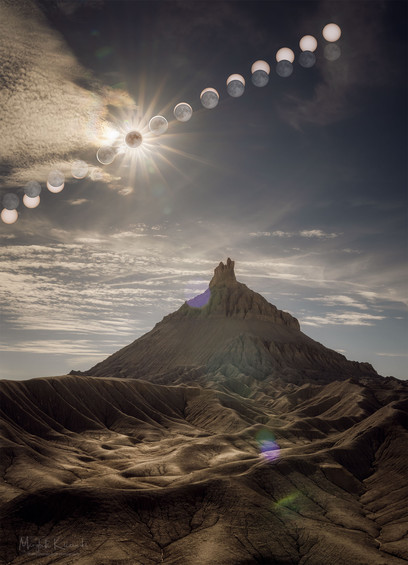
#PPOD: This composite photograph is an eclipse sequence taken during last month's annular solar eclipse as the Moon was overtaking the rising Sun in the sky over Factory Butte in Utah. The rays flaring out from the Sun are an illusory result of camera aperture diffraction. The Moon is artificially brightened to enhance its outline -- which helps the viewer better visualize the Moon's changing position during this ring-of-fire eclipse. Credit: MaryBeth Kiczenski via APOD
... Here is my de-archaized version of *Calculus Made Easy*, with the shillings and the obsolete names for things we now know to be polonium isotopes all fixed up:
https://www.sunclipse.org/wp-content/downloads/2023/10/revising.pdf
And here is how the LaTeX stands at the moment:
https://www.sunclipse.org/wp-content/downloads/2023/10/calculus-made-easy.tgz
 CosmicRami
 Marcio Aleksandravicius
 Benjamin Knispel
 Madeleine Bonsma-Fisher, PhD
 AkaSci 🛰️
 Bruce Davie
 SETI Institute
 Blake C. Stacey