📢 EGU 2025 Call for abstracts is now open! 📢
Are you tired of the same old, same old in soil-erosion modelling? We have a session for you:
| Website | https://www.uni-augsburg.de/en/fakultaet/fai/geo/prof/georwa/team/pedro-batista/ |
| ORCID | https://orcid.org/0000-0002-7318-2234 |
📢 EGU 2025 Call for abstracts is now open! 📢
Are you tired of the same old, same old in soil-erosion modelling? We have a session for you:
Accurate estimates of the location, timing, and severity of soil-erosion events on arable land have eluded erosion-prediction technology for decades. Here, for the first time, we demonstrate how a machine learning model can nowcast the occurrence and relatively rank the severity of erosion events...
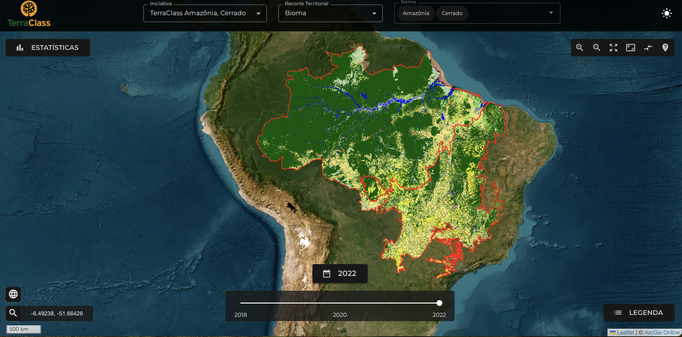
We have just launched the new Geoportal of #TerraClass (https://bit.ly/3M9Twwd) with the updated historical mapping series for the #Amazon and #Cerrado biomes!
The maps were produced using #Brazilian technology (#INPE, #EMBRAPA), combining #datacubes (#Sentinel and #Landsat) and Big Data analysis with #SITSpackage.

Abstract. In the last decades, soils and their agricultural management have received great scientific and political attention due to their potential to act as a sink of atmospheric carbon dioxide (CO2). Agricultural management has strong potential to accelerate soil redistribution, and, therefore, it is questioned if soil redistribution processes affect this potential CO2 sink function. Most studies analysing the effect of soil redistribution upon soil organic carbon (SOC) dynamics focus on water erosion and analyse only relatively small catchments and relatively short time spans of several years to decades. The aim of this study is to widen this perspective by including tillage erosion as another important driver of soil redistribution and by performing a model-based analysis in a 200 km2 sized arable region of northeastern Germany for the period since the conversion from forest to arable land (approx. 1000 years ago). The spatially explicit soil redistribution and carbon (C) turnover model SPEROS-C was applied to simulate lateral soil and SOC redistribution and SOC turnover. The model parameterisation uncertainty was estimated by simulating different realisations of the development of agricultural management over the past millennium. The results indicate that, in young moraine areas, which are relatively dry but have been intensively used for agriculture for centuries, SOC patterns and dynamics are substantially affected by tillage-induced soil redistribution processes. To understand the landscape-scale effect of these redistribution processes on SOC dynamics, it is essential to account for long-term changes following land conversion as typical soil-erosion-induced processes, e.g. dynamic replacement, only take place after former forest soils reach a new equilibrium following conversion. Overall, it was estimated that, after 1000 years of arable land use, SOC redistribution by tillage and water results in a current-day landscape-scale C sink of up to 0.66 ‰ yr−1 of the current SOC stocks.
 Filipe C. Felix
 Anatoly Tsyplenkov