 Anne Pasek
The pope cited Donna Haraway y'all
Catherine Will
- 130 Followers
- 95 Following
- 50 Posts
Work on personal and public health. Current attention on antimicrobial resistance and mobilisation with perspectives from STS.
Pronouns she/her.
 Aleks Lewicki
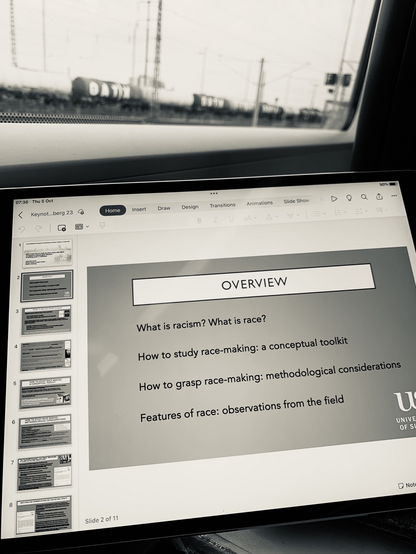
On route to Nürnberg to meet the „Forschungsverbund Diskriminierung & Rassismus“ and propose some conceptual & methodological considerations on studying racism in institutions - this brings several things together that I have done over the past years, so really curious what the discussion will bring
 Aaron DeVries
#IDMastodon
#infectiousdisease
#UTI
Fascinating study looking at how certain types of E. coli train the lining of the bladder to become more vulnerable to future infections. This may in part explain why some people have bladder colonization or UTI and then continue to get more bacteruria subsequently.

Uropathogenic Escherichia coli infection-induced epithelial trained immunity impacts urinary tract disease outcome - Nature Microbiology
Uropathogenic Escherichia coli infection induces epigenetic remodelling and trained immune responses in bladder epithelial stem cells that affect susceptibility to recurrent infection.
 Imogen Tyler
“British politics has long been seen as a shitshow. It's taken on a more literal meaning of late. …England is the only country in the world with a fully-privatized water & sewage system, run by large — and wildly unpopular — regional monopolies.” https://www.politico.eu/article/the-politics-of-poo-how-sewage-strewn-beaches-became-britains-new-election-battleground/

RT @alison_phipps
Built of the same container modules used as torture chambers & prisons in regimes from people flee persecution - we deliberately continue persecution in fled ways. We may not yet be actively killing but we know suicide rates will rise. Despair is required https://www.bbc.co.uk/news/uk-65193446
Built of the same container modules used as torture chambers & prisons in regimes from people flee persecution - we deliberately continue persecution in fled ways. We may not yet be actively killing but we know suicide rates will rise. Despair is required https://www.bbc.co.uk/news/uk-65193446

Does anyone know about comedy videos about pipetting on YouTube?
 Cost of Living Blog
New blog out now - "Understanding Health Inequalities in Scotland – Getting Beyond Death & Despair in (Quantified) Data" - Ellen Stewart
& Kat Smith make a case for using qualitative & participatory data to explore health inequalities #inequalities #Scotland https://www.cost-ofliving.net/understanding-health-inequalities-in-scotland-getting-beyond-death-and-despair-in-quantified-data/
& Kat Smith make a case for using qualitative & participatory data to explore health inequalities #inequalities #Scotland https://www.cost-ofliving.net/understanding-health-inequalities-in-scotland-getting-beyond-death-and-despair-in-quantified-data/

 A11yAlicia
Today is #HolocaustMemorialDay
I will be thinking of the first and often overlooked victims of the Holocaust…people with disabilities. #WeRemember #OperationLegacy #DisabledLivesMatter #DisabledNotDisposable https://encyclopedia.ushmm.org/content/en/article/the-murder-of-people-with-disabilities
 European Greens
Today, 78 years after the liberation of #Auschwitz, #WeRemember the millions of lives lost in the #Holocaust.
We must never forget.
We want to make Europe a place where everyone can live safely & express their religious beliefs without fear.

New paper early access online with @STS_Journal on home blood pressure monitoring as material participation and the clinic. https://sciencetechnologystudies.journal.fi/article/view/112027
The Logics of Invited and Uninvited Material Participation : Bringing Blood Pressure Self-Monitoring Into the Clinic
This paper addresses debates concerning the ‘participatory turn’ in healthcare. It focuses on the case of blood pressure self-monitoring, understanding this as a form of patient participation at the level of individual care. Drawing and expanding on the work of Marres and Wynne and their notions of material participation and of uninvited engagement, we examine how patients’ home blood pressure self-monitoring is incorporated into clinical care, how the materials of blood pressure self-monitoring mediate participation and how we might characterise the practices of participation found within everyday clinical care. Our analysis makes new conceptual links, suggesting that, in this context, invited participation appears to align with participation made easy, while uninvited participation involves more invested, more engaged participation. We offer two further developments of these concepts. First, we trouble characterisations of invited and uninvited participation as distinct and separate, observing movement between these. Second, through applying the logics of material participation in a new context, everyday clinical practice, we suggest that the logic of participation made easy might be extended beyond lay people, to apply to professionals as well. Our analysis illustrates how materials are mobilised to facilitate invited and uninvited participation within the context of the on-going asymmetries in doctor patient relationships.