pgMustard Pro now includes 1,000 API credits 🎉
Bulk-analyse plans, plug into your LLM workflows, or build something we haven't thought of yet.

| Website | https://www.pgmustard.com |
| Status | https://status.pgmustard.com |
pgMustard Pro now includes 1,000 API credits 🎉
Bulk-analyse plans, plug into your LLM workflows, or build something we haven't thought of yet.
New blog post: Read efficiency issues in Postgres queries
If you've got a query that's slowly degrading in performance over time, you might have a read efficiency issue. The root cause could be table bloat, index bloat, or data locality degradation. In this new post we go through how this can happen, how to mitigate the issue, and the options for preventing it happening again.
https://www.pgmustard.com/blog/read-efficiency-issues-in-postgres-queries

A lot of the time in database land, our queries are I/O constrained. As such, performance work often involves reducing the number of page reads. Indexes are a prime example, but they don’t solve every issue (a couple of which we’ll now explore).
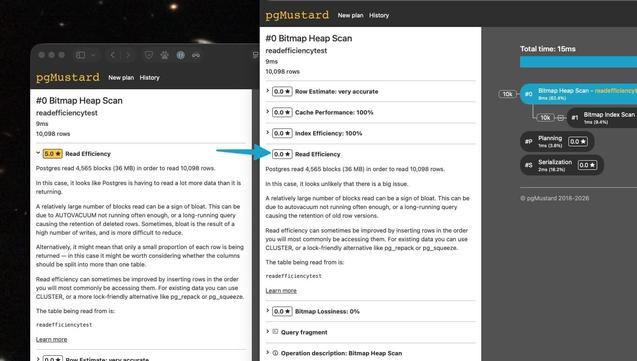
Our Read Efficiency tips are now more efficient to read!
📝 Better wording, mostly for clarity
🔬 More specific to the scan type, and therefore shorter in most cases
🌟 Improved scoring, especially for Bitmap Heap Scans
More details: https://www.pgmustard.com/changelog

If pgMustard has made your life easier this year, we'd love a review on G2! It does take a few minutes, but we like that it is verified, and are already using the feedback to shape what we work on next.
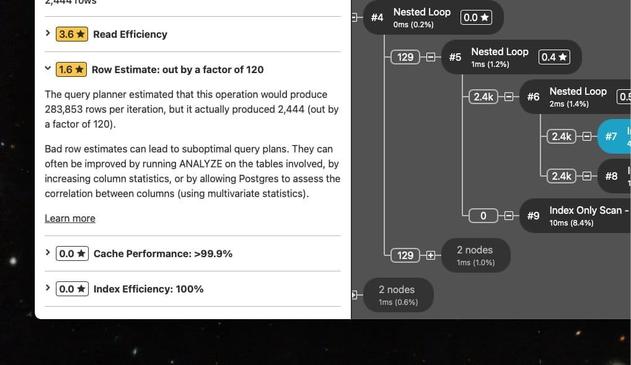
Bad row count estimates are a common cause of slow queries.
We've had a tip for them in pgMustard from the start, but we've just finished a revamp of it, mostly to make the advice in several common cases clearer. We also now report the ratios a little more naturally.
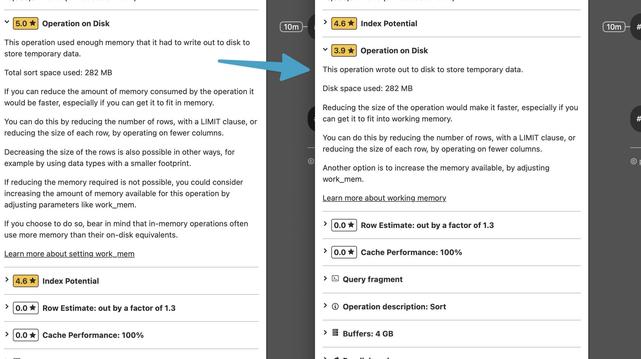
We've revamped our "Operation on Disk" tips ✨
* Made them clearer
* Made them more succinct (in most cases)
* Improved the scoring
* Mention hash_mem_multiplier (when relevant)
* Show "Operation in Memory" in more cases, with the memory used
* Updated the linked blog post

 Michael Christofides