@AdrienB We'll be putting an updated version on arXiv soon with all the same results. In the meantime, you can read an older version (without double excitation results) here:
https://arxiv.org/abs/2308.16848 
Natural Quantum Monte Carlo Computation of Excited States
We present a variational Monte Carlo algorithm for estimating the lowest excited states of a quantum system which is a natural generalization of the estimation of ground states. The method has no free parameters and requires no explicit orthogonalization of the different states, instead transforming the problem of finding excited states of a given system into that of finding the ground state of an expanded system. Expected values of arbitrary observables can be calculated, including off-diagonal expectations between different states such as the transition dipole moment. Although the method is entirely general, it works particularly well in conjunction with recent work on using neural networks as variational Ansatze for many-electron systems, and we show that by combining this method with the FermiNet and Psiformer Ansatze we can accurately recover vertical excitation energies and oscillator strengths on molecules as large as benzene. Beyond the examples on molecules presented here, we expect this technique will be of great interest for applications of variational quantum Monte Carlo to atomic, nuclear and condensed matter physics.
We are excited (yeah, sorry) to release the code for our method and experiments on GitHub - open source matters! We’re looking forward to seeing what the community does with it, and to take another step towards universal quantum simulation with deep learning.
https://github.com/google-deepmind/ferminet/tree/main/ferminet/configs/excited
ferminet/ferminet/configs/excited at main · google-deepmind/ferminet
An implementation of the Fermionic Neural Network for ab-initio electronic structure calculations - google-deepmind/ferminet
While excited state energies are harder to calculate than ground states, double excitations - where two electrons are excited at once - are even harder. We show results on these systems that match state-of-the-art calculations at the frontier of what is possible today.
On the carbon dimer - a molecule whose excited states are responsible for the green tint of carbon-rich comets - we match experimental results *five times* more accurately than previous gold-standard calculations.
We couldn’t extend our work with neural networks to excited states because existing methods had several limitations. So we developed a new method that is general, robust, and as accurate as state-of-the-art classical methods as you scale it.
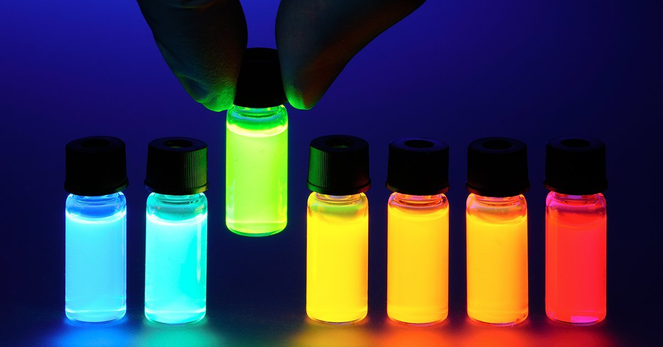
The physics of how electrons get kicked into or fall out of higher energy states, absorbing or releasing light in the process, is important for lasers, semiconductors, LEDs, solar panels, fluorescent dyes, and the biophysics of vision and photosynthesis.
We had previously shown that deep learning could be used for gold-standard calculations of the *lowest* energy states of real molecules. This is already quite challenging, but ignores all of the exotic physics that happens when molecules are stimulated.
https://www.nature.com/articles/s41570-023-00516-8

Ab initio quantum chemistry with neural-network wavefunctions - Nature Reviews Chemistry
Quantum Monte Carlo methods using neutral-network ansatzes can provide virtually exact solutions to the electronic Schrödinger equations for small systems and are comparable to conventional quantum chemistry methods when investigating systems with dozens of electrons.
I’m beyond thrilled to share that our work on using deep learning to compute excited states of molecules is out today in Science Magazine! This is the first time that deep learning has accurately solved some of the hardest problems in quantum physics.
https://www.science.org/doi/full/10.1126/science.adn0137@varavs Where has the ML scene gone? Seems like Twitter is just AI influencers now.
About time to drop a paper thread. Anyone still on here?