While excited state energies are harder to calculate than ground states, double excitations - where two electrons are excited at once - are even harder. We show results on these systems that match state-of-the-art calculations at the frontier of what is possible today.
On the carbon dimer - a molecule whose excited states are responsible for the green tint of carbon-rich comets - we match experimental results *five times* more accurately than previous gold-standard calculations.
We couldn’t extend our work with neural networks to excited states because existing methods had several limitations. So we developed a new method that is general, robust, and as accurate as state-of-the-art classical methods as you scale it.
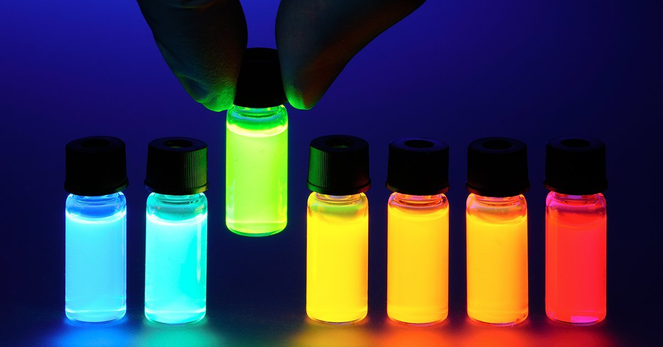
The physics of how electrons get kicked into or fall out of higher energy states, absorbing or releasing light in the process, is important for lasers, semiconductors, LEDs, solar panels, fluorescent dyes, and the biophysics of vision and photosynthesis.
We showed that neural network VMC methods like the FermiNet can be used to accurately calculate binding energies between positrons and molecules for large challenging non-polar molecules like benzene.
The great thing about this is it was an *extremely simple* change to the base FermiNet. This shows part of why neural network VMC is so powerful - it is very easily *extensible* to all sorts of new applications.
Positrons are used in all sorts of technology - medical (positron emission tomography), material (positron annihilation spectroscopy) and more exotic proposals, like gamma ray lasers.
Positrons are the antiparticle to electrons. If you combine them with normal matter they annihilate and create gamma rays, but not before bouncing around and occasionally binding to molecules or filling in gaps in materials.
We run our method through a battery of tests, and find that by combining deep learning methods with our new, natural method for computing excited states, we are able to accurately compute all sorts of properties of excited states for molecules as big as benzene. It works!
We’ve figured out a new way to compute excited states with VMC which has none of the drawbacks of earlier methods. It has no free parameters, allows unbiased estimation of gradients and energies, and does not require different states to be explicitly orthogonal.
We do this by transforming the problem of finding many excited states of a system into the problem of finding the ground state of a generalized system. Then you can just use all the normal VMC machinery for computing ground states!
How can we calculate the properties of excited states? Deep learning has been used for very accurate quantum calculations, but the basic method behind these calculations, VMC, is almost 60 years old.
VMC works well for ground states, but despite decades of work, no one knows the right way to extend VMC for excited states. With only ground states, it’s like you’re trying to understand how a marble moves in a well when you only know where the bottom of the well is.
https://www.nature.com/articles/s41570-023-00516-8

Ab initio quantum chemistry with neural-network wavefunctions - Nature Reviews Chemistry
Quantum Monte Carlo methods using neutral-network ansatzes can provide virtually exact solutions to the electronic Schrödinger equations for small systems and are comparable to conventional quantum chemistry methods when investigating systems with dozens of electrons.