New paper hot of the presses in PDR with
@MarcoCozzani,
@JuhoHarkonen,
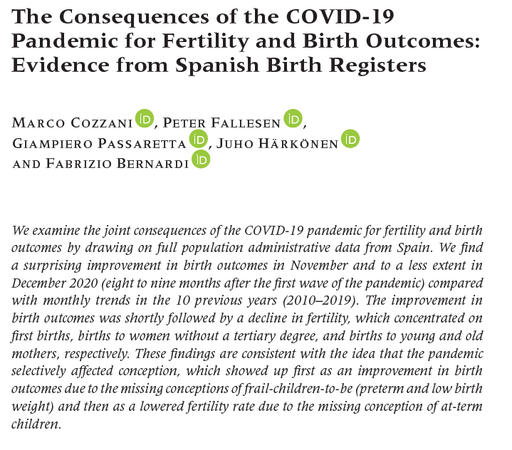
@PassarettaG, and @FabrizioBernardi "The Consequences of the COVID-19 Pandemic for Fertility and Birth Outcomes: Evidence from Spanish Birth Registers".

| Website | www.peterfallesen.com |
New paper hot of the presses in PDR with
@MarcoCozzani,
@JuhoHarkonen,
@PassarettaG, and @FabrizioBernardi "The Consequences of the COVID-19 Pandemic for Fertility and Birth Outcomes: Evidence from Spanish Birth Registers".
Great session on data visualisation at this week's @[email protected] methods meetup; here are some #dataviz resources we found that social scientists might find helpful
🐦🔗: https://twitter.com/markfransham/status/1620419574821982212
OH på redaktionen: Irmas lukning bliver Østerbros Ungdomshuset #dkmedier
🐦🔗: https://twitter.com/BertilFruelund/status/1620368429072125953
Did you use Clarify for Stata but would like to do it in R? Or maybe you used {Zelig} for R (before it retired)? Welcome to our new R package {clarify}: Software for Interpreting and Presenting Statistical Results https://www.iq.harvard.edu/news/dss-new-r-package-clarify
I dagens @[email protected] kommenterer jeg på retssikkerhed, retsfølelse og politiets efterforskningsarbejde og hvordan det nu lige er det står til med varetægtsfængsling i Danmark. https://www.information.dk/debat/2023/01/varetaegtsfaengsling-skader-arbejds-familieliv-uanset-skyld-systemet-kan-indrettes-bedre?lst_frnt
🐦🔗: https://twitter.com/L_H_Andersen/status/1620065532274962435

Danmark får jævnligt kritik af FN’s Torturkomité for brugen af varetægtsfængsling. Uanset skyld har varetægtsfængsling store negative konsekvenser, og derfor er der behov for, at vi ser på, hvordan vi kan indrette systemet bedre.
⏰ One week left to apply ⏰
I can't wait to get started on this project - come work with me and the rest of a great group! https://twitter.com/kikarstoft/status/1598239870350082049
🐦🔗: https://twitter.com/kikarstoft/status/1619968405569929219
“🥁 POST DOC POSITION IN WONDERFUL COPENHAGEN 🥁 I'm looking for a post doc for our project on adverse childhood experiences and high-risk employment. If you're into lots of data, nice people, public health/psychology/epidemiology, this might be for you: https://t.co/cS7W0RfKl5”
Did I mention that I have a new paper out w great folks (Marcelo Cardona, @pfallesen, and Tim Bruckner)? Just published in BMC Public Health, on the risk of stress/depression during the pandemic in Denmark: https://bmcpublichealth.biomedcentral.com/articles/10.1186/s12889-023-15129-5.
For the study behind the paper, we collected and used 10 nationally representative survey rounds (some panel, some repeat cross sections) from just before first lockdown to April 2022.
Key findings:

Background Global estimates suggest strained mental health during the first year of the COVID-19 pandemic, but the lack of nationally representative and longitudinal data with clinically validated measures limits knowledge longer into the pandemic. Methods Data from 10 rounds of nationally representative surveys from Denmark tracked trends in risk of stress/depression from just before the first lockdown and through to April 2022. We focused on age groups and men and women in different living arrangements and controlled for seasonality in mental health that could otherwise be spuriously related to pandemic intensity. Results Prior to first lockdown, we observed a “parent gap”, which closed with the first lockdown. Instead, a gender gap materialized, with women experiencing higher risks than men—and higher than levels predating first lockdown. Older respondents (+ 70 years) experienced increasing risks of stress/depression early in the pandemic, while all other groups experienced decreases. But longer into the pandemic, risks increased for all age groups and reached (and sometimes exceeded) levels from before first lockdown. Conclusion Denmark had low infection rates throughout most of the pandemic, low mortality rates across the entire pandemic, and offered financial aid packages to curb financial strains. Despite this circumstance, initial improvements to mental health during the first lockdown in Denmark were short-lived. Two years of pandemic societal restrictions correspond with deteriorating mental health, as well as a change from a parenthood gap in mental health before first lockdown to a gender gap two years into the pandemic.
Submit a paper to the Bank of Italy GENDER ECONOMICS workshop! ROME, June, 23, 2023 (deadline: April 3, 2023)👇
🐦🔗: https://twitter.com/eliana_viviano/status/1618296381650927617
🚨New Publication🚨
@[email protected] , @[email protected] , T. Bruckner and I used 10 rounds of survey data from just before the first lockdown in Denmark 🇩🇰through April 2022 to study the development in the risk of stress/depression in Denmark
https://bmcpublichealth.biomedcentral.com/articles/10.1186/s12889-023-15129-5
1/4🧵
🐦🔗: https://twitter.com/mcardona87/status/1618536526136344576
Background Global estimates suggest strained mental health during the first year of the COVID-19 pandemic, but the lack of nationally representative and longitudinal data with clinically validated measures limits knowledge longer into the pandemic. Methods Data from 10 rounds of nationally representative surveys from Denmark tracked trends in risk of stress/depression from just before the first lockdown and through to April 2022. We focused on age groups and men and women in different living arrangements and controlled for seasonality in mental health that could otherwise be spuriously related to pandemic intensity. Results Prior to first lockdown, we observed a “parent gap”, which closed with the first lockdown. Instead, a gender gap materialized, with women experiencing higher risks than men—and higher than levels predating first lockdown. Older respondents (+ 70 years) experienced increasing risks of stress/depression early in the pandemic, while all other groups experienced decreases. But longer into the pandemic, risks increased for all age groups and reached (and sometimes exceeded) levels from before first lockdown. Conclusion Denmark had low infection rates throughout most of the pandemic, low mortality rates across the entire pandemic, and offered financial aid packages to curb financial strains. Despite this circumstance, initial improvements to mental health during the first lockdown in Denmark were short-lived. Two years of pandemic societal restrictions correspond with deteriorating mental health, as well as a change from a parenthood gap in mental health before first lockdown to a gender gap two years into the pandemic.

 Lars H. Andersen