 Admiral Wonderboat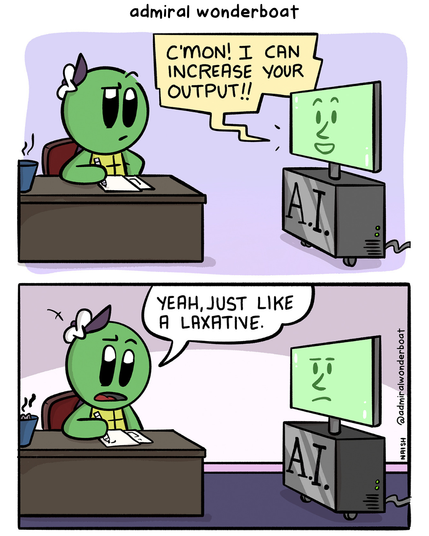
System/DevOps engineer. FOSS & privacy in tech enthusiast. Homelab dabbler.
might start a blog *one day*
| Joined | May 15, 2023 |

System/DevOps engineer. FOSS & privacy in tech enthusiast. Homelab dabbler.
might start a blog *one day*
| Joined | May 15, 2023 |
Inside you are two wolves.
You can use update-alternatives --config wolf to set your default wolf.
recurseUntilSuccess which is more of a prayer than an efficient architecture.I doubt that anything resembling genuine "artificial general intelligence" is within reach of current #AI tools. However, I think a weaker, but still quite valuable, type of "artificial general cleverness" is becoming a reality in various ways.
By "general cleverness", I mean the ability to solve broad classes of complex problems via somewhat ad hoc means. These means may be stochastic or the result of brute force computation; they may be ungrounded or fallible; and they may be either uninterpretable, or traceable back to similar tricks found in an AI's training data. So they would not qualify as the result of any true "intelligence". And yet, they can have a non-trivial success rate at achieving an increasingly wide spectrum of tasks, particularly when coupled with stringent verification procedures to filter out incorrect or unpromising approaches, at scales beyond what individual humans could achieve.
This results in the somewhat unintuitive combination of a technology that can be very useful and impressive, while simultaneously being fundamentally unsatisfying and disappointing - somewhat akin to how one's awe at an amazingly clever magic trick can dissipate (or transform to technical respect) once one learns how the trick was performed.
But perhaps this can be resolved by the realization that while cleverness and intelligence are somewhat correlated traits for humans, they are much more decoupled for AI tools (which are often optimized for cleverness), and viewing the current generation of such tools primarily as a stochastic generator of sometimes clever - and often useful - thoughts and outputs may be a more productive perspective when trying to use them to solve difficult problems.
 Neil Brown
 antlers
 Low Quality Facts
 Jonathan Hogg
 disorderlyf
 AnarchoCatgirlism
 宮城巴惠
宮城巴惠 
 Terence Tao
 climbertobby