Oliver Maclaren

@omaclaren
506 Followers
557 Following
164 Posts
I use #mathematics, #computation, & #statistics to help think about biology, energy, industry, & other things. University of Auckland, Aotearoa NZ.
githubhttps://github.com/omaclaren
google scholarhttps://tinyurl.com/ojmscholar
abandoned website/bloghttps://omaclaren.com/
pronounshe/him
Trying bluesky…https://bsky.app/profile/omaclaren.bsky.social catch me there
Oliver Maclaren (@omaclaren.bsky.social)

I use mathematics, computation, & statistics to help think about biology, engineering, & other things. University of Auckland, NZ. Research: http://tinyurl.com/ojmscholar, Teaching: https://tinyurl.com/ojmteaching

Bluesky Social
Profile-Wise Analysis: A profile likelihood-based workflow for identifiability analysis, estimation, and prediction with mechanistic mathematical models

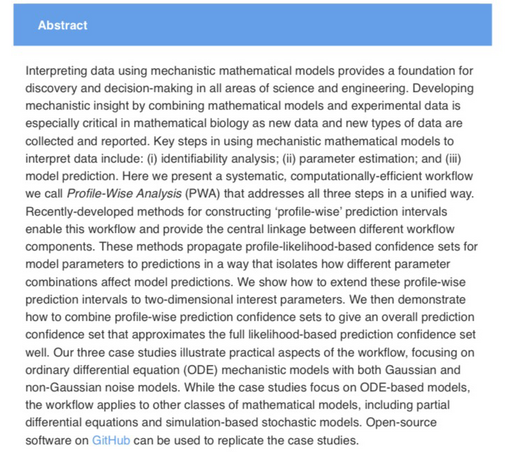
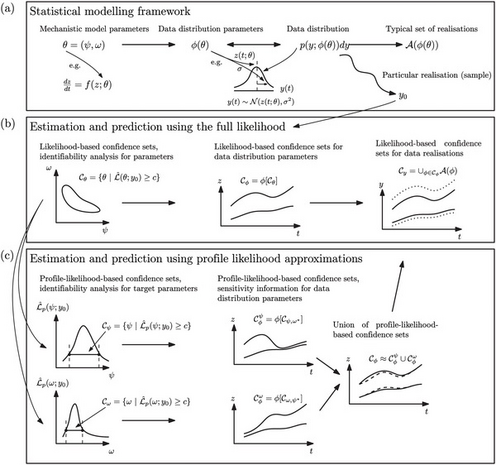
Author summary Parameter estimation and model prediction are essential steps when mathematical models are used to provide biological insight or to make practical predictions about future scenarios. We present an efficient, unified workflow that addresses parameter identifiability, parameter estimation and model prediction from a likelihood-based frequentist perspective. Our workflow, called Profile-Wise Analysis (PWA), involves constructing ‘profile-wise’ predictions that propagate profile-likelihood-based confidence sets for model parameters to predictions, explicitly isolating how different parameter combinations affect model predictions. Combining profile-wise prediction confidence sets gives an overall prediction confidence set that efficiently approximates the full likelihood-based prediction confidence set. Three case studies, focusing on canonical mathematical models used in biology and ecology, illustrate various aspects of the workflow for commonly-encountered ODE-based mechanistic models with both Gaussian and non-Gaussian measurement error.

Any good suggestions for software tools for creating combo handwritten and typed lecture notes involving a fair bit of math/stats/science/eng? Eg for the sort of material here https://github.com/omaclaren/open-learning-material #teaching #lecturenotes #mathematics #statistics
GitHub - omaclaren/open-learning-material: Some teaching material and other educational resources

Some teaching material and other educational resources - GitHub - omaclaren/open-learning-material: Some teaching material and other educational resources

GitHub
Here are 8 lectures (handwritten, sorry...) & 2 tuts on 'decision-making & modelling under uncertainty' for anyone interested...my first attempt on this particular topic this year. Looks at probability, utility, maximin utility/minimax regret/expected utility, statistical decision theory, graphical models, causal inference, Markov chains etc https://github.com/omaclaren/open-learning-material/tree/master/decision-making-and-modelling-under-uncertainty #DecisionTheory #Statistics #CausalInference
open-learning-material/decision-making-and-modelling-under-uncertainty at master · omaclaren/open-learning-material

Some teaching material and other educational resources - open-learning-material/decision-making-and-modelling-under-uncertainty at master · omaclaren/open-learning-material

GitHub
In #CausalInference can stability/modularity wrt to an intervention on X be defined as P_GX(Y | Pa_G(Y)) = P_G(Y | Pa_GX(Y)), where G is the original DAG, GX is the graph obtained from G by deleting arrows into X, Pa_GX(Y) are the parents of Y in GX and P_G is a probability model factorising according to G (similarly for P_GX)? #Causal #Statistics #DAGs
I have another naive question about #DecisionTheory / #Statistics sparked by teaching it…is there a stat decision rule in the lit of the form: choose a confidence level & rejection sets for all states of nature (params), rule out all that would be rejected (CI by inversion) then do ‘no data’ minimax? Seems like a natural (naively anyway) freq analogue of eg posterior expected loss
Weird #statistics and #DecisionTheory question: Is defining a parameter via an M-estimator functional equivalent to maximising expected utility for a lottery where the states of nature correspond to the sample space values of the data and the decision is a choice of parameter? And if so, do estimators not derived from M-estimators violate max expected utility? Eg Z-estimators/estimating equations defined by zeros of functions not derived from potentials? What principle defines these?
Vapnik’s books have some good relevant material too