New preprint !! 🌟 🤩 In this study we examined reproductive isolation among broadcast spawning and sympatric lineages of the tropical echinoderm Stichopus cf. horrens. https://www.biorxiv.org/content/10.1101/2024.10.29.620868v1
| Bluesky | https://bsky.app/profile/nextstrain.bsky.social |
our paper got published 🙂 https://www.nature.com/articles/s41598-024-54987-w
In this study, pseudocryptic diversity within the tropical echinoderm species Stichopus cf. horrens was clarified using mitochondrial and microsatellite markers. 1/2

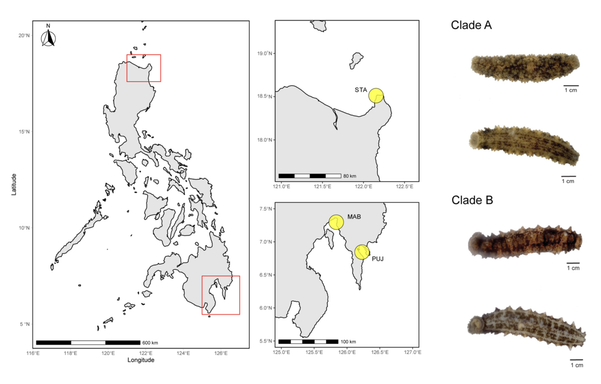
Morphologically cryptic and pseudo-cryptic species pose a challenge to taxonomic identification and assessments of species diversity and distributions. Such is the case for the sea cucumber Stichopus horrens, commonly confused with Stichopus monotuberculatus. Here, we used mitochondrial cytochrome oxidase subunit I (COI) and microsatellite markers to examine genetic diversity in Stichopus cf. horrens throughout the Philippine archipelago, to aid species identification and clarify species boundaries. Phylogenetic analysis reveals two recently diverged COI lineages (Clade A and Clade B; c. 1.35–2.54 Mya) corresponding to sequence records for specimens identified as S. monotuberculatus and S. horrens, respectively. Microsatellite markers reveal two significantly differentiated genotype clusters broadly concordant with COI lineages (Cluster 1, Cluster 2). A small proportion of individuals were identified as later-generation hybrids indicating limited contemporary gene flow between genotype clusters, thus confirming species boundaries. Morphological differences in papillae distribution and form are observed for the two species, however tack-like spicules from the dorsal papillae are not a reliable diagnostic character. An additional putative cryptic species was detected within Clade B-Cluster 2 specimens warranting further examination. We propose that these lineages revealed by COI and genotype data be referred to as Stichopus cf. horrens species complex.