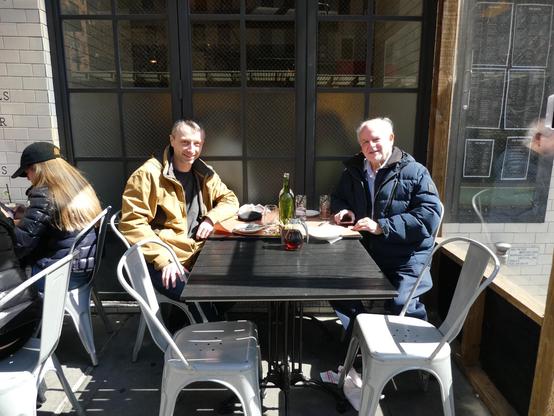
I’m extremely saddened to learn that my former PhD mentor, Eric Weinberg passed away past week. The guidance and opportunities he provided in his lab hooked me on fish research for life. This last picture of us was taken 4 years ago, when we met for a lunch in NYC. RIP Eric.
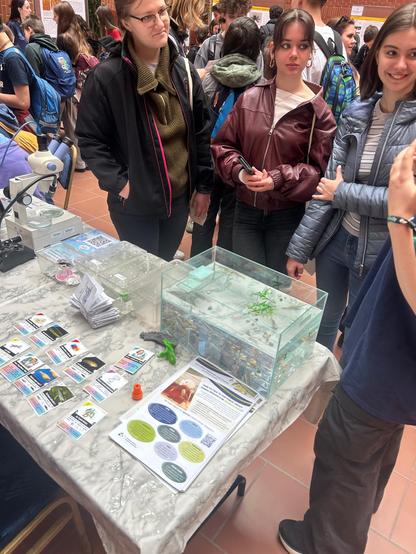
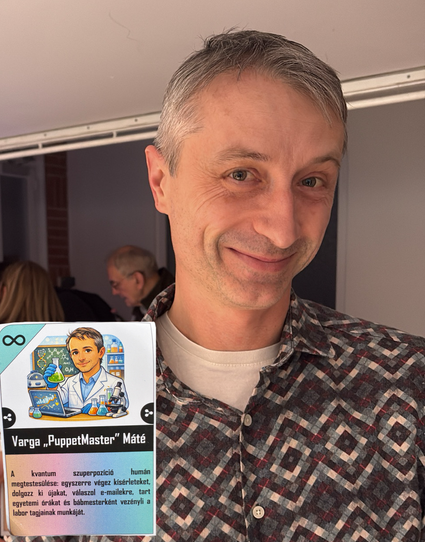
For last week’s Brain Awareness Week activities, my fantastic students designed a deck of “pokémon” cards with actions related to the lab’s work. Even more fabulously they designed one card for me.
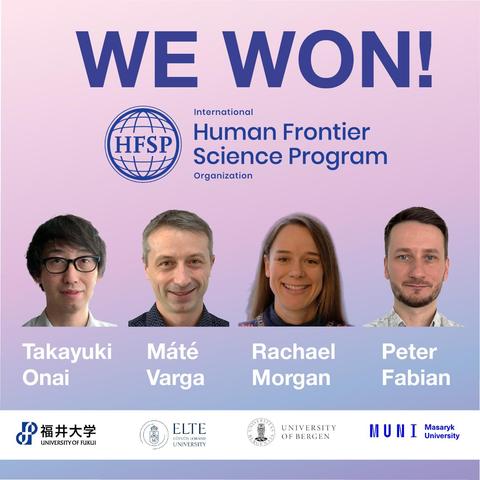
We are quite happy that through a generous HFSP Accelerator Grant Rachael Morgan from the University of Bergen will join our team studying the evodevo of air breathing in fish. Rachael brings much need physiology know-how to the team.
https://www.hfsp.org/hfsp-news/research-grants-awarded-117-most-pioneering-scientists-31-nationsWhat is even more remarkable, this might be also the paper with the first documented experiment on fin (albeit anal fin) regeneration (discussed in the context of pattern re-formation). See below at 13 and 16 dpi. (7/9)
I could not find the original Schreitmüller descriptions, but as for the D. rerio x D. albolineatus, we can always rely on earlier work from
@dparichy.bsky.social, where these patterns have been described in detail (
https://link.springer.com/article/10.1007/s004270100155). (4/9)
Briefly discussing crosses by various aquarists, Goodrich credits Wilhelm Schreitmüller (
https://de.wikipedia.org/wiki/Wilhelm_Schreitmüller) in describing “Danio rerio" x "D. albolineatus" and “Brachydanio rerio" x “Danio malabaricus" crosses. (3/9)
We usually credit Charles W. Creaser with the first scientific zebrafish paper, but that is true only with some caveats. Meet another strong contender, Hubert B. Goodrich of Wesleyan University, interested in all things related to fish genetics. (Photo: Smithsonian,
https://prod.learninglab.si.edu/resources/view/1828290) (1/9)
Yet, in the same year (while still at Yale) she did publish an abstract in Proc. Soc. Exp. Biol. Med. about a transplantation experiment about which I was always dreaming as a PhD student (not knowing that it was done 70 years prior): putting a fish organizer into a newt embryo. (3/4)
Next, in my miniseries on early researchers using zebrafish is Jane M. Oppenheimer (
https://www.sdbonline.org/sites/archive/sdbmembership/oppenheimer.html), fish embryologist and science historian par excellence. (True, I’m cheating here a bit, but if I mentioned Hellen Battle in the previous bluetorial, it is fair to mention Oppenheimer here.) (1/4)
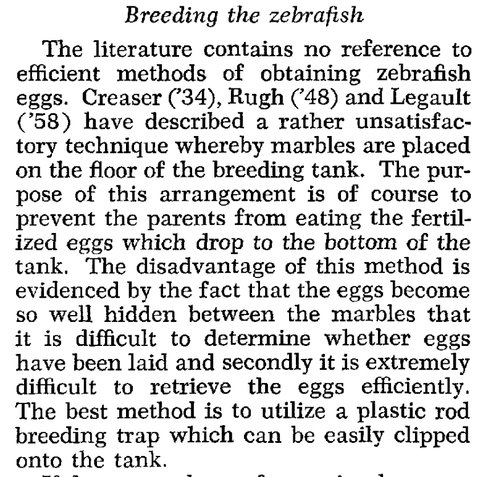
One more achievement for Hisaoka: as far as I could tell, he was amongst the first to suggest the use of breeding tanks to collect zebrafish eggs in his "Further Studies on the Embryonic Development of the Zebrafish, Brachydanio rerio (Hamilton-Buchanan)” paper from 1960 (
https://onlinelibrary.wiley.com/doi/10.1002/jmor.1051070206). (8/8)