New: "Behavioral insights in the Global South"
https://psychologicalscience.org/observer/gs-behavioral-insights-global-south
The piece describes what it's like to do applied behavioral science in the Global South -- including a case study where Busara Center experimenters mistakenly dressed themselves as butchers 🤭
Check it out!

Behavioral Insights in the Global South
Seven authors provide case studies that illustrate both the potential of behavioral science to improve people’s lives and some of the unique challenges of applying it in Global South settings.
New preprint "Exploring Open Science Practices in Behavioural Public Policy" with
@fbartos, Nichola Raihani, David Shanks, T.D. Stanley,
@EJWagenmakers & Adam Harris.
https://psyarxiv.com/msv8yFor the direct effect on abstraction, we only found few recent studies using Soderberg et at.'s search terms. We, therefore, stopped coding in June 2019 with no evidence for or against a mean effect and moderate evidence for publication bias.
We also conducted a sequential meta-analysis to compare Soderberg et al. (2015) to more recent evidence. Using sequential Bayes factors allows us to stop conditional on the evidence (i.e., BF > 3), thus allowing us to sequentially code studies backwards in time until BF > 3. For downstream consequences of abstraction, the sequential meta-analysis indicates moderate evidence against an effect and strong evidence for publication bias.
We tested for an effect in each of the levels of the significant moderators from Soderberg et al. (2015) to investigate whether any subgroup showed an effect different from zero. This indicates evidence for an effect only in 1 out of 11 subgroups (field studies). However, there were only 6 field studies included, potentially diminishing the effectiveness of publication bias correction methods in this subset. We further find evidence for heterogeneity in 8 out of 11 subgroups.
We updated our preprint on publication bias in research on construal-level theory to include subgroup analyses of Soderberg et al. (2015) and a sequential meta-analysis of more recent literature (
https://psyarxiv.com/r8nyu).
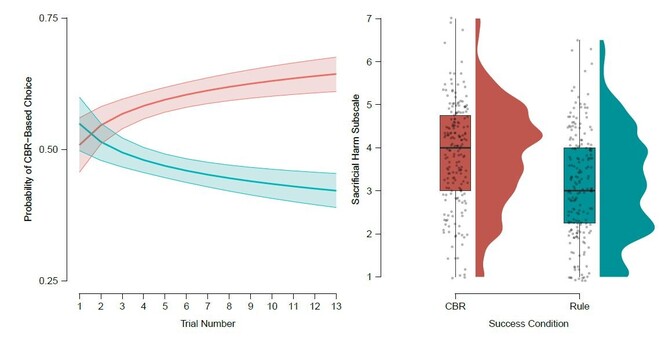
We observed systematic, experience-dependent changes in decisions over the course of 13 trials (in choices, ratings, and the Oxford Utilitarianism Scale). Our findings corroborate reinforcement learning theories of moral decision-making (@
[email protected]) and challenge previous approaches that equate the meta-ethical theory of consequentialism with the decision procedure of CBR.
Our participants (N=387) faced a series of realistic moral dilemmas between two conflicting choices: one prescribed by a moral rule (typically 'deontologist') and the other favored by cost benefit reasoning (CBR, typically 'utilitarian'). Unlike previous trolley-type experiments, we allowed participants to observe the consequences of each of their decisions.
New preprint with Vanessa Cheung,
@fbartos , & Falk Lieder "Learning from Consequences Shapes Reliance on Moral Rules vs. Cost-Benefit Reasoning". Using realistic moral dilemmas with outcomes, we show that moral decision-making is shaped by experience (
https://doi.org/10.31234/osf.io/gjf3h).
We demonstrate the resulting Ising Model of Explanatory Coherence (IMEC) on several contemporary and historic examples. The model is available in the R package IMEC so researchers can compare theories in practice. For details see our paper (open access)!
https://psycnet.apa.org/fulltext/2023-50323-001.html
 Patrick S. Forscher