
Mason Porter

@masonporter
790 Followers
216 Following
875 Posts

Professor of Mathematics at UCLA and External Professor at Santa Fe Institute.

I am an applied mathematician (and occasional physicist) who studies networks, complex systems, nonlinear systems, and their applications.

Websitehttp://www.math.ucla.edu/~mason/
GamesBoard games
RPGsDungeons & Dragons
BaseballLos Angeles Dodgers
“Researchers measured autistic people against neurotypical expectations and called every difference a deficit. They tested empathy by measuring in-group preference and missed commitment to universal fairness. They measured creativity by counting the number of ideas and missed originality. They saw moral consistency and called it rigidity. They saw deep engagement and called it rigidity. They saw sensory richness and called it disorder.”
https://www.psychologytoday.com/us/blog/positively-different/202601/what-the-world-got-wrong-about-autistic-people
What the World Got Wrong About Autistic People

For decades, autism research compared autistic people to animals, denied them moral sensitivity, and assumed autistic traits made them miserable. All wrong.

Psychology Today
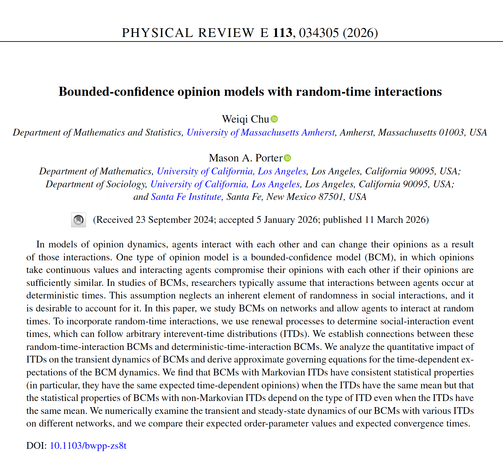
Here is the published version of our paper "Bounded-confidence opinion models with random-time interactions" (by Weiqi Chu and me): https://www.math.ucla.edu/~mason/papers/weiqi-PRE2026.pdf

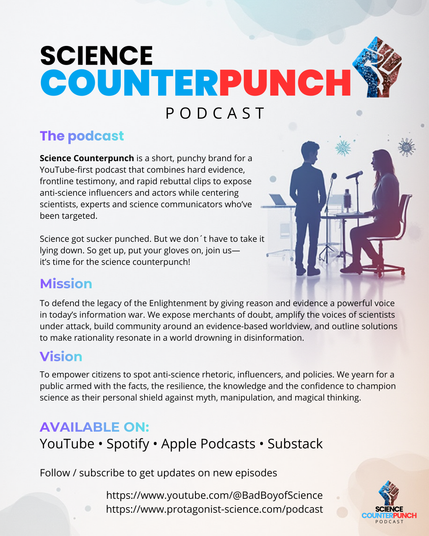
So I started this thing where we interview some high profile academics, science communicators, science activists and science journalists that currently fight against anti-science.

First few episodes in, and I think more people should come togeher for #science & #democracy

Ep1: Peter Hotez & Mike Mann
https://www.youtube.com/watch?v=O4PFGQFm5ZQ

Ep2: Dave Farina
https://www.youtube.com/watch?v=F2fhLAZd250

Ep3: Colette Delawalla (Stand up for Science)
https://www.youtube.com/watch?v=KDTtXeymuT0

Ep4: Steve Lewandowsky
https://www.youtube.com/watch?v=nHz3SXsJb_E

Enjoy

@gleick

My reflex was to think of the movie "Mars Attacks!".

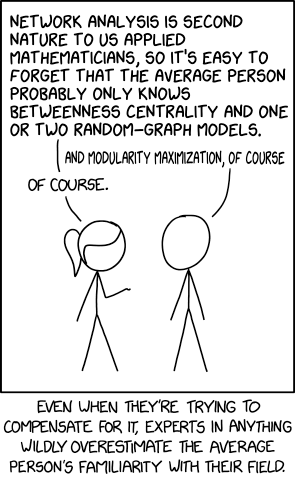
Here is an XKCD 2501 generator: https://marshdeer.github.io/xkcd2501-generator/

Below is an example that I made.

(h/t Valdis Krebs)

I wonder how large a deciMason (dM) is?

I think that I'll use it as a unit of sarcasm.

Puns intended.

Please help promote this project called "First Proof" led by Mohammed Abouzaid (Stanford), Nikhil Srivastava (Cal), Rachel Ward (UT Austin), and Lauren Williams (Harvard). The goal is to understand the capabilities of AI systems on problems that come up in math research. We have a collection of research problems for which solutions have not yet been posted online, so it's a good testbed. The solutions will come out in just one week. Take a crack at it! #FirstProof #1stProof

https://arxiv.org/abs/2602.05192

First Proof

To assess the ability of current AI systems to correctly answer research-level mathematics questions, we share a set of ten math questions which have arisen naturally in the research process of the authors. The questions had not been shared publicly until now; the answers are known to the authors of the questions but will remain encrypted for a short time.

arXiv.org

@tao

Also, with log tables, there is the question of what AI-based or AI-necessited things should be added to projects like the Digital Library of Mathematical Functions (DLMF). This is an exact question that Charles Clark asked me last week.

The DLMF is the 'modern' version (though getting older) of Abramowitz and Stegun, and one change is that the latter has things like tables of values of evaluated special functions but the former does not (deemed as old-fashioned).

@tao

Not just making exams in class, but also tightening up and more people (myself included) making them closed-book, even though I have never liked that and it's not how we do research. There's just no choice. There are too many shortcuts available outside of the exam that we have to tighten up the rules to encourage students to study and learn, even at the expense of creating more "unrealistic" settings.