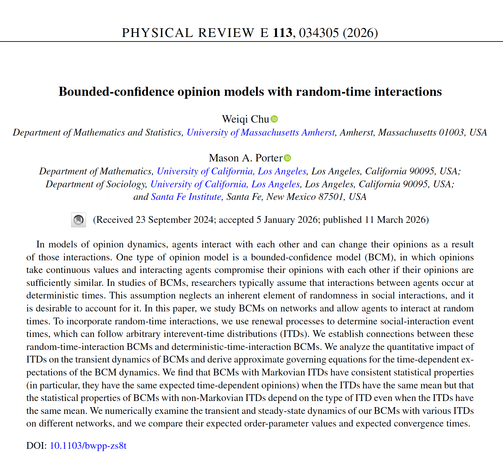
Here is the published version of our paper "Bounded-confidence opinion models with random-time interactions" (by Weiqi Chu and me):
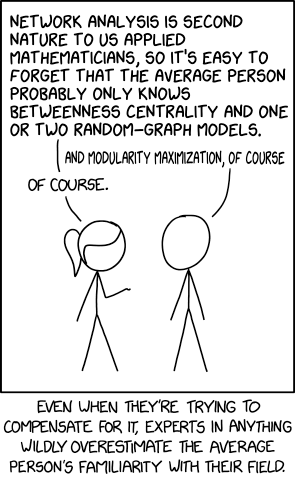
https://www.math.ucla.edu/~mason/papers/weiqi-PRE2026.pdfHere is an XKCD 2501 generator: https://marshdeer.github.io/xkcd2501-generator/
Below is an example that I made.
(h/t Valdis Krebs)
I wonder how large a deciMason (dM) is?
I think that I'll use it as a unit of sarcasm.
Puns intended.
I am never forget the day I first try the ChatLobachevsky.
In two words it showed me secret of success in mathematics:
Use AI!
Use AI!
Don't do the work with your own brain and eyes.
Remember yes to cleverly disguise.
And be quick; time flies!
So use AI, use AI, use AI ---
Only be sure always to call it please "research".
(With apologies to Tom Lehrer, of course: https://tomlehrersongs.com/wp-content/uploads/2018/12/lobachevsky.pdf)
Authors: Mohammed Abouzaid, Andrew J. Blumberg, Martin Hairer, Joe Kileel, Tamara G. Kolda, Paul D. Nelson, Daniel Spielman, Nikhil Srivastava, Rachel Ward, Shmuel Weinberger, Lauren Williams
Abstract: "To assess the ability of current AI systems to correctly answer research-level mathematics questions, we share a set of ten math questions which have arisen naturally in the research process of the authors. The questions had not been shared publicly until now; the answers are known to the authors of the questions but will remain encrypted for a short time."
https://arxiv.org/abs/2602.05192
[author list in next post in thread]

First Proof
To assess the ability of current AI systems to correctly answer research-level mathematics questions, we share a set of ten math questions which have arisen naturally in the research process of the authors. The questions had not been shared publicly until now; the answers are known to the authors of the questions but will remain encrypted for a short time.

 Peter Gassner
 Philipp Markolin ☑️
 aburka 🫣
 Tammy Kolda