 Marijn
The idea that ownership provides moral permission to do whatever you want with the owned thing, along with the idea that almost everything can be owned, lies at the heart of our political system. While this works pretty well for a pair of pants or maybe even a house, when people or companies are able to to own large amounts of land, other people's homes, infrastructure, and influence, i.e. the things that make up a society, ownership becomes a form of irresponsibly unchecked power.

@marcell
- 166 Followers
- 187 Following
- 336 Posts
 Felicitas Pojtinger 🌅
Decided to take a look at how I could use Loro CRDT with p2panda to get rid of my old ephemeral sync protocol in Multiplex and it's been a ton of fun so far figuring it out knowing what people use it for now & comparing it to how Jellyfin does things. The ephemeral vs. persistent messages distinction helps a ton for example and wasn't there on the old protocol. Not sure if I should stagger the changes or just go for a straight up rewrite at this point ...
 r҉ustic cy͠be̸rpu̵nk🤠🤖
TIL There's a website that shows a random image of a person pointing at your mouse pointer, every time you move your mouse

 felix stalder
Oh, Sci-Hub has now an AI interface that queries and references its huge repository of scientific articles and provides access to the full source papers. I think this is the logical next step in access to large archives.
"Hear the good news: recent advances in artificial intelligence enabled Sci-Hub to launch a robot that gives scientifically-grounded responses to questions. The robot starts with searching for relevant literature in Sci-Hub database, then turns to selecting and reading most recent studies, and composes the answer based on this information. The answer includes all the references, and each referenced article can be read on Sci-Hub with one click.
Unlike question-answering robots that were based upon the early generation of neural networks, Sci-Hub bot does not hallucinate and is not making up scientific facts and does not cite sources that do not exist. To support its statements, Sci-Bot uses articles from Sci-Hub database. Questions can be asked in any language, and answers can be saved on server and shared."

 wakest likes your bugs ⁂
 𝓻𝓻𝓪
𝓻𝓻𝓪I have a new article out together with @rwg : "What is 'alternative' about 'alternative social media'?"
It is published in Résaux, in their special issue on Alternative Internets edited by Stéphane Couture and @guillaume https://shs.cairn.info/journal-reseaux-2025-6?lang=en
The article is available in French (translated by Pauline Côté and edited by @guillaume) and English: https://shs.cairn.info/journal-reseaux-2025-6-page-183?lang=en
1/3
 洪 民憙 (Hong Minhee)
I'm writing this in English.
Not because English is my first language—it isn't. I'm writing this in English because if I wrote it in Korean, the people I'm addressing would run it through an outdated translator, misread it, and respond to something I never said. The responsibility for that mistranslation would fall on me. It always does.
This is the thing Eugen Rochko's post misses, despite its good intentions.
@Gargron argues that LLMs are no substitute for human translators, and that people who think otherwise don't actually rely on translation. He's right about some of this. A machine-translated novel is not the same as one rendered by a skilled human translator. But the argument rests on a premise that only makes sense from a certain position: that translation is primarily about quality, about the aesthetic experience of reading literature in another language.
For many of us, translation is first about access.
The professional translation market doesn't scale to cover everything. It never has. What gets translated—and into which languages—follows the logic of cultural hegemony. Works from dominant Western languages flow outward, translated into everything. Works from East Asian languages trickle in, selectively, slowly, on someone else's schedule. The asymmetry isn't incidental; it's structural.
@Gargron notes, fairly, that machine translation existed decades before LLMs. But this is only half the story, and which half matters depends entirely on which languages you're talking about. European language pairs were reasonably serviceable with older tools. Korean–English, Japanese–English, Chinese–English? Genuinely usable translation for these pairs arrived with the LLM era. Treating “machine translation” as a monolithic technology with a uniform history erases the experience of everyone whose language sits far from the Indo-European center.
There's also something uncomfortable in the framing of the button-press thought experiment: “I would erase LLMs even if it took machine translation with it.” For someone whose language has always been peripheral, that button looks very different. It's not an abstract philosophical position; it's a statement about whose access to information is expendable.
I want to be clear: none of this is an argument that LLMs are good, or that the harms @Gargron describes aren't real. They are. But a critique of AI doesn't become more universal by ignoring whose languages have always been on the margins. If anything, a serious critique of AI's political economy should be more attentive to those asymmetries, not less.
The fact that I'm writing this in English, carefully, so it won't be misread—that's not incidental to my argument. That is my argument.
 mr.w0bb1t
 Valerie Aurora 🇺🇦
Writing used to be proof-of-thought...
This how I feel about genAI: it's informational poison. If you read or look at it without knowing it is AI, you have already lost.
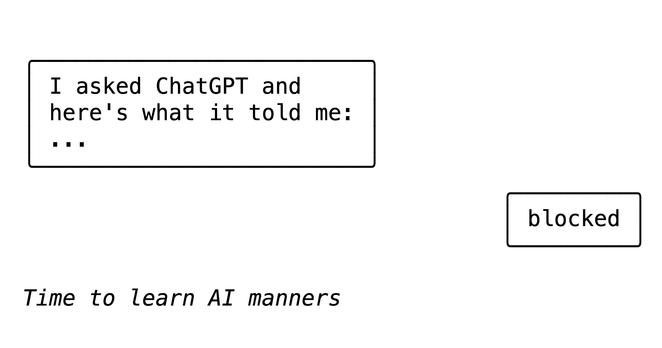
The solution they proposed is exactly the one I adopted while working on the CRA standards: if you send me AI output, tell me it is AI output and any due diligence you did on it. Then I can make a decision about whether to engage.
https://distantprovince.by/posts/its-rude-to-show-ai-output-to-people/