What's commonly known as git "squash merge" is more aptly described as "squash rebase".
Icelandic: https://lodfill.is/@maranomynet
...
Former life: https://twitter.com/maranomynet_en

@gthb This is a false binary. Cleaning up history is important, and comes in multiple flavors/methods.
One of which could be squash the branch, *then* merge (as opposed to the current effective "squash rebase"). Lots of cool options are available.
@gthb
On the other hand, squash merge strategies require the whole team to strictly abstain from large parts of git's basic feature set (and usage idioms) – lest you end up with repeated problems that are hard to decipher and to untagle.
Even veteran git users often have a hard time reasoning about how and why things went wrong and frequently end up force-resolving conflicts incorrectly and thereby losing valuable changes (and then the evidence of that gets wiped after the merge).
@gthb Yes.
Squash merges are good for exactly two things:
1. Writing abbreviated history
2. Preventing (sensitive?) metadata leaking.
There are other and better ways to be a neat freak about your git history, and if you want to want to prevent metadata escaping, you should be doing your squashed commits off in a separate repo anyway.
git squash-merge — for people who hate:
* Long-lived branches
* Change history
* Parallel/decoupled maintainence of application/features and CI pipelines.
* Nice things.
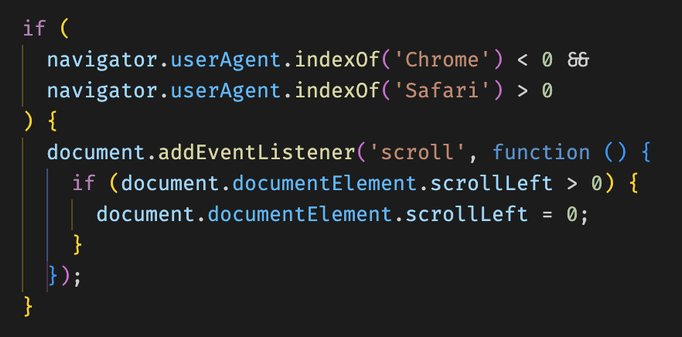
Raw version of the side-scroll prevention script:
```js
if (
navigator.userAgent.indexOf('Chrome') < 0 &&
navigator.userAgent.indexOf('Safari') > 0
) {
document.addEventListener('scroll', function () {
if (document.documentElement.scrollLeft > 0) { document.documentElement.scrollLeft = 0;
}
});
}
```
Since JSON is pronounced Jason (this is an undisputed fact), I declare DNS is now pronounced Dennis.
It's not DNS
There's no way its DNS
It was DNS
Becomes....
It is not Dennis
There is no way its Dennis
Yep, it was Dennis
And here is a picture of Dennis in his natural habitat.

 XKCD Bot
 Matt Bowen
 Brian 👾