videos from SciPy 2024 are live! here's my talk on a vision for composable interactive data visualization with #anywidget

trevor manz
@manzt
- 33 Followers
- 35 Following
- 20 Posts
phd-ing in boston
i keep finding fun/interesting workflows that fall out of quak's query-based design
example: define a table subset interactively, copy the SQL, and run it in
@duckdb cli to build unix pipelines
kudos to @Posit for adding support for Jupyter Widgets in Positron IDE!
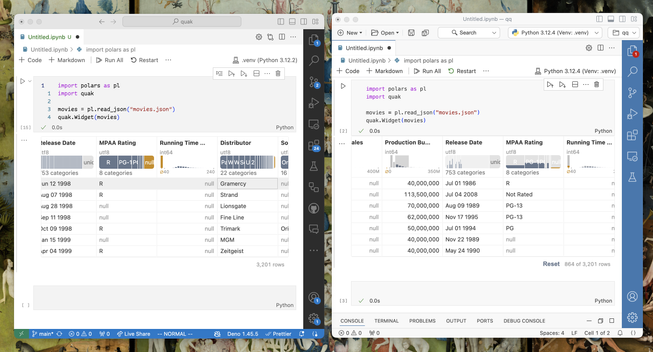
just fixed a scroll behavior issue, and now quak works swimmingly in VS Code (left) and Positron (right) thanks to #anywidget
quak 🦆 v0.1.3 adds a hover indicator for summary histograms, thanks to @dvdkouril

Thrilled @marimo_io is standardizing on #anywidget for their plugin API! Our projects are really well aligned, pushing widget interactivity beyond Jupyter.
Learn more in our blog post: https://marimo.io/blog/anywidget

 timelyportfolio
couldn't help myself and made a very crude but working #rstats #htmlwidget out of @manzt new quak
https://github.com/timelyportfolio/quak/tree/htmlwidget/htmlwidget

The core idea in quak is that all table state is expressed via database queries. User interactions produce SQL, executed lazily at the database level (DuckDB) to refresh data views.
This SQL can also be accessed in Jupyter to materialize data subsets for further analysis.
Excited to introduce quak 🦆 (https://github.com/manzt/quak) a scalable, interactive data profiler built with #anywidget.
- 🖱️ crossfilter & sort millions of rows in real time
- 🔄 supports any Apache Arrow __dataframe__
- ⚡ powered by Mosaic & DuckDB
- 📓 materialize data subsets back in Jupyter

i made a little website to select and export calendar invites (.ics) for events at the 2024 #Olympic games https://olympicks.xyz

 David Chisnall (*Now with 50% more sarcasm!*)
Someone recently suggested to me that AI systems bring the users' ability closer to the average. I was intrigued by this idea because it reflects my experience. I am, for example, terrible at any kind of visual art, but with something like Stable Diffusion I can produce things that are merely quite bad, whereas without it I can produce things that are absolutely terrible. Conversely, with GitHub Copilot I can write code with more bugs that's harder to read. Watching non-programmers use it and ChatGPT with Python, they can produce fairly mediocre code that mostly works.
I suppose it shouldn't surprise anyone that a machine that's trained to produce output from a statistical model built from a load of examples would tend towards the mean.
An unflattering interpretation of this would suggest that the people who are most excited by AI in any given field are the people with the least talent in that field.