José Lourenço

209 Followers
398 Following
50 Posts
Ecologist of infectious diseases.
Spaceships & pathogens.
🇵🇹🇬🇧🇪🇺🌈🎮
Scholarhttps://scholar.google.com/citations?user=A4y9Yw8AAAAJ&hl=en
Twitterhttps://twitter.com/LourencoJML
ORCIDhttps://orcid.org/0000-0002-9318-2581
Católica Biomedical Research Centerhttps://ciencia.ucp.pt/pt/persons/jos%C3%A9-louren%C3%A7o

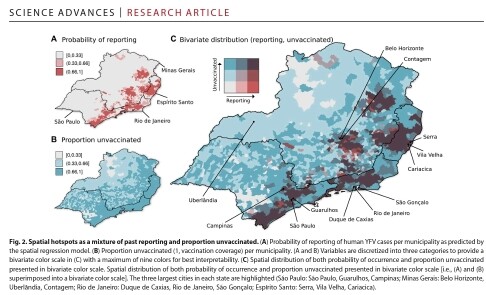
We reconstructed the recent transmission history of #YellowFeverVirus in #Brazil. A suitability index was able to capture the seasonality of #zoonotic cases. Spatial modeling revealed hotspots with both past reporting and low #vaccination coverage, coinciding with the largest urban centers in the Southeast. #Phylodynamics identified 3 lineages & provided proof of the directionality of a spatial corridor connecting the endemic North with the extra-Amazonian basin.

https://www.science.org/doi/10.1126/sciadv.adg9204

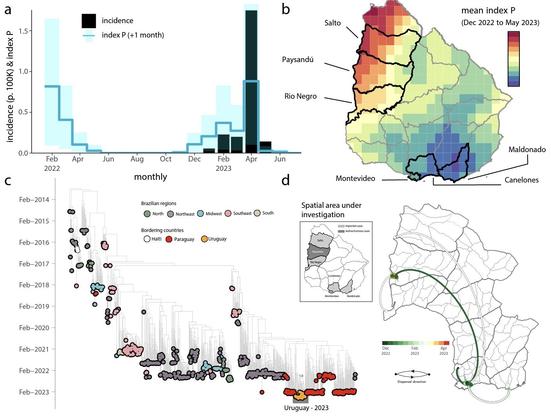
(our new manuscript) Uruguay experienced its first Chikungunya virus outbreak in 2023, resulting in a significant burden to its healthcare system. We conducted analysis based on real-time genomic surveillance (30 novel whole genomes) to offer timely insights into recent local transmission dynamics and eco-epidemiological factors behind its emergence and spread in the country.

https://medrxiv.org/cgi/content/short/2023.08.17.23294156v1

During the ZIKV public health crisis (2015-2018) Brazil reported low circulation of DENV. In 2018 DENV resurged with large outbreaks. DENV incidence after 2018 reveals a decrease in mean age of infection in regions most exposed to ZIKV. Using modelling we show that a combination of a short-term protection period to DENV followed by DENV disease enhancement in those exposed to ZIKV can reconcile the observed post-ZIKV DENV epidemiology.

https://www.medrxiv.org/content/10.1101/2023.05.29.23290597v1

Shifting patterns of dengue three years after Zika virus emergence in Brazil

The Zika virus (ZIKV) emerged in Brazil in 2015, causing large outbreaks across South America and the Caribbean. In the years that followed, many countries in these areas reported exceptionally low circulation of Dengue virus (DENV), which later resurged in 2018-2019. Several hypotheses have been proposed to explain low DENV transmission, yet no consensus has been reached so far. We show that while short-term cross-protection induced by ZIKV can explain the temporary disappearance of DENV, it also predicts, in contrast with observations, a rising mean age of DENV incidence in the post-ZIKV era. We further demonstrate that disease enhancement of DENV, especially in primary infections in ZIKV-positive hosts, is required to remedy these shortfalls. Our results suggest that both population-level immunity to DENV and ZIKV contributed positively to the reduction in mean age of DENV incidence. ### Competing Interest Statement The authors have declared no competing interest. ### Funding Statement This work was funded by the UKRI GCRF One Health Poultry Hub (Grant No. BBS011269/1), one of twelve interdisciplinary research hubs funded under the UK government's Grand Challenge Research Fund Interdisciplinary Research Hub initiative. ### Author Declarations I confirm all relevant ethical guidelines have been followed, and any necessary IRB and/or ethics committee approvals have been obtained. Yes The details of the IRB/oversight body that provided approval or exemption for the research described are given below: Counts of incident Dengue and Zika cases in Feira de Santana used in Figure 1 in the main manuscript were collated from epidemiological bulletins found at Feira de Santana's Secretaria Municipal de Saúde website: [https://www.feiradesantana.ba.gov.br/servicos.asp?id=14&link=sms/vigilancia\_saude/vigilancia\_epidemiologica.asp][1] Age-specific counts of incident Dengue cases and hospitalisations across Brazilian states and the cities of Feira de Santana and Salvador be downloaded from the following repository <https://datasus.saude.gov.br/informacoes-de-saude-tabnet/> I confirm that all necessary patient/participant consent has been obtained and the appropriate institutional forms have been archived, and that any patient/participant/sample identifiers included were not known to anyone (e.g., hospital staff, patients or participants themselves) outside the research group so cannot be used to identify individuals. Yes I understand that all clinical trials and any other prospective interventional studies must be registered with an ICMJE-approved registry, such as ClinicalTrials.gov. I confirm that any such study reported in the manuscript has been registered and the trial registration ID is provided (note: if posting a prospective study registered retrospectively, please provide a statement in the trial ID field explaining why the study was not registered in advance). Yes I have followed all appropriate research reporting guidelines, such as any relevant EQUATOR Network research reporting checklist(s) and other pertinent material, if applicable. Yes All data produced are available online at <https://datasus.saude.gov.br/informacoes-de-saude-tabnet/> and [https://www.feiradesantana.ba.gov.br/servicos.asp?id=14&link=sms/vigilancia\_saude/vigilancia\_epidemiologica.asp][1] <https://drive.google.com/file/d/1_K65eUKvG9SituMalYthCcEyuvyhuBis/view?usp=sharing> <https://datasus.saude.gov.br/informacoes-de-saude-tabnet/> [https://www.feiradesantana.ba.gov.br/servicos.asp?id=14&link=sms/vigilancia\_saude/vigilancia\_epidemiologica.asp][1] [1]: https://www.feiradesantana.ba.gov.br/servicos.asp?id=14&link=sms/vigilancia_saude/vigilancia_epidemiologica.asp

medRxiv

#OneHealth #YellowFever #Brazil, soon in Science Advances.

2015-2022 phylodynamics provided proof of directionality connecting the endemic Amazon to the South East. We identify municipalities with high likelihood of spillover & low vaccination, that border urban centres & should be targeted for catch-up #vaccination.

Collaborative work with a large number of local & international researchers, epidemiologists, public health policy makers, ecologists & zoologists.

https://www.medrxiv.org/content/10.1101/2023.01.13.23284525v1

Genomic epidemiology sheds light on the recent spatio-temporal dynamics of Yellow Fever virus and the spatial corridor that fueled its ongoing emergence in southern Brazil

Despite the considerable morbidity and mortality of Yellow fever virus (YFV) infections in Brazil, as well as its widespread presence in non-human primate host, our understanding of disease outbreaks is hampered by limited viral genomic data. Determining the timing and spatial corridors of YFV spread, as well as the geographic hotspots that link the endemic north of the country with epidemic extra-Amazonian regions, are central to predicting and preventing future outbreak events and epidemics. Here, we tracked the recent spread of the virus by integrating genome sequences of new YFV infections sampled from infected non-human primates and humans with both epidemiological and vector data. Through a combination of phylogenetic and epidemiological models we reconstructed the recent transmission history of YFV within different epidemic seasons in Brazil. A suitability index based on the highly domesticated Aedes aegypti was able to capture the seasonality of reported human infections. Spatial modelling revealed spatial hotspots with both past reporting and low vaccination coverage, which coincided with many of the largest urban centres in the Southeast. Phylodynamic analysis unravelled the circulation of three distinct YFV lineages, and provided proof of the directionality of a known spatial corridor of viral spread that connects the endemic North with the extra-Amazonian basin. This study illustrates that genomics linked with field sampling of animals and humans within a One Health framework can provide new insights into the landscape of YFV transmission, augmenting traditional approaches to infectious disease surveillance and control. ### Competing Interest Statement The authors have declared no competing interest. ### Funding Statement This work was supported in part through National Institutes of Health USA grant U01 AI151698 for the United World Arbovirus Research Network (UWARN) and the Brazilian Ministry of Health (SCON2021-00180). MG is funded by PON Ricerca e Innovazione 2014-2020. JL is funded by BioISI (Biosystems and Integrative Sciences Institute), Faculdade de Ciencias da Universidade de Lisboa (UIDP/4046/2020). FP is funded by the One Health Poultry Hub, a Global Challenges Research Fund (GCRF) and United Kingdom Research and Innovation (UKRI) initiative. ECH is funded by an Australian Research Council Australian Laureate Fellowship (FL170100022). CNDS was founded by CNPq (307176-2018-5). Authors additionally thanks Fiocruz/CVSLR for the logistic support. ### Author Declarations I confirm all relevant ethical guidelines have been followed, and any necessary IRB and/or ethics committee approvals have been obtained. Yes The details of the IRB/oversight body that provided approval or exemption for the research described are given below: The project was supported by the Pan American World Health Organization (PAHO) and the Brazilian Ministry of Health (MoH) as part of the arboviral genomic surveillance efforts within the terms of Resolution 510/2016 of CONEP (Comissao Nacional de Etica em Pesquisa, Ministerio da Saude; National Ethical Committee for Research, Ministry of Health). I confirm that all necessary patient/participant consent has been obtained and the appropriate institutional forms have been archived, and that any patient/participant/sample identifiers included were not known to anyone (e.g., hospital staff, patients or participants themselves) outside the research group so cannot be used to identify individuals. Yes I understand that all clinical trials and any other prospective interventional studies must be registered with an ICMJE-approved registry, such as ClinicalTrials.gov. I confirm that any such study reported in the manuscript has been registered and the trial registration ID is provided (note: if posting a prospective study registered retrospectively, please provide a statement in the trial ID field explaining why the study was not registered in advance). Yes I have followed all appropriate research reporting guidelines and uploaded the relevant EQUATOR Network research reporting checklist(s) and other pertinent material as supplementary files, if applicable. Yes New sequences generated as part of this study have been deposited in GenBank under accession numbers [OP508570][1]-[OP508716][2] (Table 1). Aggregate estimates of YFV temporal suitability (index P) and its input (humidity, temperature, rainfall) for the South and Southeast between 2014 and 2021 are provided as a comma separated values (CSV) file (Supplementary Data File 1). Estimates of the probability of reporting human cases per municipality for the South and Southeast (output of spatial regression model) are provided as a comma separated values (CSV) file (Supplementary Data File 2) geocoded with GEOCMU7 (a seven digit unique identifier). [1]: /lookup/external-ref?link_type=GEN&access_num=OP508570&atom=%2Fmedrxiv%2Fearly%2F2023%2F01%2F13%2F2023.01.13.23284525.atom [2]: /lookup/external-ref?link_type=GEN&access_num=OP508716&atom=%2Fmedrxiv%2Fearly%2F2023%2F01%2F13%2F2023.01.13.23284525.atom
medRxiv

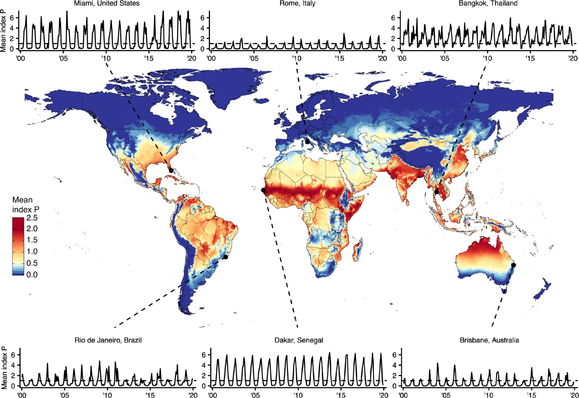
We mapped the global climate-driven transmission potential of #dengue by Aedes #aegypti (1981-2019) & offer a database & R-package as resources towards the identification of past and recent transmission hotspots.

This was hard work by Taishi Nakase, a student from the MSc programme Modelling for Global Health, from NDMOxford@twitter UniofOxford@twitter. Thanks also to the support of Mittenavoig@twitter & UriObolski@twitter climade_health@twitter

https://www.nature.com/articles/s41597-023-02170-7

Global transmission suitability maps for dengue virus transmitted by Aedes aegypti from 1981 to 2019 - Scientific Data

Mosquito-borne viruses increasingly threaten human populations due to accelerating changes in climate, human and mosquito migration, and land use practices. Over the last three decades, the global distribution of dengue has rapidly expanded, causing detrimental health and economic problems in many areas of the world. To develop effective disease control measures and plan for future epidemics, there is an urgent need to map the current and future transmission potential of dengue across both endemic and emerging areas. Expanding and applying Index P, a previously developed mosquito-borne viral suitability measure, we map the global climate-driven transmission potential of dengue virus transmitted by Aedes aegypti mosquitoes from 1981 to 2019. This database of dengue transmission suitability maps and an R package for Index P estimations are offered to the public health community as resources towards the identification of past, current and future transmission hotspots. These resources and the studies they facilitate can contribute to the planning of disease control and prevention strategies, especially in areas where surveillance is unreliable or non-existent.

Nature

The study "The impacts of #SARSCoV2 vaccine dose separation & targeting on the COVID-19 epidemic" in Nature showing how targeting disease (not transmission) by focusing on the vulnerable was the right choice in the UK (and should have been universally).

https://www.nature.com/articles/s41467-023-35943-0

The impacts of SARS-CoV-2 vaccine dose separation and targeting on the COVID-19 epidemic in England - Nature Communications

In England, SARS-CoV-2 vaccines were initially targeted to older, more vulnerable people; first vaccine doses were prioritised over second doses, and an interval of twelve weeks was used between doses. Here, the authors assess the impacts of these policy decisions by simulating counterfactual scenarios.

Nature

Through a combination of phy and epi models we reconstructed the recent transmission of #yellowfever virus in #Brazil.

#Modelling revealed spatial hotspots with both past reporting and low vaccination coverage, which coincided with the largest Southeast urban centres.

#Phylodynamics unravelled three distinct #YFV lineages, and provided proof of the directionality of a known spatial corridor of spread that connects the endemic North with the extra-Amazonian basin.

https://www.medrxiv.org/content/10.1101/2023.01.13.23284525v1

Have a look at our newest initiative (this is work in progress, but we are activily updating the website):

Climate Amplified Diseases and Epidemics (CLIMADE): A global consortium led by the global south to study and respond to Climate Amplified Diseases and Epidemics

The overarching long-term goal of CLIMADE is to predict, track and control diseases and epidemics that are amplified by human-caused climate change in the most affected countries in the world.

https://climade.health/about/

About – CLIMADE

We (*) decided to face the Biggest Global Problems: Climate Change & Epidemics - Together with some of the top funders in the world, we are looking for the best minds to take Fellowships in #Epidemiology, #Ecology and #Climate Studies

(*) Big initiative led by Tulio de Oliveira: https://twitter.com/Tuliodna

More info here:

https://krisp.org.za/news.php?id=610

https://www.krisp.org.za/manuscripts/PostDoctEcoClinmate2023.pdf

Tulio de Oliveira (@Tuliodna) / Twitter

Director of CERI (Centre for Epidemic Response & innovation) @StellenboschUni and KRISP (KZN Research Innovation & Sequencing Platform) @UKZN. Tweets my own.

Twitter