@lerentis

7 Followers
265 Following
198 Posts
DevOps - Dad - IT-Security and Open Source Enthusiast - Addicted to Martial Arts and (now mostly cold) Coffee
LanguageEn/De
PronounceHe/Him

"Let’s be clear — what you are doing is not about climate action or responding to an emergency. It never was. This is communication tactics disguised as politics."

"You can — and will — of course choose to continue to play your parts, say your lines, wear your costumes. You can and will continue to pretend. But nature and physics will not fall for it. Nature and physics are not entertained nor distracted by your theatre.

The audience has grown weary. The show is over."

https://gretathunberg.medium.com/the-show-is-over-66e03dd38efa

¯\_(ツ)_/¯
no factor authentication.
we trust you

Google has just updated its 2FA Authenticator app and added a much-needed feature: the ability to sync secrets across devices.

TL;DR: Don't turn it on.

The new update allows users to sign in with their Google Account and sync 2FA secrets across their iOS and Android devices.

We analyzed the network traffic when the app syncs the secrets, and it turns out the traffic is not end-to-end encrypted. As shown in the screenshots, this means that Google can see the secrets, likely even while they’re stored on their servers. There is no option to add a passphrase to protect the secrets, to make them accessible only by the user.

Why is this bad?

Every 2FA QR code contains a secret, or a seed, that’s used to generate the one-time codes. If someone else knows the secret, they can generate the same one-time codes and defeat 2FA protections. So, if there’s ever a data breach or if someone obtains access .... 🧵

#Privacy #Cybersecurity #InfoSec #2FA #Google #Security

Update results/syntax page · duckduckgo/duckduckgo-help-pages@d35d03e

DuckDuckGo Help Pages. Contribute to duckduckgo/duckduckgo-help-pages development by creating an account on GitHub.

GitHub
Braucht noch jemand OpenBikeSensor Platinen? Habe hier ein paar mehr als ich brauche in einem hübschen Lila. Kann mir vorstellen, dass die Platinen machen zu lassen einige vom selber bauen abgehalten hat. Will nix dafür haben und verschicke auch gern einzeln per Brief. #OpenBikeSensor (Edit: Alle weg, hätte gar nicht mit so viel Interesse gerechnet, falls ihr aber noch welche wollt, kann ich auch bei der Bestellung zur Fertigung helfen, oder wenn sich noch mehr Leute finden selber eine machen)

I just released a new version of my #bitwarden crd-operator. Now with images default from ghcr. Docker hub images will continue to be punished

https://artifacthub.io/packages/helm/lerentis/bitwarden-crd-operator/0.6.0
#helm #kubernetes #operator #opensource

bitwarden-crd-operator 0.6.0 · Lerentis/lerentis

Deploy the Bitwarden CRD Operator

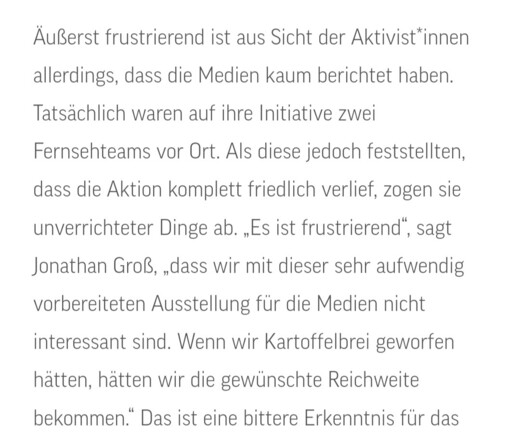
Hier gab es einen aufwendigen und guten Klimaprotest im Forum Wissen in Göttingen.

Aktivisti haben ein halbes Jahr lang eine Ausstellung konzipiert und dann mit 35 Leuten das Museum gekapert und alles aufgebaut.
Das Museum war überrumpelt, hat sie aber gewähren lassen – weil sie es gut fanden.

Die Fernsehteams sind untätig wieder abgezogen:
kein Krawallpotenzial –> keine Medienpräsenz.

Lesenwerter Artikel im Blog des Museums↓
https://blog.forum-wissen.de/forum-handeln-konstruktiver-klimaprotest-im-forum-wissen/

„Forum Handeln“ – konstruktiver Klimaprotest im Forum Wissen – Forum Wissen Blog

Am vergangenen Wochenende haben Klimaaktivist*innen von „EndFossil:Occupy! Göttingen“ das Forum Wissen gekapert. Die „Räume des Wissens“ verwandelten sie durch eine eigens konzipierte Ausstellung in „Räume des Handelns“. Sie gingen der… Weiterlesen

Forum Wissen Blog
We really missed an opportunity to call logging, monitoring, alerting, and observability LMAO 😹

I'm fascinated by the Inuit-Yupik-Unangan languages in Alaska, Canada and Greenland. There are many of these languages: they ring much of the Arctic Ocean. I just learned that they use a base 20 system for numbers, with a 'sub-base' of 5. That is, quantities are counted in scores (twenties) with intermediate numerals for 5, 10, and 15. This makes a lot of sense if you look at your fingers and toes.

But the Inuit didn't have a written form of their number system - until the early 1990s, when high school students in the town of Kaktovik, Alaska invented one! There were just 9 students at this small school, and they all joined in.

They used 5 principles:

• Visual simplicity: The symbols should be easy to remember.

• Iconicity: There should be a clear relationship between the symbols and their meanings.

• Efficiency: It should be easy to write the symbols without lifting the pencil from the paper.

• Distinctiveness: There should be no confusion between this system and Arabic numerals.

• Aesthetics: They should be pleasing to look at.

They decided that the symbol for zero should look like crossed arms, meaning that nothing was being counted.

This was the start of quite a tale!

(1/n)