Dr Kamran Soomro

29 Followers
47 Following
101 Posts
#datascience | #machinelearning | #smartcities | #datavisualiation
Associate Professor (Reader) of Artificial Intelligence. Interested in developing and applying machine learning and data science techniques to smart cities and healthcare solutions.
LocationUK
Alt@kamran_soomro
“When [I first got] hooked on Claude, I did not sleep. I spent two months excessively prompting the thing and wasting tokens. I ended up building and building and creating a ton of tools I did not end up using much… Quite a few of the tools I built I felt really great about, just to realize that I did not actually use them or they did not end up working as I thought they would.”
https://www.fast.ai/posts/2026-01-28-dark-flow/
fast.ai - Breaking the Spell of Vibe Coding

Sinister variations on the positive state of flow

New paper out in Concurrency and Computation: Practice and Experience! We explored how LLMs can help public authorities analyse citizen feedback more efficiently.

Using survey data from East Bristol's liveable neighbourhood initiative, we found sentiment classification achieved >90% accuracy, and LLMs outperformed traditional summarisation methods.

Open access:

https://doi.org/10.1002/cpe.70547

#SmartCities #LLM #MachineLearning #UrbanPlanning #OpenAccess #CitizenScience

I had no clue Google had introduced a consensus.app killer! Excited to try this out!
UNIX V4 tape successfully recovered: First ever version of UNIX written in C is running again

: Crucial early evolutionary step found, imaged, and ... amazingly ... works

The Register
Thanks also to my colleague Alireza.

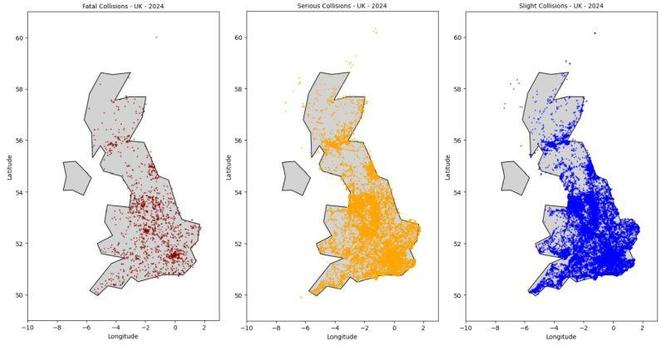
Here’s one of the visualisations we created: the geographical distribution of collisions in 2024, classified by severity: fatal, serious, and slight.

More about the dataset:

https://www.data.gov.uk/dataset/cb7ae6f0-4be6-4935-9277-47e5ce24a11f/road-accidents-safety-data

Today in our #Business_Intelligence module, we explored a data science case study on UK road collisions, using the latest dataset (updated Sep. 2025) from the Department for Transport (DfT), United Kingdom.

We went through the analytics cycle: business & data understanding, data preparation, developing a predictive model and model evaluation.

“For most of computing history, designers have been the authors of the visible world…But we are entering a new frontier. For the first time, the interface itself thinks. And when it thinks, the rules change”
https://www.suffsyed.com/futurememo/designers-have-to-move-from-the-surface-to-the-substrate
Designers Have to Move from the Surface to the Substrate — Suff Syed

Designers once controlled 85% of user experience through interfaces and interactions. Now, with intelligence moving beneath the surface, that control has collapsed to 5%—while the real design decisions happen in training data, system prompts, and model behavior that most designers never see.

Suff Syed
The Majority AI View

A blog about making culture. Since 1999.

Anil Dash

@ksoomro State Space Model -- Mamba/RWKV/XLSTM, S4, RetNet:

https://www.youtube.com/watch?v=yceNl9C6Ir0

https://www.latent.space/p/2024-post-transformers

Transformers are O(l^2) and have to re-read full token histories with each prompt.

SSMs are recurrent and have a fixed size memory state that can be continued from (no history re-read) at any point.

O(1) memory and time.

Mamba, Mamba-2 and Post-Transformer Architectures for Generative AI with Albert Gu - 693

YouTube