
0 Followers
20 Following
7 Posts

@neuroecology
I've been following this field for three months or so,
1. OpenAI gym, now gymnasium
2. MineRL extension to Malmo project
3. Griddly

There should be more

@radek I am going to get into this when my assignments are finished. I am going to follow you. Your explanations are great and helpful. Thank you šŸ”„

The virtual StateOfTheArt() 2023 conference will take place tomorrow.
To kick it off, Bindu Reddy & I will be chatting about generative & large language models at 9:00 am PST.

If you are interested in attending, there is a free registration form for the Zoom link here: https://www.eventbrite.com/e/stateoftheart-free-ai-conference-with-top-aiml-influencers-tickets-472810176967
StateOfTheArt() - Free AI Conference with Top AI/ML Influencers!

This is a half-day event featuring top AI/Ml leaders, researchers from prestigious universities, tech companies, and more!

Eventbrite

[P] searchthearxiv.com: Semantic search across more than 250,000 ML papers on arXiv

https://searchthearxiv.com

Discussions: https://discu.eu/q/https://searchthearxiv.com

#compsci #machinelearning

search the arXiv

@ParanoidFactoid @shoq this is a good idea. I always thought that one day one app will cover everything, and if enough organizations do it, it will be the web browser.

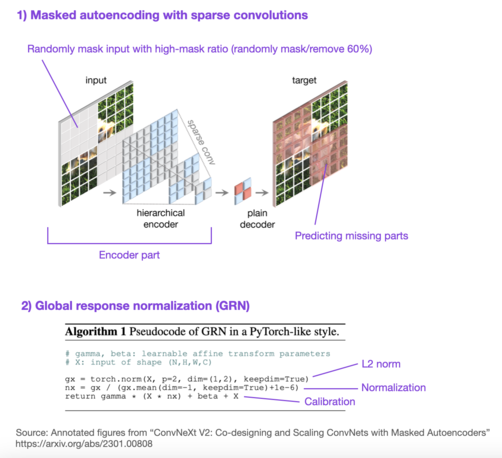
Self-supervised learning is one of the keys to success behind language and vision transformers. However, self-supervised learning techniques like masked auto-encoding can even harm the performance of convolutional networks.

In "ConvNeXt V2: Co-designing and Scaling ConvNets with Masked Autoencoders" researchers co-design the convolutional network architecture with masked autoencoding for self-supervised learning: https://arxiv.org/abs/2301.00808

ConvNeXt V2: Co-designing and Scaling ConvNets with Masked Autoencoders

Driven by improved architectures and better representation learning frameworks, the field of visual recognition has enjoyed rapid modernization and performance boost in the early 2020s. For example, modern ConvNets, represented by ConvNeXt, have demonstrated strong performance in various scenarios. While these models were originally designed for supervised learning with ImageNet labels, they can also potentially benefit from self-supervised learning techniques such as masked autoencoders (MAE). However, we found that simply combining these two approaches leads to subpar performance. In this paper, we propose a fully convolutional masked autoencoder framework and a new Global Response Normalization (GRN) layer that can be added to the ConvNeXt architecture to enhance inter-channel feature competition. This co-design of self-supervised learning techniques and architectural improvement results in a new model family called ConvNeXt V2, which significantly improves the performance of pure ConvNets on various recognition benchmarks, including ImageNet classification, COCO detection, and ADE20K segmentation. We also provide pre-trained ConvNeXt V2 models of various sizes, ranging from an efficient 3.7M-parameter Atto model with 76.7% top-1 accuracy on ImageNet, to a 650M Huge model that achieves a state-of-the-art 88.9% accuracy using only public training data.

arXiv.org
When I recognize somebody from Twitter who just joined Mastodon…