 Sebastian Raschka
Self-supervised learning is one of the keys to success behind language and vision transformers. However, self-supervised learning techniques like masked auto-encoding can even harm the performance of convolutional networks.
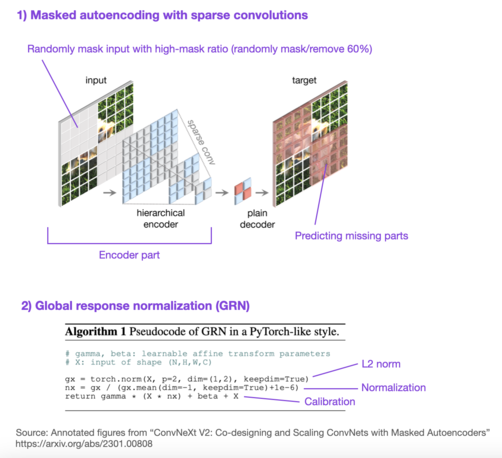
In "ConvNeXt V2: Co-designing and Scaling ConvNets with Masked Autoencoders" researchers co-design the convolutional network architecture with masked autoencoding for self-supervised learning: https://arxiv.org/abs/2301.00808
ConvNeXt V2: Co-designing and Scaling ConvNets with Masked Autoencoders
Driven by improved architectures and better representation learning frameworks, the field of visual recognition has enjoyed rapid modernization and performance boost in the early 2020s. For example, modern ConvNets, represented by ConvNeXt, have demonstrated strong performance in various scenarios. While these models were originally designed for supervised learning with ImageNet labels, they can also potentially benefit from self-supervised learning techniques such as masked autoencoders (MAE). However, we found that simply combining these two approaches leads to subpar performance. In this paper, we propose a fully convolutional masked autoencoder framework and a new Global Response Normalization (GRN) layer that can be added to the ConvNeXt architecture to enhance inter-channel feature competition. This co-design of self-supervised learning techniques and architectural improvement results in a new model family called ConvNeXt V2, which significantly improves the performance of pure ConvNets on various recognition benchmarks, including ImageNet classification, COCO detection, and ADE20K segmentation. We also provide pre-trained ConvNeXt V2 models of various sizes, ranging from an efficient 3.7M-parameter Atto model with 76.7% top-1 accuracy on ImageNet, to a 650M Huge model that achieves a state-of-the-art 88.9% accuracy using only public training data.
 Evangelos Kazakos
 Richard