Josef Taalbi

0 Followers
32 Following
17 Posts
Researcher at Lund University. Innovation studies, sustainable transitions, network science, history of technology. Sometimes I compose piano music.
Homepagehttp://www.joseftaalbi.com
Google Scholarhttps://scholar.google.com/citations?user=dBO5CxsAAAAJ
SWINNO databasehttps://www.lusem.lu.se/economic-history/databases/swinno
Musichttps://joseftaalbi.bandcamp.com/album/improvisations-nomadesques

What are the breast radiologists' views about integrating AI into mammography screening?
Check out my new article in BMJ Health and Care Informatics, co-authored with Stefan Larsson and Kristina Lång : https://informatics.bmj.com/content/30/1/e100712

#AI #breastcancer #screening

Anticipating artificial intelligence in mammography screening: views of Swedish breast radiologists

Objectives Artificial intelligence (AI) is increasingly tested and integrated into breast cancer screening. Still, there are unresolved issues regarding its possible ethical, social and legal impacts. Furthermore, the perspectives of different actors are lacking. This study investigates the views of breast radiologists on AI-supported mammography screening, with a focus on attitudes, perceived benefits and risks, accountability of AI use, and potential impact on the profession. Methods We conducted an online survey of Swedish breast radiologists. As early adopter of breast cancer screening, and digital technologies, Sweden is a particularly interesting case to study. The survey had different themes, including: attitudes and responsibilities pertaining to AI, and AI’s impact on the profession. Responses were analysed using descriptive statistics and correlation analyses. Free texts and comments were analysed using an inductive approach. Results Overall, respondents (47/105, response rate 44.8%) were highly experienced in breast imaging and had a mixed knowledge of AI. A majority (n=38, 80.8%) were positive/somewhat positive towards integrating AI in mammography screening. Still, many considered there to be potential risks to a high/somewhat high degree (n=16, 34.1%) or were uncertain (n=16, 34.0%). Several important uncertainties were identified, such as defining liable actor(s) when AI is integrated into medical decision-making. Conclusions Swedish breast radiologists are largely positive towards integrating AI in mammography screening, but there are significant uncertainties that need to be addressed, especially regarding risks and responsibilities. The results stress the importance of understanding actor-specific and context-specific challenges to responsible implementation of AI in healthcare. No data are available. Data cannot be openly shared, due to respondent anonymity.

BMJ Health & Care Informatics

Roger Penrose explains the origins of his work on black holes and singularity theorems, among other things in this series in 3 parts:

https://www.youtube.com/watch?v=xlDNh5WYGbU

Roger Penrose on Spacetime, Quantum Theory, and General Relativity (Part 2) | Closer To Truth Chats

YouTube
@henry One would think that Fukushima would be fresh in collective memory but surprisingly, nuclear power has in the past few years reemerged in Sweden as a serious option. The current right wing government views NP as a serious option for solving the climate crisis. So far difficult to see in technology trends though.
@henry just 6 years prior Sweden (in 1980) went to popular referendum about nuclear power - meant that nuclear power was to be dismantled over the long haul. Very few innovations related to nuclear power from the early 1980s and onwards, perhaps underlined by #ChernobylDisaster.
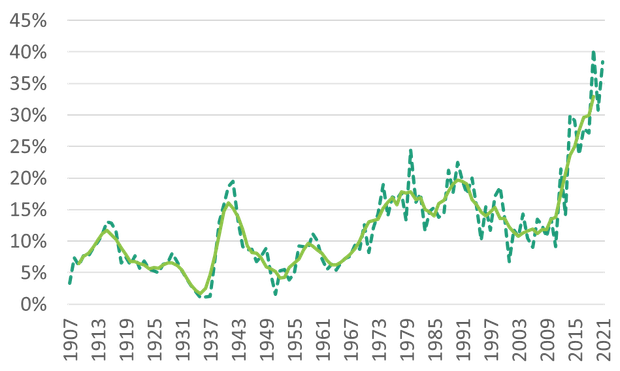
Percentage of environmental innovations in Sweden from 1908 to 2021. Part of this is creative response to energy crises: WWI, WWII, and OPEC, part may be legislation, social and political pressure to transform. From the SWINNO database.

If we calculate how many grains are in a teaspoon of sand (an average) & multiply that by the amount of sand estimated on every beach & desert in the world, we get (roughly) seven quintillion, five hundred quadrillion grains of sand on Earth. https://www.npr.org/sections/krulwich/2012/09/17/161096233/which-is-greater-the-number-of-sand-grains-on-earth-or-stars-in-the-sky #space #science

Meanwhile, there are ~70 thousand million, million, million stars in the observable universe - a figure vastly surpassing all of those grains of sand. The universe is immense, breathtaking & beyond imagination ✨

I finally got time to read this study https://www.nature.com/articles/s41586-022-05543-x
Shows that the fraction of disruptive science has declined since the mid 20th century . One explanation is changes in the incentives for research, benifiting incremental science and digging deeper within safe areas of expertice rather than exploring new knowledge combinations. I wonder how these results go with research that show that big collaborations, also inter-disciplnary, tend to be more incremental.
Papers and patents are becoming less disruptive over time - Nature

A decline in disruptive science and technology over time is reported, representing a substantive shift in science and technology, which is attributed in part to the reliance on a narrower set of existing knowledge.

Nature
Women own only 30% of electric cars. One reason is safety. Unlike gas stations, charging stations do not have employees on site and are more out of the way. It takes 5 min to fill up a car with gas, but 30 minutes to recharge an electric car. https://19thnews.org/2023/03/electric-vehicles-gender-gap/

"When the Paris Agreement was signed, scientists said the world could conceivably cut emissions sufficiently to avoid breaching 1.5C. But since 2016 emissions have increased each year except 2020 as the world burns through its carbon budget."

With immense consequences.

New theory re-ignites debate about identity of Leonardo da Vinci’s mother - https://arstechnica.com/science/2023/03/new-theory-re-ignites-debate-about-identity-of-leonardo-da-vincis-mother/ "Could Leonardo da Vinci's mother, Caterina, have been a slave kidnapped from the mountainous Caucasus region of Central Asia? " #circassia
New theory re-ignites debate about identity of Leonardo da Vinci’s mother

Was Caterina a slave kidnapped from the Caucasus region?

Ars Technica