58 Followers
153 Following
80 Posts
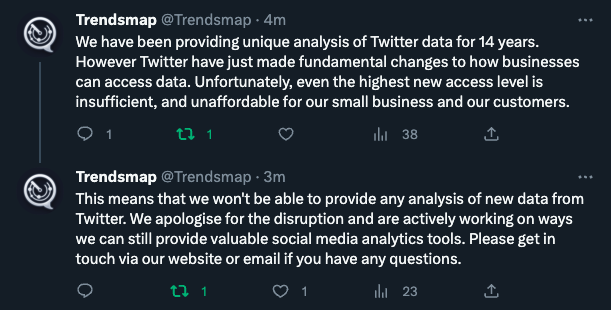
14 years of working with the latest data from twitter is over. I particularly loved the 4am wake up call on Easter Saturday morning 🙄. The servers were screaming at me that the sky was falling. Access to the API was abruptly and without notice cut. More details from the bird site : 🫡

I’m mind-blown 🤯 by the Safari 16.4 beta release: https://webkit.org/blog/13878/web-push-for-web-apps-on-ios-and-ipados/. Some highlights:

🛎️ Web Push for apps added to the Home Screen
📲 Ability for other browsers to add apps to the Home Screen
🔴 Badging API
💤 Screen Wake Lock API
🔃 Screen Orientation API
🙋 User Activation API
🎥 WebCodecs API
📄 Manifest ID

Full release notes with all details: https://developer.apple.com/documentation/safari-release-notes/safari-16_4-release-notes. 🎉

Web Push for Web Apps on iOS and iPadOS

With iOS and iPadOS 16.4 beta 1 comes support for Web Push for Home Screen web apps, Badging API, Manifest ID, and more.

WebKit

I showed my students this movie of how atmospheric #CarbonDioxide (CO₂) travels around the globe and you should see it too.

https://svs.gsfc.nasa.gov/11719

NASA Scientific Visualization Studio - A Year In The Life Of Earth’s CO2

Narrated video - Jan. 1, 2006 - Dec. 31, 2006For complete transcript, click here. Visualization - Jan. 1, 2006 - Dec. 31, 2006 North America - Feb. 1 - 28, 2006 Africa - Aug. 1 - 31, 2006 Himalayas - Feb. 1 - 28, 2006 Still image - Jan. 1, 2006 Still image - North America - Feb. 12, 2006 Visualization without annotation - Jan. 1, 2006 - Dec. 31, 2006 An ultra-high-resolution NASA computer model has given scientists a stunning new look at how carbon dioxide in the atmosphere travels around the globe.Plumes of carbon dioxide in the simulation swirl and shift as winds disperse the greenhouse gas away from its sources. The simulation also illustrates differences in carbon dioxide levels in the northern and southern hemispheres and distinct swings in global carbon dioxide concentrations as the growth cycle of plants and trees changes with the seasons.The carbon dioxide visualization was produced by a computer model called GEOS-5, created by scientists at NASA Goddard Space Flight Center’s Global Modeling and Assimilation Office.The visualization is a product of a simulation called a “Nature Run.” The Nature Run ingests real data on atmospheric conditions and the emission of greenhouse gases and both natural and man-made particulates. The model is then left to run on its own and simulate the natural behavior of the Earth’s atmosphere. This Nature Run simulates January 2006 through December 2006.While Goddard scientists worked with a “beta” version of the Nature Run internally for several years, they released this updated, improved version to the scientific community for the first time in the fall of 2014. For More InformationSee [http://www.nasa.gov/content/goddard/a-closer-look-at-carbon-dioxide/#.VGpHfC9by7s](http://www.nasa.gov/content/goddard/a-closer-look-at-carbon-dioxide/#.VGpHfC9by7s) Related pages

SVS
With the new Navigation API, you can now show the native spinner + stop button for any asynchronous operation - all you need is a Promise.
Be careful when combining powers.
Musk and Murdoch together at the football game is a gathering of today's most powerful anti-democracy media barons. And it's a reminder that journalists who would never consider working for Murdoch's Fox "News" -- at least he pays for his content -- are still toiling for free to support Musk's rancid trollsite.
Absolutely the best Acknowledgments section of a paper I’ve read. From https://arxiv.org/abs/2302.03988 #astrodon / h/t @playingwithdust
On Cosmological Low Entropy After the Big Bang: Universal Expansion and Nucleosynthesis

We investigate the sensitivity of a universe's nuclear entropy after Big Bang nucleosynthesis (BBN) to variations in both the baryon-to-photon ratio and the temporal evolution of cosmological expansion. Specifically, we construct counterfactual cosmologies to quantify the degree by which these two parameters must vary from those in our Universe before we observe a substantial change in the degree of fusion, and thus nuclear entropy, during BBN. We find that, while the post-BBN nuclear entropy is indeed linked to baryogenesis and the Universe's expansion history, the requirement of leftover light elements does not place strong constraints on the properties of these two cosmological processes.

arXiv.org

When a car is repaired after a crash, the GDP goes up.

When a fruit or vegetable is grown only to be thrown out by a supermarket as food waste, the GDP goes up.

When you replace a phone that still works because of planned obsolescence, the GDP goes up.

When you throw out a perfectly good coat because it's no longer fashionable, and buy a new one in this season's style, the GDP goes up.

When a bridge has to be replaced because it wasn't built right, the GDP goes up.

When a piece of packaging is manufactured only to be thrown away straight away, the GDP goes up.

When a site needs to be decontaminated because chemicals weren't stored correctly, the GDP goes up.

In each case, society has no more usable wealth than it would have had if the car didn't crash, the vegetable wasn't grown, the phone wasn't replaced, the old coat was still being worn, there was less packaging, or the chemicals were stored correctly. Yet the GDP goes up.

Meanwhile, most of the wealth that is generated ends up in the top one percent's pockets.

The truth is that GDP isn't a useful measurement. It's just a convenient one.

#economics #politics #gdp #auspol #ukpol

the Apple Human Interface Guidelines from 1987 is full of little gold nuggets:

> People aren't trying to use computers—they're trying to get their jobs done.

(Slinks back here from twitter)