
56 Followers
59 Following
924 Posts

Relatively chill, given the circumstances. He/him.

Business: [email protected]

Websitehttps://jerp.tv
Twitchhttps://twitch.tv/jerp
YouTubehttps://youtube.com/jerpdoesgames
Discordhttps://jerp.tv/discord

I'd really like to know what the fuck their business model looks like at this point though that "trick a/o force users to use this product that they have clearly signaled they don't want, that costs US money every time they use it" is their go-to plan? Still? Like

The money burn ain't working y'all

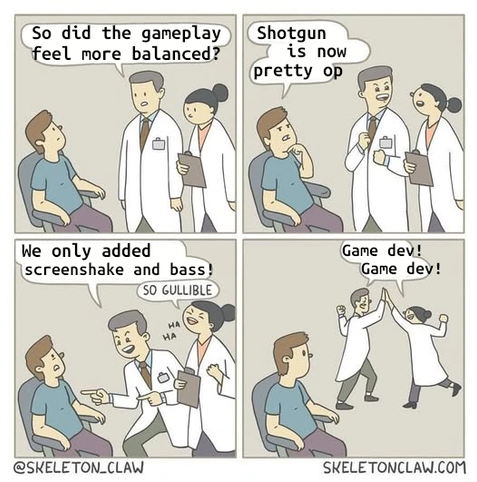
Interesting part about that is it raises the age-old question -- when the best thing you can do to improve the gameplay experience is to make the player weaker, how do you make that palatable?

I do think the DLC showed promise at least, but they did need to scale the game so far up that you had to rely on the couple of super busted setups / have minimal character and mechanical involvement (really laser-focused setups).

If player damage output didn't scale so high and a few action-economy-breaking setups didn't exist, I think they could've made the gameplay much more engaging. Could have even had better balancing between parrying and everything else.

It seems the only recourse at that point was just giving bosses abilities that ignored or disabled player abilities and game mechanics - like disabling shields, having additional immutable turns, ignoring status effects, making death permanent, or having conditional invulnerability.

I do like the general idea of forcing the player to use their entire party though (or at the very least, more than 3 characters).

I wonder what the reception would've been for #Expedition33 if the balance didn't fall apart in the third act.

Like there's plenty of people who play games just for the story that would've recoiled in horror if there was a shred of difficulty between them and the ending.

On the other hand, the final boss not getting a single turn on expert mode with 50x health kinda deflated it. Let alone being able to destroy the non-DLC superbosses.

Part of what makes Jump King kind of insidious is that they structure the pattern of jumps in each area in such a way that when you inevitably lose a ton of progress to a major fall and need to complete a series of tricky jumps in a prior area to avoid losing more progress, the layout and structure of the area is different enough to second-guess jumps and grinding the latter area skews your muscle memory - meaning you're more likely to lose another large amount of progress.

I played through ~most of Getting Over It and have watched the rest multiple times, and I can't remember if even that game has a situation where they set up difficulty in such a way to where successive failures not only increase the difficulty but also increase how much progress you can potentially lose with each additional failure.

Am I misremembering it? I feel like you were more or less hitting checkpoints where the worst you could do is flounder at resuming from where you fell.

It also seems to loop two specific major potentials for failure - right before some generally-inconsequential midpoint where there is a short-term cap on how much progress you can lose, or right before you reach a new area. In either case, difficulty is suddenly ramped up right at a point where failure sends you back to the previous area (and generally right at the point where failure _there_ will cost you an entire additional area worth of progress).

Played a bit of #JumpKing earlier and I'm not sure I've played another game where the penalty for failure is not just loss of progress, but a higher risk of losing even more progress.

Like not a roguelike, not the Gradius effect, etc. where they're either designed for repeatedly starting anew or have a hard checkpoint that you can get stuck at - but actually moving increasingly further backwards. Usually there's a point midway where the difficulty is locked or the loss of progress is capped.