Jean Tessier

17 Followers
22 Following
194 Posts

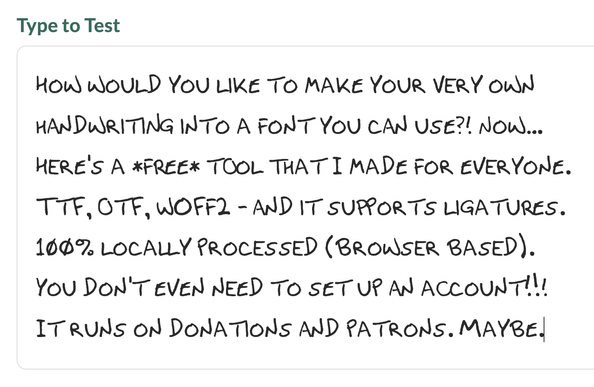
I just spent the last 24 hours building... a free tool to create your very own handwriting font quickly within the browser (no logins, all local processing):

https://arcade.pirillo.com/fontcrafter.html

Having tested it extensively on my own manuscript, I can definitely say that it works. ;) Download the OTF and/or TTF when done!

#fonts #typography #web #app #ai #vibecoding #free

Build Event-Sourced Systems in Quarkus with Java Records and CQRS
https://www.the-main-thread.com/p/event-sourcing-quarkus-java-records-cqrs-tutorial

#java #cqrs #quarkus

Event Sourcing in Quarkus: A Modern Java Tutorial

Learn event sourcing in Quarkus using Java records, CQRS patterns, and immutable event streams in a clean, hands-on tutorial.

The Main Thread
One of the best videos you're ever likely to see on why Agile is so poorly applied and miscommunicated, by @antonymarcano:
https://www.youtube.com/watch?v=fzqEHwXVpKQ

Please, I beg, if you're posting about a new release of the cool thing you made, include a small description of what it is and what it does.

It's hard to boost "libencarbulator turbo++ 2.8a release is now available! Now supports configuring reticulation of splines" in a vacuum, and I want nothing more than to boost the cool thing you made

LangChain4j has crossed an important line:
from “interesting library” → production Java AI infrastructure.

I wrote a long-form guide with 50 LangChain4j interview questions, covering:
• AI Services
• RAG & embeddings
• Tools & agents
• Memory & context limits
• Observability, cost, and security

Written from a production Java perspective — not Python demos.

https://www.the-main-thread.com/p/langchain4j-interview-questions-java

#Java #LangChain4j #AIinJava #EnterpriseJava #RAG #LLM #SoftwareArchitecture #DevExperience

Do you have a personal website? If so, are you paid to develop software? I know this won't be academically robust, but I'm curious about the number of people who have a personal website and are not themselves professional or semi-professional software developers, compared to the number of those who are.

For purposes of this poll, "professional developer" means have been paid to make software. Boost if this is interesting to you too!

I have a website and am a pro developer
53.8%
I have a website and I am NOT a pro developer
32%
I should make a personal website
14.1%
Poll ended at .

Hot new James Webb Space Telescope image just dropped. Like, *really* hot.

This is just a tiny portion of the #HelixNebula. It is the end result of a life stage of #stars with about the mass of the Sun. Like people, stars are born, live and die. The Helix Nebula represents old age for Sun-like stars, after the exhaust their nuclear fuel. The stars shed their outer layers into the surrounding space and contract to become white dwarfs, a kind of shell or husk of their former selves.

What you're seeing here are thousands of so-called 'cometary knots', each about the size of our Solar System. They're only 'cometary' in appearance, forming tails behind them. Note that they all point in a common direction, toward the white dwarf star that is outside the frame toward the top. The knots are clumps of material rich in molecules, shed by the dying star before it entered its current phase. Now they are blasted by the intense radiation coming from that star, which shapes their appearance.

As the European Space Agency puts it: "Its intense radiation lights up the surrounding gas, creating a rainbow of features: hot ionized gas closest to the white dwarf, cooler molecular hydrogen farther out, and protective pockets where more complex molecules can begin to form within dust clouds. This interaction is vital, as it’s the raw material from which new planets may one day form in other star systems."

Read more about this image on: https://esawebb.org/news/weic2601/

#Astronomy

Coming from C programming ages ago, I have an unhealthy obsession with using end-less function in #Ruby #programming.

Absolutely love it!

Day 4 of #ruby #adventOfCode was the longest so far but has 2 things I ♥️, part_2 calling part_1's method, and readability one-liners

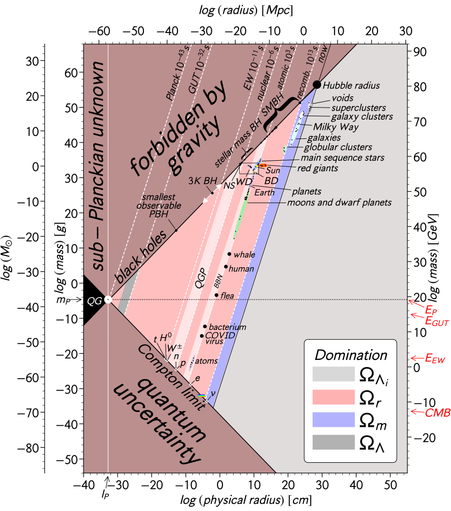
This chart shows all objects in the Universe, arranged by mass (vertical) and radius (horizontal).

The edge of the upper left corner is the "Schwarzschild radius" - anything along this edge becomes a black hole, so we don't expect stuff above and to the left of that.

The edge of the lower left corner is the "Compton wavelength" - anything here has a size so small that measuring its position that accurately would require enough energy to create a new one.

These two corners intersect in a white dot. This would be a black hole so small that it's heavily affected by quantum mechanics. By definition its mass would be the Planck mass, and its radius the Planck length. Nobody has seen such a thing.

The black region to the left of that dot, labeled "QG", contains imaginary objects that are more compressed than black holes, yet also ruled out by the uncertainty principle. So they're doubly impossible - unless Quantum Gravity, which we don't understand, changes the rules.

The pink strips of slope 3 are lines of constant density. For example "QGP" is the density of quark-gluon plasma, "BBN" is the density of the universe when Big Bang nucleosynthesis was going on, and so on.

The Earth is only slightly more dense than a flea.

The black dot labeled "Hubble radius" is the whole observable universe.

I like this chart a lot. It's from here:

C. H. Lineweaver and V. M. Patel, “All objects and some questions”, American Journal of Physics 91 (2023), 819-825. Free at https://pubs.aip.org/aapt/ajp/article-pdf/91/10/819/20107261/819_1_5.0150209.pdf

A higher-resolution version is on Wikicommons:

https://commons.wikimedia.org/wiki/File:Masses_and_sizes_of_objects_in_our_Universe.png

See the alt text for more!