@host Why was grup.pe blocked? @[email protected] has been markedly useful and without abuse.
| BGG | https://boardgamegeek.com/user/clearclaw |
| Blog | https://kanga.nu/~claw/blog/ |
| Keybase | https://keybase.io/clearclaw |

| BGG | https://boardgamegeek.com/user/clearclaw |
| Blog | https://kanga.nu/~claw/blog/ |
| Keybase | https://keybase.io/clearclaw |
@host Why was grup.pe blocked? @[email protected] has been markedly useful and without abuse.
The double dits in 1813 haven't really been working. They're effectively single dits with noise, and that's not enough to justify their existence. So....now trying silly things with double dits.

3-player 1832. Tried something.
Bought the London Investment, Coal and Georgia Central presidency for $400, leaving me $300 cash -- just enough to float the GC using the London Investment.
SR2 sell a GC to buy into GM&O and L&N. OR2 the GC withholds (so the London Investment would keep paying $6 difference to me). SR3 tapped the GC again -- which setup 5 ORs of the GC with a CMV well below IPO and paying out with 40% paying to treasury.
Ended up with two systems: ACL+GC and SAL+N&W with, collectively, 6/6/10/12 and the ACL+GC at a $400 stock price.


3-player 1832. Called on time, but I think the Central player had it. I did not play well. Several really basic errors, starting in the auction. Still, there's a comfort in old familiar gloves.


@18xx Current state: it works, it is solidly an RGC revenue game, I find it almost entirely uninteresting (true of all RGC and revenue games), other people than me seem to like it, I'm still trying to make it actually interesting, there are glimmers of promise (like raw share count winning over company quality), and there's a possibly (pretty sure not) dominant strategy of spamming out lots of companies (eg 4-6) just before brown. Asides minor details, current focus is on getting the market more active and functioning like a proper market.
@18xx Mergers are unchanged:
Share redemption and the closed box are gone. Price movements are:
White area of stock market (under $67) requires two shares to be sold to move down. Plus movements as above for capital calls and mergers.
Receivership and train-leasing is gone. A trainless company has no possible income and just falls down the market until something gives it a train. There are no EMRs.
No more double buys for directors in any cases.
@18xx Yellow trains both price reduced. Current train roster:
Train limit is 3 until brown, then it is 2 for the rest of the game. Dits count against length for # trains. E trains entirely ignore dits but still collect Cousin bonuses. +trains are infinite dits. ++ trains double dits and cousin bonuses. 2x trains are 2 trains of that type in a single cert and occupy 2 train slots against limit (so they fully occupy a company and are thus hard to buy horizontally).
Reds and browns are possibly under-priced. Trains after yellow are deliberately expensive/over-priced.
Capital calls are simplified (no 11th share):
@18xx The start packet has been reduced to:
So 8–9 items depending on player-count. All privates pay $20/OR except for the cousins, which start at $20/OR and can go up as their tile is upgraded. There are no set face values. Privates are sold with an 18Neb-style price-finding (hate this) auction (bids are any multiple or raises of $5, losing bids are returned to their players, all items are sold at their bids on an all-pass).
Priority is now rotational LOLA instead of pass-order.
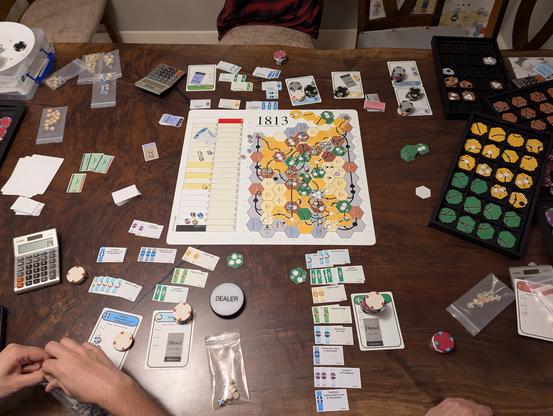
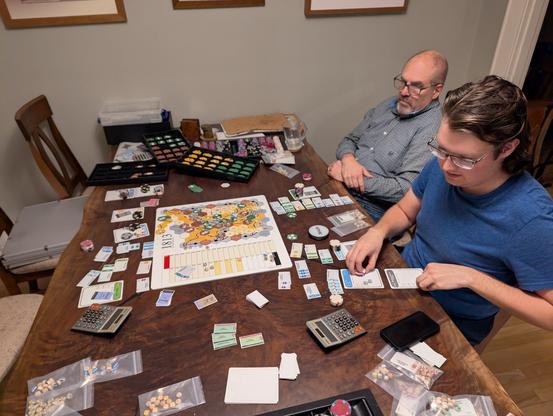
3-player 1813 using the simplified capital calls, reduced start packet and train roster brought back from Seattle.
Train counts (finally) seemed right. Starting capital wasn't clearly wrong. Stations were over-priced. Rotational priority isn't wrong. Par choices were meaningful. Cousins were slightly over-powered. The market....wasn't inactive, but also wasn't properly active (I think this changes with more players). Our bids on privates were so wrong. We didn't play well. 5 hours end-to-end.
Somewhat surprisingly, raw share count won it. The winner had just under 40 shares, with stock prices averaging just over $40 and mediocre routes. The other players had teens of shares, but with average share prices close or over $200. Share-count won.
(change description follows)