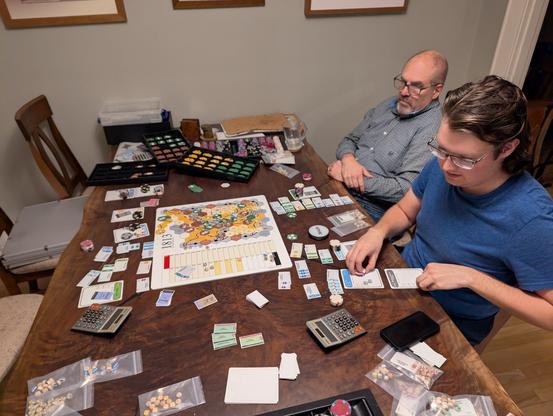
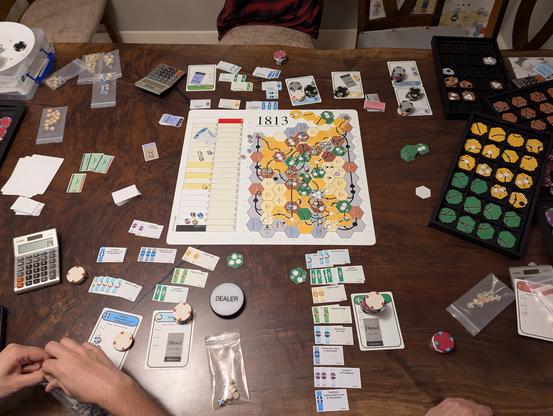
3-player 1813 using the simplified capital calls, reduced start packet and train roster brought back from Seattle.

Train counts (finally) seemed right. Starting capital wasn't clearly wrong. Stations were over-priced. Rotational priority isn't wrong. Par choices were meaningful. Cousins were slightly over-powered. The market....wasn't inactive, but also wasn't properly active (I think this changes with more players). Our bids on privates were so wrong. We didn't play well. 5 hours end-to-end.

Somewhat surprisingly, raw share count won it. The winner had just under 40 shares, with stock prices averaging just over $40 and mediocre routes. The other players had teens of shares, but with average share prices close or over $200. Share-count won.

(change description follows)
@18xx #18xx

@18xx The start packet has been reduced to:

  • 2 cousins (pay bonus revenue of their tile, or instead can lay for $free one $20 tile or upgrade, all owner's companies running the cousin get their bonus).,
  • 2 floated companies (ie 4 shares@$67) with locations determined during setup.,
  • A random selection of 3 of:
    • LtGreen train foundry (take two of the three $160 LtGreen trains, or $160 and discard a LtGreen train from the game).
    • DkGreen: A floated company (ie 4 shares$82) with location determined during setup.
    • LtBlue train foundry (take one of three $200 LtBlue trains or $200 to hand).
    • Brown train foundry (take one of two $600 brown trains, discard all trains company when assigned to a company).
    • Red train foundry (ditto, but one of two $700 red trains).,
  • Teleport allows floating a company without a concession anywhere on the map.
  • (4+ player only) DuchyOfLancaster (4 shares@$101 of a company in Lancaster, private is worth $2,000 at game end).,

So 8–9 items depending on player-count. All privates pay $20/OR except for the cousins, which start at $20/OR and can go up as their tile is upgraded. There are no set face values. Privates are sold with an 18Neb-style price-finding (hate this) auction (bids are any multiple or raises of $5, losing bids are returned to their players, all items are sold at their bids on an all-pass).

Priority is now rotational LOLA instead of pass-order.

#18xx

@18xx Yellow trains both price reduced. Current train roster:

  • Infinite LtYellow "2", $60 (all remaining discarded from supply at end of OR1).
  • 2 DkYellow "2E", $100.
  • 3 LtGreen "3", $240.
  • 2 DkGreen "3E", $300, rust LtYellow.
  • 3 LtBlue "5", $400, rust DkYellow.
  • 2 DkBlue "5E", $460, rust LtGreen.
  • 2 Brown "2x3+", $600, rust DkGreen.
  • 2 Red "2x4+", $700, rust LtBlue.
  • 4 Gray "Diesel", $900, rust DkBlue.
  • Infinite Purple "Diesel++", $1,200, rust Brown & Red.,

Train limit is 3 until brown, then it is 2 for the rest of the game. Dits count against length for # trains. E trains entirely ignore dits but still collect Cousin bonuses. +trains are infinite dits. ++ trains double dits and cousin bonuses. 2x trains are 2 trains of that type in a single cert and occupy 2 train slots against limit (so they fully occupy a company and are thus hard to buy horizontally).

Reds and browns are possibly under-priced. Trains after yellow are deliberately expensive/over-priced.

Capital calls are simplified (no 11th share):

  • Any shareholder of a sold-out company can do a Capital Call.
  • CMV to 150%.
  • All shareholders must pay the price delta per share or sell those shares at their original CMV.
  • New CMV is paid to treasury afterward.
  • Caller cannot sell out of company in that action.

#18xx

@18xx Mergers are unchanged:

  • Any two companies, both operated or both not.
  • New CMV of largest plus half smaller.
  • Singles trade up for delta, director first.
  • Combine/unify all assets.

Share redemption and the closed box are gone. Price movements are:

  • Up for paying CMV or more.
  • Up again for paying double CMV or more.
  • Down for paying less than CMV.
  • Down again for being trainless.
  • Down once per share sold.
  • Down once for any shares in pool at the end of SR.
  • Up for sold-out.

White area of stock market (under $67) requires two shares to be sold to move down. Plus movements as above for capital calls and mergers.

Receivership and train-leasing is gone. A trainless company has no possible income and just falls down the market until something gives it a train. There are no EMRs.

No more double buys for directors in any cases.

#18xx