Jack Krooss

19 Followers
49 Following
97 Posts
Retired electronics engineer. Interests include #media, #politics, #astronomy and #technology.

Just amazing!

This image of the dusty debris disk surrounding the young star Fomalhaut is from JWST’s Mid-Infrared Instrument. It reveals an inner belt, akin to the solar system's asteroid belt but dustier and more extended; an intermediate belt; and a previously imaged outer belt that's analogous to our Kuiper Belt. The inner two belts had never been imaged before.

https://skyandtelescope.org/astronomy-news/the-james-webb-space-telescope-reveals-fomalhauts-disk-in-unprecedented-detail/

#JWST #Fomalhaut #astronomy

The James Webb Space Telescope Reveals Fomalhaut's Disk In Unprecedented Detail

Continuing its run of discoveries, the James Webb Space Telescope has snapped the clearest images yet of the dusty disk around Fomalhaut.

Sky & Telescope

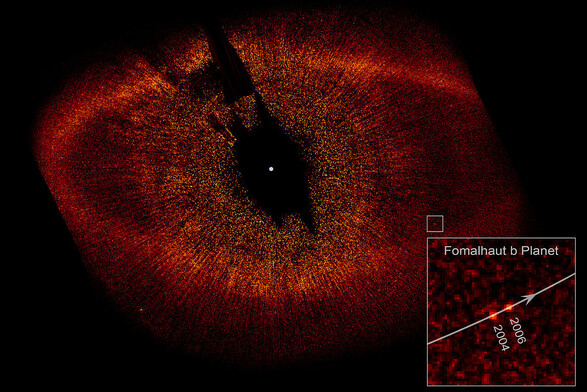
In 2008, the first 2 directly imaged exoplanet systems were announced, Fomalhaut b being one of them. (Also like...did they choose the Eye of Sauron colour scheme on purpose? I've always wanted to ask...)

https://en.wikipedia.org/wiki/Fomalhaut_b#/media/File:Fomalhaut_with_Disk_Ring_and_extrasolar_planet_b.jpg

Anyway, Fomalhaut's debris ring was eccentric, which is odd. Why would an asteroid belt be eccentric? Fomalhaut b provided an easy answer: it's gravitationally shepherding the eccentric ring. Makes perfect sense!

Fomalhaut b - Wikipedia

In light of the really impressive JWST observations of Fomalhaut that were released yesterday, I wanted to share my view of the Fomalhaut system. Story time!

Fomalhaut is a bright nearby star that has been known for decades to have a debris disk, a belt of dust caused by asteroids crashing into each other. Sounds very dramatic, but we see them all over the place! Our own Kuiper Belt and asteroid belt are extremely faint/low mass versions of debris disks we observe around other stars.

Loops of superheated plasma larger than the Earth dancing across the Sun, recorded by the Solar Dynamics Observatory spacecraft.

Credit: SDO/NASA Goddard
Further reading: https://www.nasa.gov/mission_pages/sdo/news/coronal-rain.html

SDO Shows A Little Rain On the Sun

On July 19, 2012, the sun treated viewers to one of its dazzling magnetic displays -- a phenomenon known as coronal rain.

NASA
A spectacular view of the International Space Station captured during a fly around by Space Shuttle Atlantis.

Late entry for my 2022 observatory summary thread!

Data captured in August/Sept. Had lots of trouble processing this one - the [OIII] "squid" in raw data is faint! Using Generalised Hyperbolic Stretch (first time for me) helped.

Ha part of this is catalogued as Sh2-129 (& probably other #'s 🤪). The "Squid" is catalogued as OU4 - from the (unofficial?) "Nicolas Outters" catalogue.

Someday I'd like to take another stab at processing this.

#astrophotography #astrodon #astronomy #nlskies2022

A full rotation of the Moon in high resolution created from photos captured by the Lunar Reconnaissance Orbiter spacecraft.

Source: https://apod.nasa.gov/apod/ap200719.html

Credit: LRO/ASU/NASA

APOD: 2020 July 19 - Rotating Moon from LRO

A different astronomy and space science related image is featured each day, along with a brief explanation.

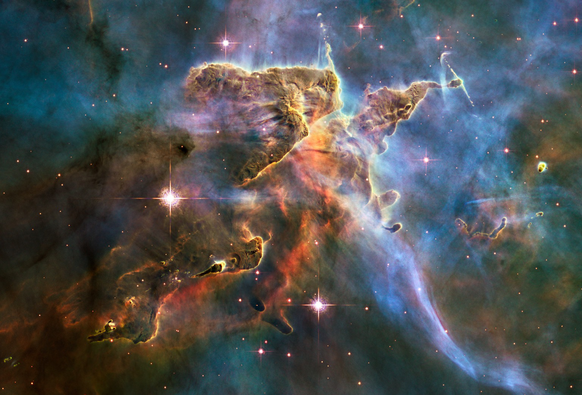
The Carina Nebula, in an image captured for Hubble's 20th anniversary back I n 2010. Good golly.

Image: NASA, ESA, and M. Livio, The Hubble Heritage Team and the Hubble 20th Anniversary Team

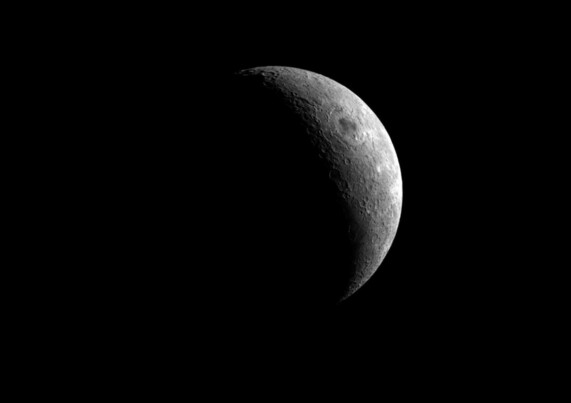
Here's a Moon phase you can never see from Earth: It's a crescent of the lunar farside, viewed from the Orion capsule aboard Artemis I. https://www.flickr.com/photos/nasa2explore/52521604633/in/album-72177720303788800/ #Orion #astronomy
Flight Day 7 -- Orion's Optical Navigation Camera Captures the Moon

Flickr
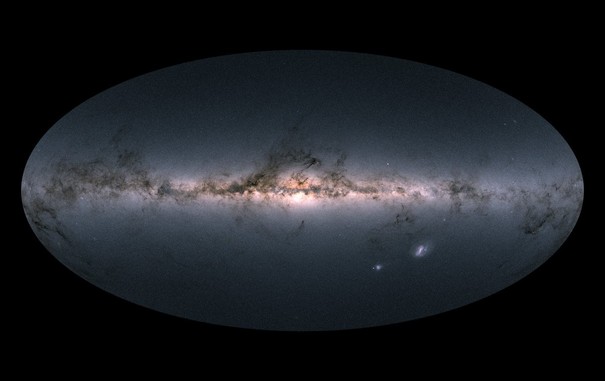
The Gaia space telescope has uncovered the "poor old heart of the Milky Way": the original clump of stars that formed more than 12.5 billion years ago and eventually gave rise to the galaxy we know today.
https://www.sciencenews.org/article/milky-way-galaxy-nucleus-oldest-stars-protogalaxy #astronomy #space
A protogalaxy in the Milky Way may be our galaxy’s original nucleus

Millions of ancient stars spanning about 18,000 light-years at the Milky Way’s heart are the kernel around which the galaxy grew, researchers say.

Science News