 Lutra Consulting
We are adding 3D globe view to @qgis thanks to the funding from Cesium.

It_me_greg
- 90 Followers
- 257 Following
- 136 Posts
GIS Lead at LiveBy Inc... serving up spatial data to the real estate industry. QGIS, PostGIS, etc, etc
 bikerouter.de
@giggls [2/3] The OpenCampingMap is an #OpenStreetMap based map that shows campsites, bivouac sites, and other overnight accommodations for cyclists, hikers and RV travelers.
Once the map layer is active, all campsites are displayed with icons. Clicking on an icon shows all relevant information about the campsite.
The feature is currently in beta but should mostly work. Available from zoom level 10.

 James Green
How much more do you need than "I sat at my desk analyzing lithic artifacts from Site 1234 every day"?
I then did, "On Monday I analyzed 461 flakes, 62 shatter & 5 points. On Tuesday I analyzed 502 flakes, 35 shatter, 3 points & 1 groundstone tool, etc."
I got called to the office. Management thought I was being flippant.
To me, this is just like Elon Musk. He has no idea what tasks government workers do, but he won't be satisfied with any answer they give him. 2/
IMO
 Dwight Silverman
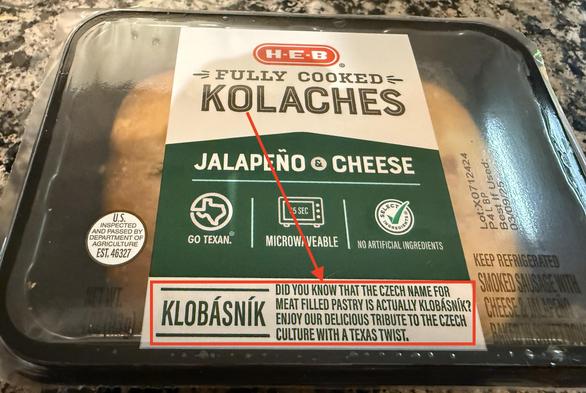
I love that H-E-B goes into "well, actually..." mode on this 2-pack of jalapeño-and-cheese kolaches, czechsplaining that the correct name is klobasnick. Most Texans just call them kolaches, but all Texans think they're delicious!
These aren't bad at all, but I wish they sold some with eggs in them. This is just sausage and bread.
HEB also sells a big bag of these, though the kolaches are smaller, with the same czechsplanation on it.
 Daniel P. Huffman
If you do any freelance mapping, you may want to check out the new Model Contract offered by the Alliance of Freelance Cartographers. It can help you get started or offer ideas to modify your existing contracts:
https://docs.google.com/document/d/1OOovTSd1yZe00qCaQHoxKsh_Mkutl0eFp8ex6kX0nXM/edit?usp=sharing
(Also I hurriedly made an AFC logo).

AFC Model Contract
Contract for Custom Cartographic Work A model contract offered by the Alliance of Freelance Cartographers This is a contract TEMPLATE, meant to guide you in the drafting of your own personal document. Parts in red should be filled out by you, the cartographer. We also recommend that you refo...
 OpenProject
OpenProject in Space: How Aerospace companies use OpenProject. 🌍✨
OpenProject is making its mark in the aerospace industry! 🚀
The current edition of @linuxmagazine features an article how Aerospace organizations rely on OpenProject for their project management.
OpenProject proves that open source software is a powerful tool even for the most complex space projects. 🌌
(German only): https://www.linux-magazin.de/ausgaben/2025/03/openproject-in-der-raumfahrt/
#OpenSource #SpaceTech #ProjectManagement #Aerospace #LinuxMagazin #OpenProject


Wie Firmen aus der Raumfahrtbranche OpenProject einsetzen
OpenProject ist eine der komplexeren Open-Source-Anwendungen und beweist auch in der Raumfahrtindustrie, dass Open Source selbst komplexen Aufgabenstellungen gewachsen ist. Für Science-Fiction-Fans gibt es nur wenige Themen, die spannender sind als die Frage nach außerirdischem Leben und mit welcher Antriebstechnik der Mensch dereinst die unendlichen Weiten des Weltalls überbrücken wird. Umso schöner, wenn Open-Source-Geeks feststellen, dass die „eigene“ Open-Source-Software sowohl beim Bau des fortschrittlichsten Antriebssystems für Satelliten als auch bei einer Jupitermission zum Einsatz kommt. So geschehen ist das bei der Berliner OpenProject GmbH [1]. Der Redmine-Fork firmiert seit 2012 unter dem neuen Namen und liegt als Community- sowie als (gehostete) Enterprise-Version vor. Im Rahmen zweier Auftragsarbeiten hat der Autor dieses Artikels herausfinden dürfen, wie wichtig den Kunden die Open-Source-Natur der Software ist, die sie zum Planen und Umsetzen ihrer Weltraummissionen verwenden. In einem Blogpost [2] durfte er beschreiben, wie die DSI Aerospace GmbH [3] aus Bremen OpenProject dazu verwendet, Speichermedien für Raumschiffe und Sensorik zu bauen, beispielsweise in Form von T-Shirts. Ein weiterer Blogpost [4] verschaffte ihm Einblicke in die Dresdener Morpheus Space GmbH [5], die sich auf den Ionenantrieb GO-2 [6] spezialisiert hat und nicht minder faszinierende Projekte wie den Missionsplaner JOURNEY [7] präsentiert. Ionenantrieb volle Kraft, Mr. Scott! Der Ionenantrieb GO-2 beschleunigt geladene Teilchen aus einer aufgeschmolzenen Metalllegierung durch ein elektrisches Feld auf extrem hohe Geschwindigkeit. Das ermöglicht hohe Energien bei kleiner Nutzlast (wenig „Treibstoff“) und eignet sich besonders für kleine und kleinste Satelliten. Seit sechs Jahren entwickelt Morpheus Triebwerke auf Basis des Feldemissionsantriebs (FEEP), vor allem weil herkömmliche Antriebssysteme nicht mehr genügen, um die typischen Probleme von Satelliten zu lösen. Im Erdorbit tummeln sich unzählige Trümmer. Wenn man nicht aufpasst, wird der eigene Satellit schnell ein Teil davon. Dafür baut Morpheus den Antrieb mit dem Star-Trek-Touch (Abbildung 1): „Unser Ionenantrieb GO-2 ist das einfachste, effizienteste und kostensparendste Antriebssystem, und es erlaubt Mobilität über die ganze Lebensspanne“, schwärmt Projektmanager Arne Riemer. Das Unternehmen entwickelt seine Prototypen in Dresden, betreibt dafür eigene Thermal-Vakuumkammern und Vibrationstesteinrichtungen. Erst im Juli 2024 hat die Firma neue Produktionsräume eröffnet, in denen 100 Ionenantriebe pro Jahr hergestellt werden sollen. Deutlich besser als Closed Source Riemer ist Projektmanager bei Morpheus, auch weil er es liebt, „Projekte zu strukturieren“. Vorher in der Flugzeugtechnik, arbeitet er seit über 10 Jahren in der Raumfahrt, und begründet seine Vorliebe so: „Wir nutzen OpenProject in der Cloud-Variante, hauptsächlich deshalb, weil uns MS Project nicht genug Agilität bieten konnte.“ Zudem sei OpenProject im Gegensatz zu Jira leicht zu administrieren, günstiger und unterstütze sowohl klassische, agile als auch hybride Methoden und Ansätze des Projektmanagements. Die wichtigste Rolle spielt für Morpheus eine typische Open-Source-Eigenschaft: „Ich kann es verbessern, wenn ich will, das ist halt das tolle bei OSS. Ich habe Ansprechpartner, kann Features forcieren und den Ablauf der Entwicklung stets nachvollziehen. Wenn ich mit Microsoft-Produkten ein Problem habe, muss ich wesentlich höhere Hürden überwinden, um Support zu erhalten, während sich Firmen wie OpenProject sehr schnell um meine Anfragen kümmern.“ Zwar finden bei Morpheus einige Arbeitsabläufe immer noch in Teams, OneNote und Gitlab statt, aber gerade bei den Tickets setze sich OpenProject gegen Konkurrenten wie
 Zuzana Chovanec
Exciting news for #duraeuropos #digital project #archaeology https://news.yale.edu/2022/12/13/digitally-rebuilding-lost-city

 Kenny Feder
Virtual book signing for my new book, Native American Archaeology In the Parks: A Guide to Heritage Sites in Our National Parks and Monuments. Dec 27, at 7:00 PM to 8:00 PM. 30% discount for registrants who would like to purchase the book directly from the publisher.
https://www.avonctlibrary.info/event/native-american-archaeology-in-the-parks-ken-feder/
https://www.avonctlibrary.info/event/native-american-archaeology-in-the-parks-ken-feder/
 ProPublica
Developers Found Graves in the Virginia Woods. Authorities Then Helped Erase the Historic Black Cemetery.
--
The cemetery’s disappearance cleared the way for the expansion of a #Microsoft data center, despite layers of federal and state #regulations nominally intended to protect culturally significant sites.
“This is not as bad as it sounds,” a consultant wrote in2014 to Microsoft & to a county official. “We should be able to relocate these graves.”
https://www.propublica.org/article/how-authorities-erased-historic-black-cemetery-virginia

Developers Found Graves in the Virginia Woods. Authorities Then Helped Erase the Historic Black Cemetery.
The cemetery’s disappearance cleared the way for the expansion of a Microsoft data center, despite layers of federal and state regulations nominally intended to protect culturally significant sites.
@coreysnipes do you know if ODM supports spherical/360 cameras? I'd like try to make some point clouds from Google Street View à la
https://www.researchgate.net/publication/330770978_ACCURACY_ASSESSMENT_OF_3D_MODELS_GENERATED_FROM_GOOGLE_STREET_VIEW_IMAGERY
...might be a little advanced for me lol