ISSRSensor

@issrsensor
1 Followers
0 Following
17 Posts
Chengdu Intelligent Sensor and System Technology Research Co., Ltd. (ISSR) was established in 2017. Our roots trace back to 2004, focusing on research and development of piezoelectric ceramic materials and intelligent sensors. Our factory boasts an annual production capacity exceeding 10 million units. We utilize advanced production equipment, including dry pressing, isostatic pressing, and spray granulation. Our facility also features various high-precision component processing methods.
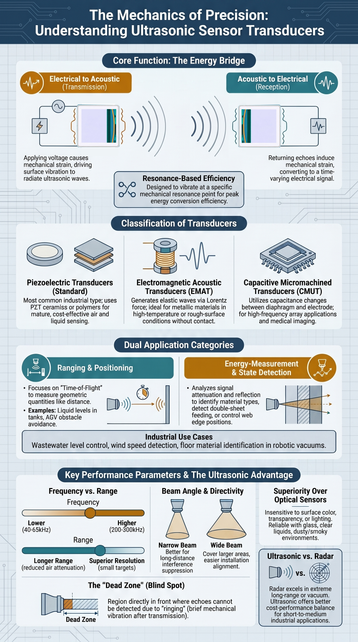
For ultrasonic distance/level sensing, reliability often hinges on the transducer, not just max range. It converts electrical → acoustic and echo → electrical. Many sensors can’t measure very close due to the dead zone / blind zone, driven by ringing (after-vibration) and transmit→receive blanking—early echoes get masked. When choosing, verify the minimum measurable distance plus frequency, sensitivity, and beam directivity.
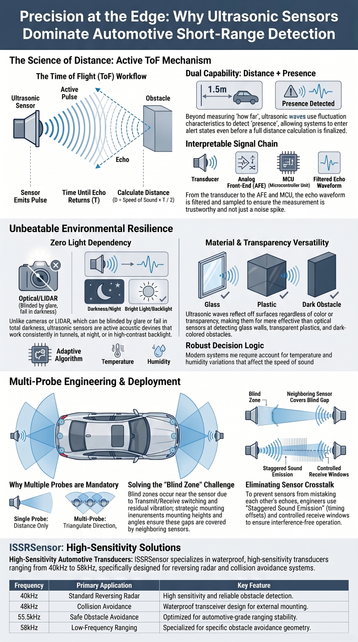
Short-range detection is an edge decision window. Ultrasonic sensors use active ToF: emit pulses, measure echo return time to get distance, and infer presence for earlier alerts. Echo-based sensing avoids light-dependency. With multi-probe coordination, blind-zone gaps and crosstalk are reduced. Built for automotive near-field use—ISSRSensor.
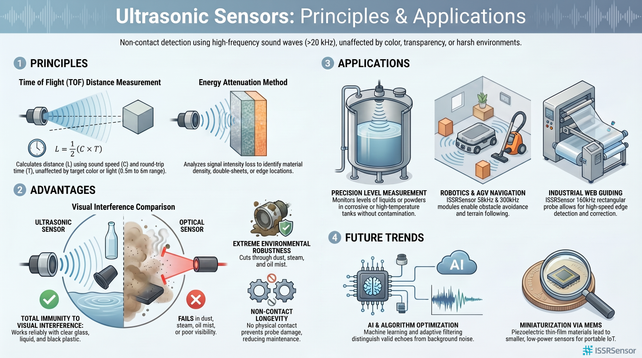
Ultrasonic sensors measure distance and presence using high-frequency sound waves—without being bothered by color, transparency, or harsh lighting.
This infographic breaks down two principles: TOF (Time of Flight) distance measurement and energy attenuation (signal strength).
See real applications like precision level measurement, robotics/AGV navigation, and industrial web guiding, plus future trends with AI & algorithm optimization.
https://issrsensor.com/how-does-an-ultrasonic-sensor-work/
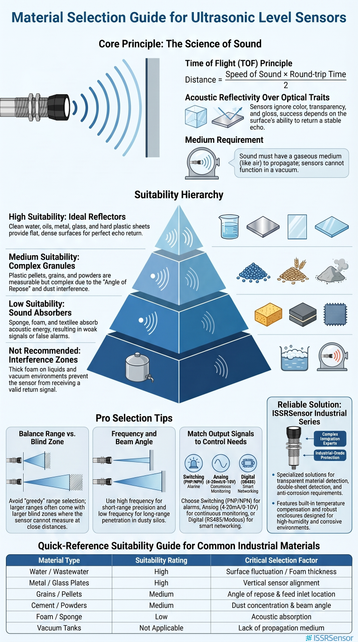
Ultrasonic level sensors don’t measure by color, transparency, or gloss. They rely on acoustic echo.
Water, oil, glass, and metal usually reflect sound well. Powders and grains need more care because of dust and uneven surfaces. Foam can absorb sound. Vacuum tanks are unsuitable because sound needs air.
Visual guide + more details:
https://issrsensor.com/what-materials-suit-ultrasonic-level-sensors/
#Sensors #Engineering
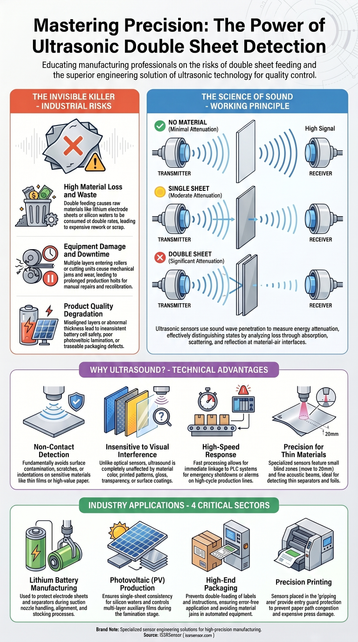
Stop manufacturing's "invisible killer"—double sheet feeding! Ultrasonic Double Sheet Detection uses non-contact sound waves to precisely distinguish single/double sheets, preventing waste, damage & quality issues. Fast, reliable, color/transparency-independent. Perfect for lithium battery, PV, packaging & precision printing. Ensure accuracy, master precision!
Read More: https://issrsensor.com/ultrasonic-double-sheet-detection-applications/
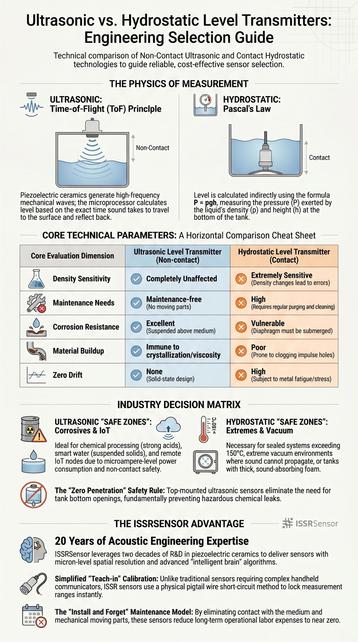
Struggling with critical level transmitter selection? Our latest infographic offers a clear comparison of Ultrasonic vs. Hydrostatic technologies! Understand key differences in measurement principles, core parameters (density sensitivity, maintenance, corrosion resistance, zero drift), and application "safe zones." ISSRSensor's advanced ultrasonic solutions, developed with decades of acoustic engineering expertise, provide reliable functionality for industrial processes. https://issrsensor.com/ultrasonic-vs-hydrostatic-level-transmitters-comparison/
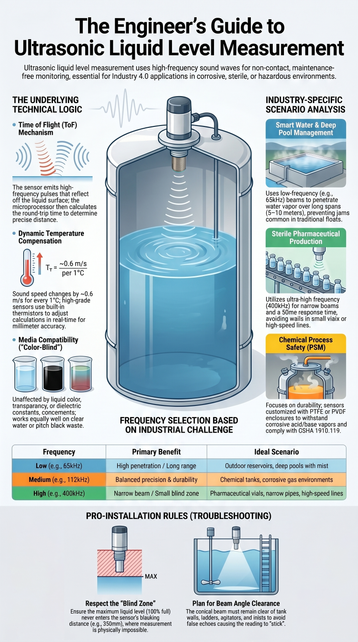
We’ve been working on making industrial tech a bit easier to visualize! 📊
If you’re an instrumentation nerd or just curious about how plants measure harsh liquids without touching them (hint: bouncing sound waves 〰️), check out this visual guide we designed on ultrasonic sensors.
It breaks down ToF physics, frequency selection, and some pro-installation rules.
Full technical notes on our blog if you want to dive deeper: https://issrsensor.com/ultrasonic-liquid-level-measurement-applications/
#Engineering #Automation #Sensors #Tech

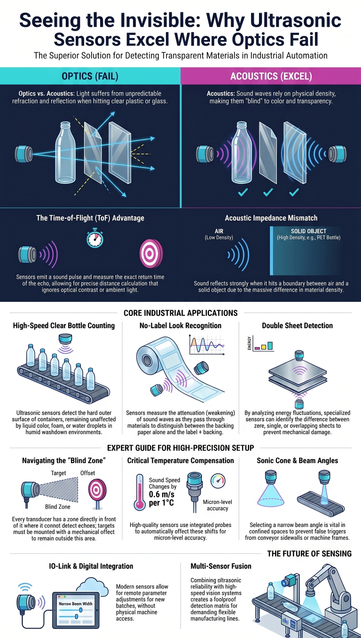
Struggling to detect clear bottles or film? Optical sensors fail here due to light refraction. The solution? Acoustics!

Our latest infographic shows why Ultrasonic Sensors excel where optics fail. Sound waves rely on density, making them "blind" to transparency. Perfect for double-sheet detection & high-speed clear container counting.

See the infographic below & read the full technical guide here:https://issrsensor.com/why-ultrasonic-detecting-transparent-objects/
#Automation #Manufacturing #UltrasonicSensors #IndustrialAutomation

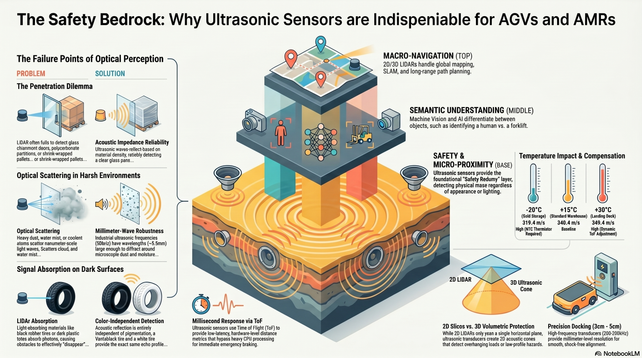
Scaling AMR fleets introduces acoustic signal challenges. In tight warehouse aisles, ultrasonic crosstalk causes phantom object detections and false stops, mitigated via Time-Division Multiplexing (TDM).

Additionally, a 30°C temp shift alters sound velocity by 18m/s, ruining ToF braking curves. Designing a robust AGV/AMR near-field perception logic inherently solves these thermal drifts and signal collisions via NTC compensation.

#Robotics #AMR #automation
https://issrsensor.com/agv-amr-near-range-obstacle-avoidance-logic/

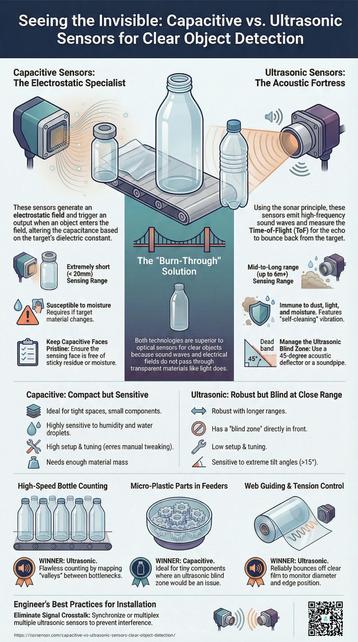
Optical sensors struggle with clear objects on the line because light just passes through them.

We compared the two best alternatives: Capacitive vs. Ultrasonic sensors. Our guide covers sensing ranges, immunity, and use cases (bottle counting vs. micro-plastics).

Stop false triggers and read our installation best practices here:
https://issrsensor.com/capacitive-vs-ultrasonic-sensors-clear-object-detection/

#Engineering #Automation #Sensors #IndustrialAutomation