16 Followers
4 Following
26 Posts
Yup'ik research engineer specialising in saltwater marine energy, energy balance, and residential heating in Alaska. Landscape photographer, aspiring cyclist & handy. He/they

If you're wondering why measuring fuel use would be so important, think about how much it costs to heat your home. Getting heat load characteristics of a building would allow for forecasting fuel consumption, seeing fuel offset from heating electrically from heat pumps/thermal batteries, weatherization impacts, better economic analysis, and so much more.

Especially with the push towards renewables, we can't forget our biggest bite from fossil fuels here in Alaska is heating.

It is estimated that ~70% of all energy consumed in Alaska goes into heat. Residential heating data is especially hard to come by because measured data is scant and non-transferable between buildings. The low flow rates of heaters also presents another challenge, with most flow meters that are capable are designed for industrial applications, cost thousands of dollars, and break into fuel lines.

So we designed something that can measure residential fuel consumption, doesn't break into fuel lines, and costs around $200. https://www.mdpi.com/1424-8220/23/12/5664

(This is also my first peer reviewed publication and I'm super excited to finally be published)

Noninvasive Fuel Flow Monitoring System for Vented Fuel Oil Heaters

In this work, we present hardware and firmware design and preliminary testing results for a noninvasive device for measuring fuel oil consumption in fuel oil vented heaters. Fuel oil vented heaters are a popular space heating method in northern climates. Monitoring fuel consumption is useful to understanding residential daily and seasonal heating patterns and understanding the thermal characteristics of buildings. The device is a pump monitoring apparatus (PuMA) that employs a magnetoresistive sensor to monitor the activity of solenoid driven positive displacement pumps, which are commonly used in fuel oil vented heaters. PuMA accuracy for calculating fuel oil consumption was evaluated in a lab setting and found to vary up to 7% from the measured consumption value during testing. This variance will be explored more in field testing.
MDPI

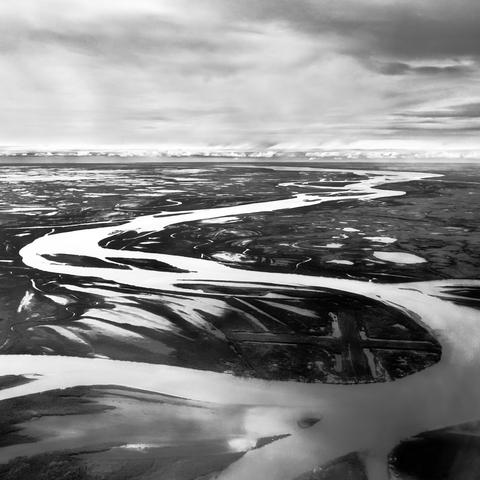
Kusquqvak (Kuskokwim river) photo from above.

The name likely comes from the deep root "ku-" (relating to flow, current, and/or liquid), -squq- (most likely an uncommon, nonproductive postbase meaning small), and -vak (meaning big). All of those together mean "big thing with small flow/current." The English word comes from the relative case use of the noun. Because the name uses a deep root and an archaic postbase, it is probably one of the older placenames in the Yup'ik language.

@rajnr it's nothing of concern as of yet. Cold weather and choppy seas aren't conducive to herring spawn; it's just unusual that this hasn't happened in a while
@hackerfactor not a serious concern, just notable since it's something that hasn't happened in some time

For the first time in around a decade, the first run of herring has not reached Tununak by June 1st, (technically Uyaqerruaq, "Chinit Point" on USGS maps, a few miles north of the village).

While this would be considered normal pre-2000s, it's a bit late in recent times.

@AlaskaWx @Climatologist49

A storm in January weathered tundra vegetation from upper elevations of Nelson Island and deposited it in the lower valleys near Tununak. No one has recalled this ever happening before in their lifetime, at least 50+ years. Now, it's slowing the snow melt and is a pain to clean up around subsistence processing areas.

Akalria: "thing that rolls" contemporary bike art based on classic Yup'ik ellanguat (circle-and-dot style, lit. "fake universes")

The writing says "Akalria" in Uyaquq's syllabary. Uyaquq went from illiterate to inventing a reproducible writing system in 5 years at the turn of the 20th century.

#alaska #nativeart

Today is Elizabeth Peratrovich day in #Alaska. A Łingit woman, her famous speech was key in passing the 1945 Anti-Discrimination Act.

"I would not have expected that I, who am barely out of savagery, would have to remind gentlemen with 5,000 years of recorded civilization behind them, of our Bill of Rights."

was a response to:

"Who are these people, barely out of savagery, who want to associate with us whites, with 5,000 years of recorded civilization behind us?" —Senator Allen Shattuck

Saw the first convertible of the year with it's roof down today at a balmy 25°F (1/29/23)