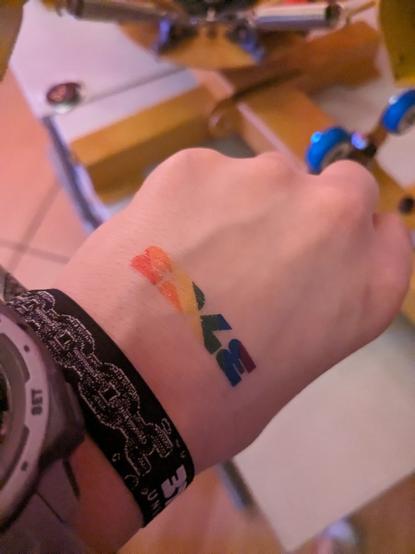
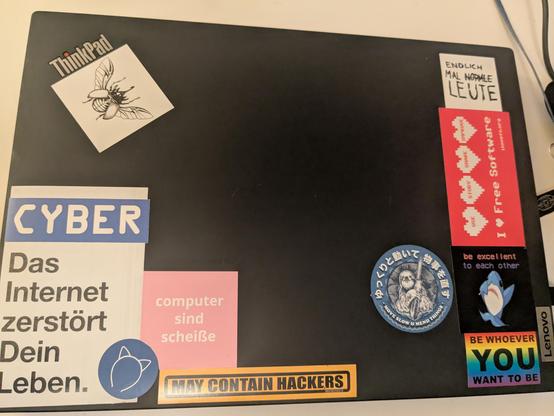
got a new-old laptop with a severe lack of stickers today. conveniently, #38c3 just happened.
good start? :)
good start? :)

| who? | https://happyturtlethings.net/ |
| where? | eu/germany |
| why? | ¯\_(ツ)_/¯ |

I've been thinking about this tidbit from Data Is Plural for /days/ now. Magical stuff, @fbartos , thank you. 😅

Many people have flipped coins but few have stopped to ponder the statistical and physical intricacies of the process. We collected $350{,}757$ coin flips to test the counterintuitive prediction from a physics model of human coin tossing developed by Diaconis, Holmes, and Montgomery (DHM; 2007). The model asserts that when people flip an ordinary coin, it tends to land on the same side it started -- DHM estimated the probability of a same-side outcome to be about 51\%. Our data lend strong support to this precise prediction: the coins landed on the same side more often than not, $\text{Pr}(\text{same side}) = 0.508$, 95\% credible interval (CI) [$0.506$, $0.509$], $\text{BF}_{\text{same-side bias}} = 2359$. Furthermore, the data revealed considerable between-people variation in the degree of this same-side bias. Our data also confirmed the generic prediction that when people flip an ordinary coin -- with the initial side-up randomly determined -- it is equally likely to land heads or tails: $\text{Pr}(\text{heads}) = 0.500$, 95\% CI [$0.498$, $0.502$], $\text{BF}_{\text{heads-tails bias}} = 0.182$. Furthermore, this lack of heads-tails bias does not appear to vary across coins. Additional analyses revealed that the within-people same-side bias decreased as more coins were flipped, an effect that is consistent with the possibility that practice makes people flip coins in a less wobbly fashion. Our data therefore provide strong evidence that when some (but not all) people flip a fair coin, it tends to land on the same side it started.