 Cédric Scherer
It's on! The first of two workshops at #positconf2023 is running 👐

david coynel
- 65 Followers
- 85 Following
- 35 Posts
Brain networks and MRI enthusiast. Division of Cognitive Neuroscience, University of Basel, Switzerland.

How can we reduce the climate costs of OHBM? A vision for a more sustainable meeting | Published in Aperture Neuro
By Samira Epp, Heejung Jung & 10 more. In this report, authored by the Sustainability and Environment Action Special Interest Group (SEA-SIG), we analysed the carbon footprint of previous Organization for Human Brain Mapping (OHBM) meetings.
Two great pieces on the impact of neuroimaging research on the climate:
 Matthias Nau
Our paper on #DeepMReye - Magnetic resonance-based eye tracking using deep neural networks - was just made #OpenAccess by @NatureNeuro
It was originally published under the wrong license in 2021. This release closes the circle and makes code, data, and paper accessible to everyone! #OpenScience
Code: https://github.com/DeepMReye/DeepMReye
Data: https://osf.io/mrhk9/
Paper: https://www.nature.com/articles/s41593-021-00947-w
w/ co-authors @cyhsm & Christian Doeller

 Daniel Lakens
Pilot studies are your friend. They will inform you about how participants interpret your instructions and questions, and identify where you need to adjust your analysis plan. It's very difficult to write a good preregistration without a pilot study.
what an interesting paper: "Geometric constraints on human brain function" -> it is possible to reconstruct cortical activity based solely on geometric properties of the cortex! Better than with connectome data, and with a simpler model. So much to uncover.

 Brian Nosek
This shows the percentage of all papers in dimensions.ai database that mention preregistration or a synonym by year and by social-behavioral science discipline.
Growth over the time period ranges from a low of 152% in education to a high of 7303% in psychology.
another interesting investigation of brain-behavior relationships: task- or rest-based functional connectivity don't really explain individual performance. Where to go from here: multi-modal, different tasks, different population...?
 Dan Quintana
Our new paper on brain-based gene expression of putative risk genes for anorexia nervosa is now online in Molecular Psychiatry 🎉 https://www.nature.com/articles/s41380-023-02110-2
View-only PDF version: https://rdcu.be/dcKNk
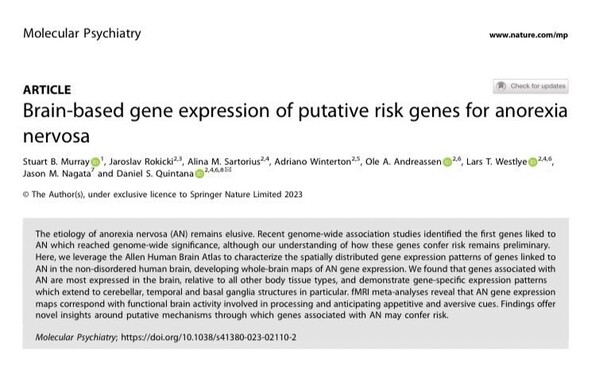
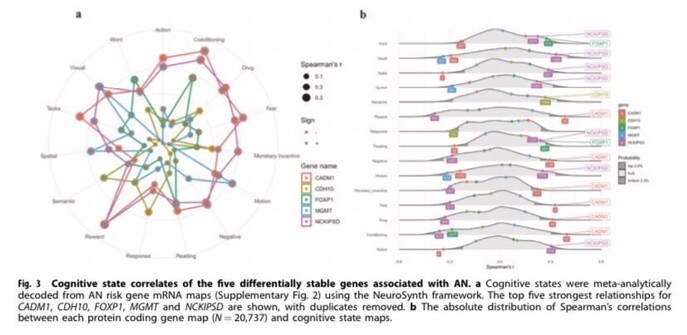

Brain-based gene expression of putative risk genes for anorexia nervosa - Molecular Psychiatry
The etiology of anorexia nervosa (AN) remains elusive. Recent genome-wide association studies identified the first genes liked to AN which reached genome-wide significance, although our understanding of how these genes confer risk remains preliminary. Here, we leverage the Allen Human Brain Atlas to characterize the spatially distributed gene expression patterns of genes linked to AN in the non-disordered human brain, developing whole-brain maps of AN gene expression. We found that genes associated with AN are most expressed in the brain, relative to all other body tissue types, and demonstrate gene-specific expression patterns which extend to cerebellar, temporal and basal ganglia structures in particular. fMRI meta-analyses reveal that AN gene expression maps correspond with functional brain activity involved in processing and anticipating appetitive and aversive cues. Findings offer novel insights around putative mechanisms through which genes associated with AN may confer risk.