

František Bartoš

@fbartos
396 Followers
205 Following
16 Posts
PhD Candidate | Psychological Methods at University of Amsterdam | interested in statistics, meta-analysis, and publication bias
Webhttps://www.frantisek-bartos.info/
GitHubhttps://github.com/FBartos
Scholarhttps://scholar.google.com/citations?user=vAo-APsAAAAJ&hl=en

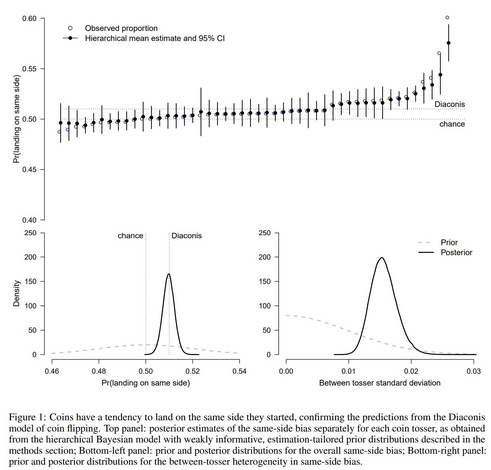
We also found considerable variance in the same-side bias between our 48 tossers. The bias varied with a standard deviation of 1.6%, CI [1.2%, 2.0%], in our sample. The variation could be explained by a different degree of "wobbliness" between our tossers.

The manuscript is at arXiv: https://arxiv.org/abs/2310.04153
And the open data, code, and video recordings at OSF: https://osf.io/pxu6r/.

Fair coins tend to land on the same side they started: Evidence from 350,757 flips

Many people have flipped coins but few have stopped to ponder the statistical and physical intricacies of the process. We collected $350{,}757$ coin flips to test the counterintuitive prediction from a physics model of human coin tossing developed by Diaconis, Holmes, and Montgomery (DHM; 2007). The model asserts that when people flip an ordinary coin, it tends to land on the same side it started -- DHM estimated the probability of a same-side outcome to be about 51\%. Our data lend strong support to this precise prediction: the coins landed on the same side more often than not, $\text{Pr}(\text{same side}) = 0.508$, 95\% credible interval (CI) [$0.506$, $0.509$], $\text{BF}_{\text{same-side bias}} = 2359$. Furthermore, the data revealed considerable between-people variation in the degree of this same-side bias. Our data also confirmed the generic prediction that when people flip an ordinary coin -- with the initial side-up randomly determined -- it is equally likely to land heads or tails: $\text{Pr}(\text{heads}) = 0.500$, 95\% CI [$0.498$, $0.502$], $\text{BF}_{\text{heads-tails bias}} = 0.182$. Furthermore, this lack of heads-tails bias does not appear to vary across coins. Additional analyses revealed that the within-people same-side bias decreased as more coins were flipped, an effect that is consistent with the possibility that practice makes people flip coins in a less wobbly fashion. Our data therefore provide strong evidence that when some (but not all) people flip a fair coin, it tends to land on the same side it started.

arXiv.org
We found overwhelming evidence for a "same-side" bias predicted by Diaconis and colleagues in 2007: If you start heads-up, the coin is more likely to land heads-up and vice versa. How large is the bias? In our sample, the mean estimate is 50.8%, CI [50.6%, 50.9%].

About a year ago, we embarked on a quest to answer one of the most intriguing questions:

If you flip a fair coin and catch it in hand, what's the probability it lands on the same side it started?

Today, we are finally ready to share the results. Thanks to my friends, collaborators, and even strangers from the internet, we collected flippin 350,757 coin flips. We ran several "Coin Tossing Marathons" (e.g., https://youtu.be/3xNg51mv-fk?si=o2E3hKa-ReXodOmc) and spent countless hours flipping coins.
Coin Tossing Marathon (4th of December 2022)

YouTube

Have you ever tossed a coin to settle a bet and wondered which side to choose?

Diaconis proposed model predicting ~1% bias in favor of the starting side up. However, no one has collected a large enough data set to test this hypothesis YET.

Watch us do it https://www.twitch.tv/cointossingteam

We are a bunch of researchers coin tossing from 9am to 9pm CET today. Yes, this is a ridiculous project but what is life about when you don't do something stupid from time to time?

CoinTossingTeam - Twitch

The Coin-Tossing Marathon

Twitch