Our new study shows that SARS-CoV-2 spike protein accumulates & persists in the body for years after infection, especially in the skull-meninges-brain axis, potentially driving long COVID. mRNA vaccines help but cannot stop it🔬🧠🦠🧵👇@cellhostmicrobe https://www.cell.com/cell-host-microbe/fulltext/S1931-3128%2824%2900438-4
Ali Maximilian Ertürk
- 163 Followers
- 405 Following
- 29 Posts
Director at Helmholtz Munich, Prof LMU- generating technologies to treat major health problems. We focus on tissue clearing technologies, and combine them with AI and spatial omics for new diagnostic and therapeutic tools. We are 🇺🇦🇩🇪🇹🇷🇭🇷🇨🇳🇮🇹🇮🇳🇸🇮🇴🇲🇨🇱🇭🇺🇧🇬🇷🇴🇦🇹🇹🇼🏳🌈www.erturk-lab.com
 Claire Lamman
For this year's gingerbread I made... Curiosity!
#space #gingerbread #nasa #mars #curiosity #baking #astronomy
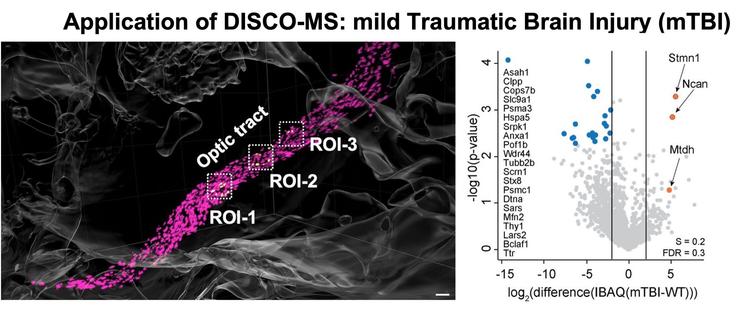
Example application 1:
To illustrate the utility of DISCO-MS, we first characterized microglia activation after traumatic brain injury. We identified numerous proteins that were differentially regulated between equivalent regions along the optical tract in damaged and healthy brains.
To illustrate the utility of DISCO-MS, we first characterized microglia activation after traumatic brain injury. We identified numerous proteins that were differentially regulated between equivalent regions along the optical tract in damaged and healthy brains.
Step 4:
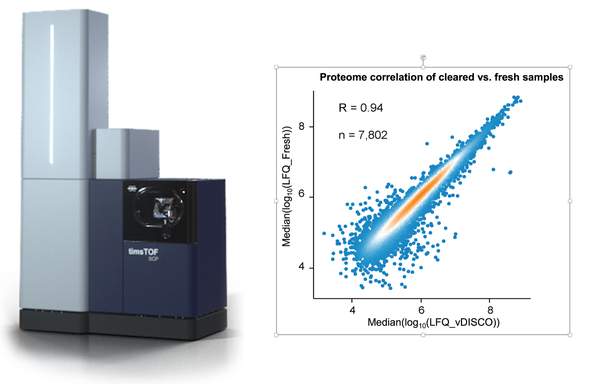
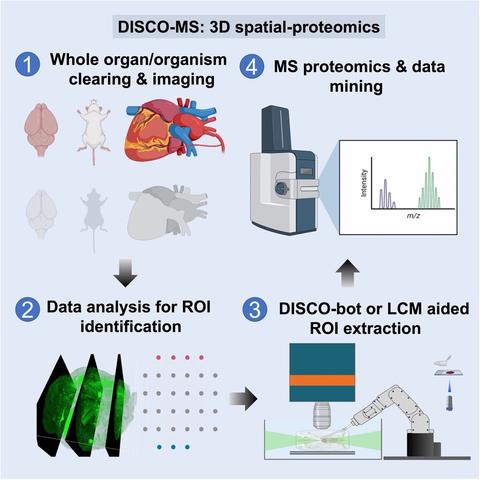
Next, the molecular composition of the tissue isolates is analyzed using high-sensitivity mass-spectrometry. The cellular proteome measured in cleared tissue is almost indistinguishable from the one obtained from fresh or fixed tissue controls.
Next, the molecular composition of the tissue isolates is analyzed using high-sensitivity mass-spectrometry. The cellular proteome measured in cleared tissue is almost indistinguishable from the one obtained from fresh or fixed tissue controls.
Step 3:
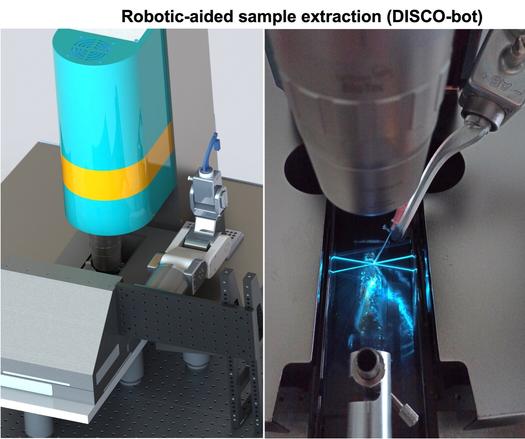
Small tissue regions are isolated with the help of a specialized robotic extraction system called DISCO-bot. Samples can currently be as small as 0.014 mm3. Smaller samples (down to 0.0005 mm3 or 60 cells) can be analyzed using laser capture microdissection.
Small tissue regions are isolated with the help of a specialized robotic extraction system called DISCO-bot. Samples can currently be as small as 0.014 mm3. Smaller samples (down to 0.0005 mm3 or 60 cells) can be analyzed using laser capture microdissection.
Step 2:
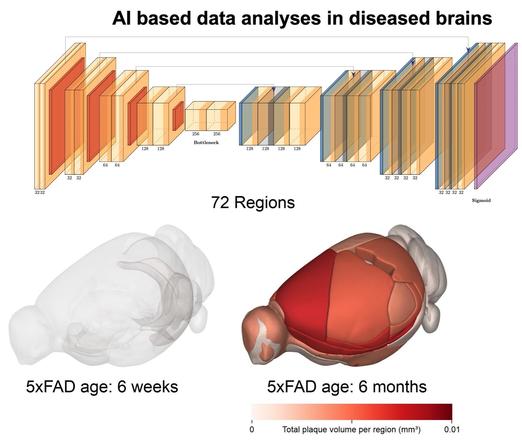
Next, we employ deep learning-based image analysis to identify regions associated with illnesses such as Alzheimer’s disease, brain injury, or coronary artery disease in an unbiased manner.
Next, we employ deep learning-based image analysis to identify regions associated with illnesses such as Alzheimer’s disease, brain injury, or coronary artery disease in an unbiased manner.
Step 1:
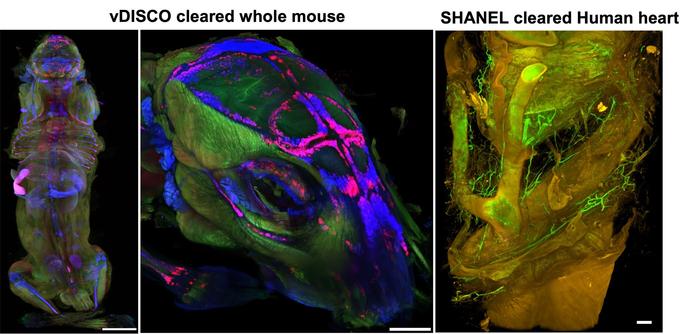
We start by rendering a mouse body or human organ optically transparent using robust clearing methods such as vDISCO or SHANEL. Then, after their cell-level light-sheet microscopy scan, we can visualize fluorescently-labeled structures in 3D as complete.
We start by rendering a mouse body or human organ optically transparent using robust clearing methods such as vDISCO or SHANEL. Then, after their cell-level light-sheet microscopy scan, we can visualize fluorescently-labeled structures in 3D as complete.
Summary:
DISCO-MS is a spatial proteomics technology: it enables proteomics analysis of cleared tissues imaged in 3D. DISCO-MS is aided by AI and robotics and yields proteome similar to fresh or fixed samples.
Have questions? Add below👇 we will answer📖
DISCO-MS is a spatial proteomics technology: it enables proteomics analysis of cleared tissues imaged in 3D. DISCO-MS is aided by AI and robotics and yields proteome similar to fresh or fixed samples.
Have questions? Add below👇 we will answer📖
Spatial-omics goes 3D🤗! Out at Cell 👉🏼 We developed DISCO-MS with @labs_mann, a spatial proteomics technology for specimens fully imaged in 3D. DISCO-MS is aided by robotics and enables the study of diseases at their early stages. @cellpress https://www.cell.com/cell/fulltext/S0092-8674(22)01465-9
🧵👇
🧵👇
 Esra Öz
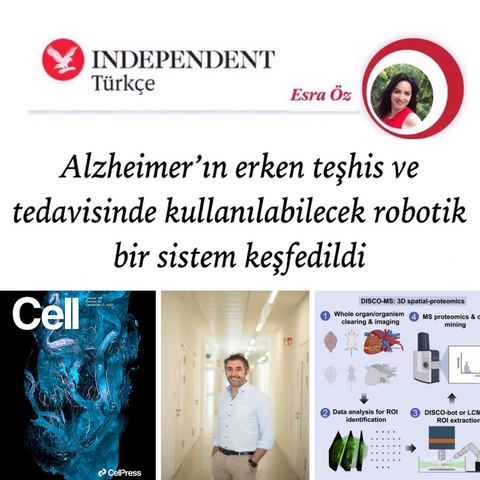
🧠Alzheimer’ın erken teşhis ve tedavisinde kullanılabilecek robotik bir sistem keşfedildi
Almanya Helmholtz Enstitüsü Direktörü Prof. Dr. Ali @erturk, dünyada bir ilke imza atarak DISCO MS adındaki robotik sistemi geliştirdi.
🔗 https://www.indyturk.com/node/591206#
📹 https://youtu.be/IdEkJ5x7S_4

VİDEO | Alzheimer’ın erken teşhis ve tedavisinde kullanılabilecek robotik bir sistem keşfedildi
Almanya Helmholtz Enstitüsü Direktörü Prof. Dr. Ali Ertürk, dünyada bir ilke imza atarak DISCO MS adındaki robotik sistemi geliştirdi. Cell dergisine kapak olan araştırmada, Alzheimer'ın erken teşhis ve tedavisinde kullanılacak robotik bir sistem keşfedildi. Bu sayede Alzheimer'a ya da kalp krizine neden olan bütün plaklara bakmak mümkün olurken, erken evrede oluşan plaklar da tespit edilebiliyor. Independent Türkçe için Prof. Dr. Ali Ertürk ile Alzheimer'ın erken teşhis ve tedavisinde kullanılacak robotik bir sistem hakkında konuştuk.