
Theodore A Hoppe

4 Followers
45 Following
15 Posts
Refuge from the Twitter Wars
https://twitter.com/tahoppe05404

From #Animbehav2023 conference

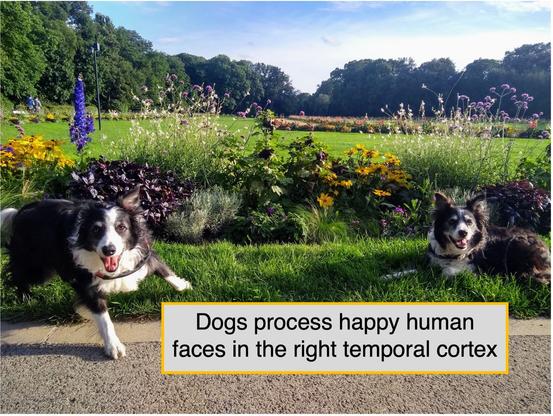
Dogs process happy human faces in the right temporal cortex

My beloved dogs, Odín and #Kun-kun, thrive in the charming city of Budapest because Hungarians have a special fondness for dogs, always showing them a smile.

We studied the dog brain's response to emotional human faces, starting with happiness.
1/n
#neuroscience #caninescience #dogsofmastodon #thread

New study uncovers how a unique, fast synapse keeps us from falling

https://news.rice.edu/news/2023/inner-ear-has-need-speed

Inner ear has a need for speed

Rice bioengineers and applied physicists, together with and colleagues at the University of Chicago and the University of Illinois Chicago, have unlocked the mechanism of the fastest synapses in the human body. A previously hidden mechanism in the inner ear that helps mammals balance via the fastest-known signal in the brain, and researchers from Rice University, the University of Chicago and the University of Illinois Chicago have modeled a hidden mechanism in the inner ear that helps mammals balance via the fastest-known signal in the brain.

Rice News | News and Media Relations | Rice University

I keep saying journalists should leave Twitter and use Mastodon, which is better for them in every way. At TechDirt I've posted a somewhat lengthy why-and-how: https://www.techdirt.com/2023/01/04/journalists-and-others-should-leave-twitter-heres-how-they-can-get-started/

#journalism #twitterexodus

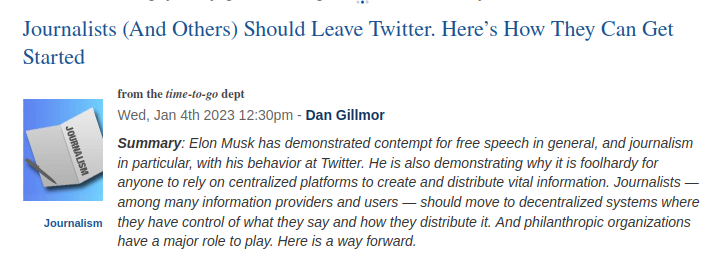
Journalists (And Others) Should Leave Twitter. Here’s How They Can Get Started

Summary: Elon Musk has demonstrated contempt for free speech in general, and journalism in particular, with his behavior at Twitter. He is also demonstrating why it is foolhardy for anyone to rely …

Techdirt

This is one of the most baffling illusions I’ve ever seen.

https://whyevolutionistrue.com/2014/09/02/why-do-the-dots-disappear/

Why do the dots disappear?

This is one of the most baffling illusions I’ve ever seen. Take a look at the gif below.  First, look at any yellow dot as the figure moves. The yellow dot remains present and stationary. If …

Why Evolution Is True
The new study, published in the Journal of Neurophysiology, suggests that voice and face recognition are linked even more intimately than previously thought.
https://www.upmc.com/media/news/010323-to-identify-a-voice
To Identify a Voice, Brains Rely on Sight

A neuroscience study from Pitt asked participants to identify U.S. presidents by their voice. Results suggest that voice and face recognition in the brain are intimately linked.

UPMC | Life Changing Medicine
Because I keep reading that Escher's work entered the public domain today.
From 2003: http://www.andrewlipson.com/escher/relativity.html
Escher's "Relativity" in LEGO

Understanding the effects of serotonin in the brain through its role in the gastrointestinal tract
https://pubmed.ncbi.nlm.nih.gov/35869620/
Understanding the effects of serotonin in the brain through its role in the gastrointestinal tract - PubMed

The neuromodulatory arousal system imbues the nervous system with the flexibility and robustness required to facilitate adaptive behaviour. While there are well understood mechanisms linking dopamine, noradrenaline and acetylcholine to distinct behavioural states, similar conclusions have not been a …

PubMed
My New Years' resolution is to make the adjustment from Twitter to Mastodon, which has been difficult for me for whatever reason.
I am just an old dog who has difficulties learning new tricks I guess.

People judge humans & machines using two different moral philosophies: Machines by outcomes & humans by intentions.
A new working paper on why.

https://arxiv.org/abs/2210.10081

Why people judge humans differently from machines: The role of perceived agency and experience

People are known to judge artificial intelligence using a utilitarian moral philosophy and humans using a moral philosophy emphasizing perceived intentions. But why do people judge humans and machines differently? Psychology suggests that people may have different mind perception models of humans and machines, and thus, will treat human-like robots more similarly to the way they treat humans. Here we present a randomized experiment where we manipulated people's perception of machine agency (e.g., ability to plan, act) and experience (e.g., ability to feel) to explore whether people judge machines that are perceived to be more similar to humans along these two dimensions more similarly to the way they judge humans. We find that people's judgments of machines become more similar to that of humans when they perceive machines as having more agency but not more experience. Our findings indicate that people's use of different moral philosophies to judge humans and machines can be explained by a progression of mind perception models where the perception of agency plays a prominent role. These findings add to the body of evidence suggesting that people's judgment of machines becomes more similar to that of humans motivating further work on dimensions modulating people's judgment of human and machine actions.

arXiv.org

Interesting discussion on #ResearchAssessment

'Machine learning, #metrics and merit: the future of research assessment'

With a summary of the recent report: 'Harnessing the Metric Tide: indicators, infrastructures & priorities for UK responsible research assessment.'

Panels: https://www.youtube.com/watch?v=q7TfNREqDJE

Report: https://rori.figshare.com/articles/report/Harnessing_the_Metric_Tide/21701624

Machine learning, metrics and merit: the future of research assessment

YouTube