 Christine Lemmer-Webber
How Decentralized Is Bluesky Really? https://dustycloud.org/blog/how-decentralized-is-bluesky/
A technical deep-dive, since people have been asking me for my thoughts. I'll expand a bit on some of the key points here in a thread. 🧵
| Website | https://store.rupertstudios.com |
| pronouns | He/Him |
How Decentralized Is Bluesky Really? https://dustycloud.org/blog/how-decentralized-is-bluesky/
A technical deep-dive, since people have been asking me for my thoughts. I'll expand a bit on some of the key points here in a thread. 🧵
Let's take a break, the analysis of server costs is boring and I don't like doing it, and I'm sure people will throw numbers at me of the absolute race-to-the-bottom hosting numbers they can find to store and run all this stuff, but really that's not interesting to me.
Let's do a comparison.
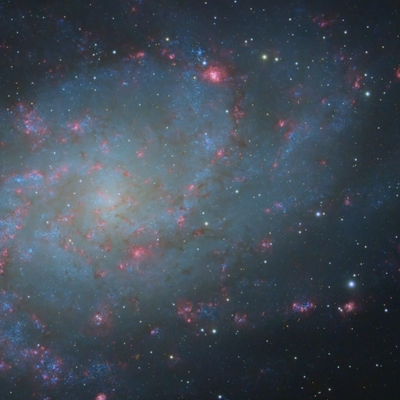
NGC 1499 (aka California nebula) is an emission nebula visible in the constellation Perseus. The bright star is Menkib (Xi Persei), visible to the naked eye. 25h cumulated exposure from my backyard, in the north of Montpellier (south of France).
More technical details: https://www.astrobin.com/wha8qc/
Bling!
I managed to get some decent data on Orion last month with the Moon out of the way.
On the left is Orion’s belt with the 🔥 and 🐴 nebulae. On the right is Orions 🗡️ with the 🏃🏼 and Orion nebulae.
All of this is embedded a giant dusty gassy star forming region and if your eyes could stare for hours and add up all the light, this is what you’d see.
Nothing super special about this image, except I used a brand new process for me. Instead of using DBE, GraXpert, or any other software solution for fraudulent removal, I used a process called Multiscale Gradient Correction and described in this tutorial: https://pixinsight.com/tutorials/multiscale-gradient-correction/index.html
It's a little complicated to go through the process, but the gist of the idea is that on a wide image you can correct the gradients better over a small area compared to a tighter field of view. So you take a wider image, correct the gradients, then subtract the corrected wider field from the tight field to give you only the gradients, which you subtract from your tight field image.
I was pleasantly surprised at how well it worked, taking out gradients I didn't realize were there. It made me want to take a wide field shot of all my targets so I can correct gradients better.
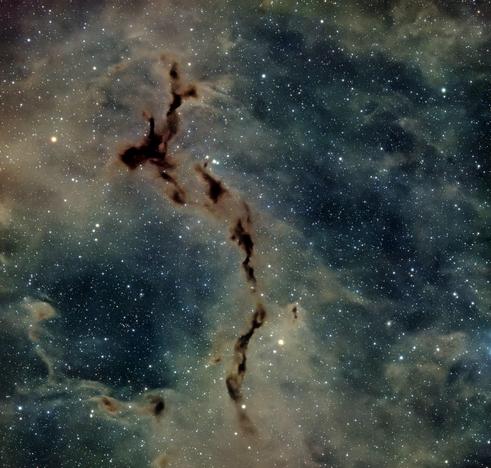
Not completely happy with this yet, but it'll be a while before I can get any more data on it as the moon waxes past 50% full. There's so much dust around the outside of this image, but it's just too noisy to bring it out as much as I want. Thankfully, this is early in the season for targets in Orion, so I should have at least a couple more new min cycles to add data.
This is the Casper the Friendly Ghost Nebula. I didn't really see the ghost, but I still think it's cool.
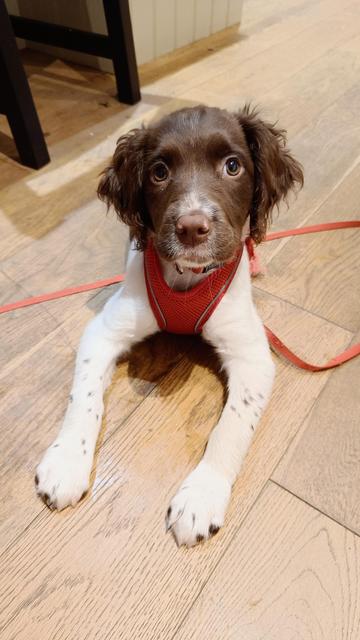
After having her second vacc early last week, Rosey Bean has LOVED her newfound freedom this week.
She's been on foot in the village for the first time, went to the fab Greenhead Park in Huddersfield on Thurs, and did a short loop at Scammoden Reservoir today.
Most importantly, she's been getting to meet dogs. Everyone has been very well behaved with her, and she became instant BFFs with a 7 month old cocker: it was lovely watching them play together 😁
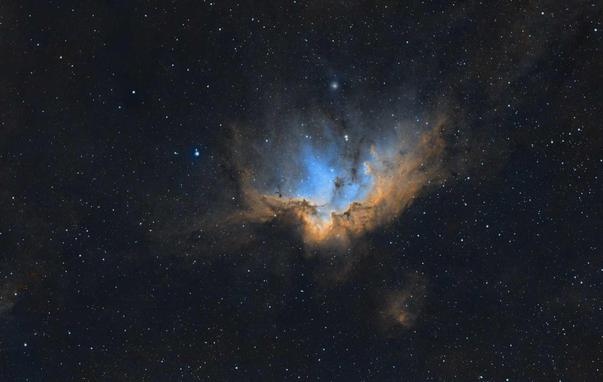
Distraction time 😬. Collected this data in October but decided to process it yesterday.
The Wizard Nebula can be found to the right of constellation Cassiopeia.
Could probably stretch out a bit more detail in processing, but happy enough with this version (for now!).
Continuing to make good progress configuring NINA (and Target Scheduler) for full 24/7 autonomous operation. Main holdback is the mount driver sometimes misbehaves.
 Clément Piel 🔭✨🌌
 cafuego 🔭🤦🏼♂️
 Geoff Duffett
 louisa_ :)
 Dave xxxiv 🇨🇦📷🔭✨
 BeeCycling has moved