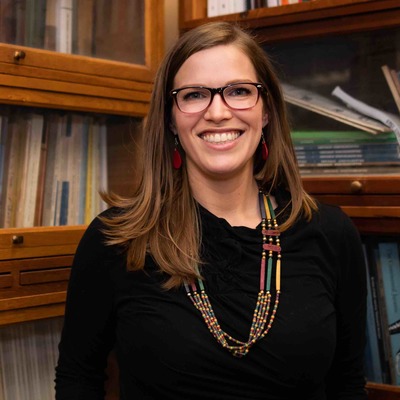
Diana Marsh

8 Followers
5 Following
15 Posts
Nerd about all things archives & museums | Assistant Professor @iSchoolUMD | Past Chair
@NativeArchSAA | Extinct Monsters to Deep Time
@berghahnbooks
Archives
Museums
Decolonizing Methodologies
Extinct Monsters to Deep Time
Museums in the Infodemic (A Paperback Book Launch Featuring Behind-the-Scenes Stories)

Event Registration Required Friday, March 17, 2023 11:00-12:30 pm EST In Person: UMD College Park, Hornbake South, Room 2119 (Directions) Virtual: Zoom, link provided upon registration Food provided In honor of the paperback release of Extinct Monsters to Deep Time, the Center for Archival Futures and the Museum Scholarship and Material Culture program at the University of Maryland invite you to a critical conversation about the shifting responsibilities of museum practitioners in an era of information (and misinformation) overload—and how this is changing the way that museums communicate with the public. Renowned experts in collections and exhibitions will join us to share behind-the-scenes stories and discuss their efforts to convey hard truths about our shared past, present, and future in the current information landscape. This is a free event, open to museum professionals, researchers, faculty, staff, students, and members of the public with an interest in information, museums, and curation. This is a hybrid event with a Zoom option as well as an option to attend in person (more on transportation and parking). Registration is required.

Google Docs
Speakers:
Ariana Curtis, National Museum of African American History and Culture
Steven Luckert, United States Holocaust Memorial Museum
Diana Marsh, University of Maryland, Author
Jennifer Shannon (Moderator), National Museum of the American Indian
Lindsay Zarwell, National Geographic

I wrote a book and it came out in paperback and we’re having a nerd party 🎉! In case anyone wants to come this (hybrid, free!) 📕 launch next Friday Mar 17 features some really cool, smart people! BYO green 🍺!

#Museums in the #infodemic
A Paperback #book Launch Featuring Behind-the-Scenes Stories
March 17 | 11:00 AM–12:30 PM EST | HBK 2119 & Virtual |

Tomorrow! @iSchoolUMD CAFe Speaker Series: Andrea Thomer on
#Curating Longitudinal #naturalhistory #Data Through the CHANGES Project
March 1 | 12:00 PM–1:00 PM (zoom!). Register here: https://umd.zoom.us/meeting/register/tJIrcumtrDItH9zq14g4cLBM2iENwSKpHU2o
Welcome! You are invited to join a meeting: CAFe Speaker Series: Curating longitudinal natural history data through the CHANGES project. After registering, you will receive a confirmation email about joining the meeting.

Hybrid Event In person location: HBK2116 Dr. Andrea Thomer, Assistant Professor at the University of Arizona School of Information, provides our March CAFe Speaker Series talk as a hybrid event, speaking about natural history data curation: The specimens, field notes, and other data stored in natural history collections can be crucial for studies of past and on-going climate change — but only if they can be transformed into computationally-ready datasets. In this talk I’ll describe the CHANGES (Collections, Heterogenous data And Next Generation Ecological Synthesis) project, in which we are developing approaches to curate rich but under-utilized longitudinal datasets that are often stored in the archives of natural history collections and surveys. Working with over 100 years of archival records from the Michigan Institute for Fisheries Research, we used the Zooniverse community science platform to ask friendly strangers from the internet to help transcribe over 100,000 data cards. Extensive data curation is needed both before and after records are entered in Zooniverse; while we have developed some workflows that will likely be generalizable to similar projects, considerable curation ‘by hand’ is still needed. We find that though natural history datasets are collected with the aspiration of longitudinally, digitization reveals the human idiosyncrasies that inevitably shape into any artifact created by many people over many years.

Zoom
🔥off the 🖨️!! #JASIST paper on centering #Indigenous and queer embodiment in sociotechnical systems!
And thanks to #UMDLibraries new agreement it’s #openaccess!! Big 🥳 and 🙏 to Travis Wagner & Lydia Curliss: https://asistdl.onlinelibrary.wiley.com/doi/10.1002/asi.24746
🔥 off the presses! New paper with Selena St Andre, Travis Wagner, & Joshua Bell on how science-oriented (biological, archaeological) #anthropologists perceive and use #archives!
Thanks @NSF for supporting this work! https://link.springer.com/article/10.1007/s10502-023-09411-z
Attitudes and uses of archival materials among science-based anthropologists - Archival Science

While archival user studies have largely focused on humanities (and adjacent) scholars, this paper focuses on anthropologists engaged in scientific research. Based on qualitative results from an open-ended survey, we investigate how science-based anthropologists perceive and use archives in their work. We ask: How are science-based anthropologists and archaeologists reusing archival data in their research? What difficulties or barriers do they encounter in reusing archival data in scientific contexts? What attitudes or understandings about archival research are held by science-based anthropologists and archaeologists? Our findings primarily add to the body of literature about user experience in archives and more broadly to the emerging literature on archival data reuse. Major findings include (1) barriers and gatekeeping legacies that impact archival research and the ability of researchers to reuse data and (2) mixed perceptions about archives among researchers. We also discuss suggestions made by these communities of practice, and the ways that barriers to archival data reuse may stem from a lack of knowledge about core archival and information infrastructures among researcher communities. Together, this research showcases possible (re)uses of important primary source data in archives among scientific communities but highlights that barriers to access and misperceptions create a gap in exploiting that potential. We argue for a “re-imagining” of anthropological archives as relevant to contemporary communities and scientific pursuits toward a richer scientific research environment.

SpringerLink
Every time I try to schedule a meeting @academicchatter
Beautiful day to be headed to the #library #umd
#MuseumSelfieDay throwback to our #DocumentingDiversity collab #nmnh #silibraries on #Anthropology media technologies. Tons of hard work and fun with Kirsten Van Der Veen, @JoshuaABellDC and #smithsonian exhibits

Yesterday we launched a new tool that lets you search museums, colleges & other institutions that have failed to return Native American remains, despite a longstanding federal law.

On 1/18, we'll be hosting a free webinar on how journalists and other researchers can use this tool:

"How to Report on the Repatriation of Native American Remains"

Sign up and get more info here:

https://www.propublica.org/events/repatriation

How to Report on the Repatriation of Native American Remains

Join our reporters to learn how you can research repatriation efforts in your community using ProPublica’s first-of-its-kind repatriation map and data.

ProPublica