
Dagmar Fraser

136 Followers
739 Following
119 Posts
Doctoral Researcher in the Autism, Social Cognition & Bodily Movement Lab Doctoral Researcher at the Autism, Social Cognition & Bodily Movement Lab (http://jencooklab.com), Senior Centre Technician at @TheCHBH, MATLAB Ambassador, He/Him. @dagmarfraser https://twitter.com/dagmarfraser @dagmarfraser.bsky.social

From humble beginnings to a cornerstone of psychological science!

❤️ But like all open source projects, PTB depends on a small team of dedicated developers. For just 200€/year, you can support PTB and its wonderfully irascible maintainer Mario Kleiner (https://www.psychtoolbox.net/#service) 5/6

Psychtoolbox | Open source solution

🖥️ With a wave of PTB's wand, any Mac became a scientific instrument. First on classic Mac OS, then in 2006 expanding to Mac OS X, Windows, and Linux.

🧠 I first met PTB in 2007, and still use it daily https://twitter.com/TheCHBH for presenting stimuli in fMRI, MEG, OPM, fNIRS, and EEG studies. From simple reaction times to complex brain imaging paradigms - it just works!

📊 By 2018, PTB had been downloaded 285,897 times and appears in thousands of papers annually. 4/6

The Centre for Human Brain Health (@TheCHBH) on X

We are a research facility @unibirmingham with the mission to understand what makes a brain healthy, how to maintain health & how to prevent and reverse damage.

X (formerly Twitter)
🌉 The breakthrough? PTB let researchers write simple high-level code while maintaining millisecond-precise control of display & sound hardware. Like having a research assistant who speaks both English and machine code fluently! 3/6

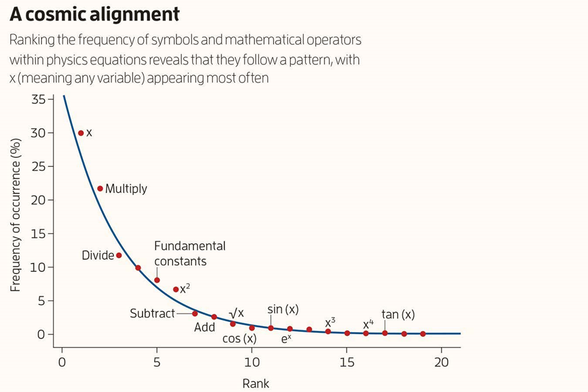
📊 Delightful new preprint reveals a meta *power law* in physics! The mathematical symbols & operators we use to describe nature's laws... follow their own mathematical pattern! #MATLAB #MATLABAmbassador

(image from New Scientist)

Constantin et al. (2024) analysed equations from physics textbooks, Wikipedia's named equations, and cosmology papers. Rather than random symbol frequencies, they discovered an exponential pattern! 🤓 https://arxiv.org/abs/2408.11065 1/5
Statistical Patterns in the Equations of Physics and the Emergence of a Meta-Law of Nature

Physics, as a fundamental science, aims to understand the laws of Nature and describe them in mathematical equations. While the physical reality manifests itself in a wide range of phenomena with varying levels of complexity, the equations that describe them display certain statistical regularities and patterns, which we begin to explore here. By drawing inspiration from linguistics, where Zipf's law states that the frequency of any word in a large corpus of text is roughly inversely proportional to its rank in the frequency table, we investigate whether similar patterns for the distribution of operators emerge in the equations of physics. We analyse three corpora of formulae and find, using sophisticated implicit-likelihood methods, that the frequency of operators as a function of their rank in the frequency table is best described by an exponential law with a stable exponent, in contrast with Zipf's inverse power-law. Understanding the underlying reasons behind this statistical pattern may shed light on Nature's modus operandi or reveal recurrent patterns in physicists' attempts to formalise the laws of Nature. It may also provide crucial input for symbolic regression, potentially augmenting language models to generate symbolic models for physical phenomena. By pioneering the study of statistical regularities in the equations of physics, our results open the door for a meta-law of Nature, a (probabilistic) law that all physical laws obey.

arXiv.org

What lies between a function and its derivatives? In kinematic terms; between Position and Velocity? Between Velocity and Acceleration? We can see a pattern in d^N/dt^N... but what if N was 0.5? 🤔 #MATLAB #MATLABAmbassador

This very question was put by L'Hopital to Leibniz in 1695! His response: "An apparent paradox, from which one day useful consequences will be drawn." 📚 1/6

Other noises? Yes... if we generalise an exponent α;
1/f^-2 Blue Noise
1/f^-1 Violet Noise
1/f^0 White Noise
1/f^1 Pink Noise (a common behaviour in biological systems!)
1/f^2, Red Noise / Brownian Noise (drunkard’s walk!)
1/f^2+ sometimes called Black Noise. 3/6

Making all the right noises...

MATLAB has wgn for White (Gaussian) Noise and pinknoise for Pink..

The power spectral density (PSD) of Pink is 1/f and so drops off as f increases (-10dB/dec as pictured). #MATLAB #MATLABAmbassador 1/6

You can keep on going (in both directions!) as noted in this delightfully retro Web 0.1 page - https://www.mathnstuff.com/math/spoken/here/1words/a/absement.htm 5/7
absement - antiderivative of displacement

What does https://twitter.com/KelloggsUKI 's Rice Crispies have to do with kinematics?

Differentiation of Position with respect to time gives successively; Velocity, Acceleration… and for those of us doing Kinematics you'll likely know Jerk.. what is next? #MATLAB #MATLABAmbassador

If you guessed the 1930s era Rice Crispies' mascots Snap, Crackle and Pop – you were right.
https://en.wikipedia.org/wiki/Fourth,_fifth,_and_sixth_derivatives_of_position#/media/File:Time_derivatives_of_position.svg 1/7

Kellogg's UK & IRE (@KelloggsUKI) on X

Instagram: https://t.co/sMvWWBs1eD Need a hand with something? @kelloggshelp_uk is on hand and happy to assist with any queries!

X (formerly Twitter)

this is by Dr David Wilby now an RSE with Antarctic Survey! https://www.davidwilby.dev/
but formerly https://x.com/RSE_Sheffield

He suggests folders for source code, subfolders for your new functions, your common functions, other people’s functions from MATLAB central, raw data, processed data, tests and images. 2/4

About Me

Research Software Engineer @ the British Antarctic Survey

Dr David Wilby