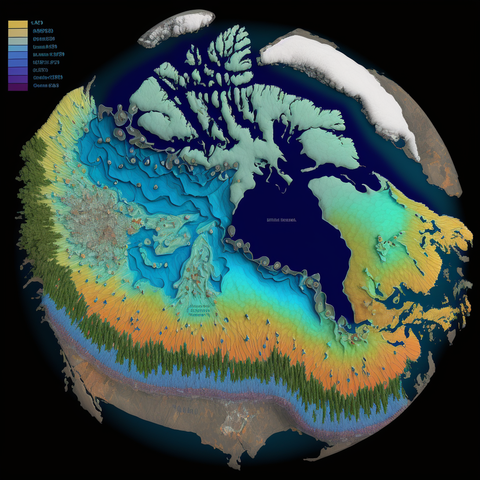
"High microbial activity in the #permafrost -dominated #watersheds" was the prompt for this illustration generated by #midjourney
The prompt is a quote from the abstract for the #AGU22 session "Seasonal and longitudinal variability in mercury concentrations in Arctic rivers".
📆 🔗 : https://bit.ly/CZNAGU22121211
#CriticalZone #biogeochemistry #AGU2022 #CriticalZoneAtAGU22

Seasonal and longitudinal variability in mercury concentrations in Arctic rivers
Permafrost regions with organic-rich substrate contain mercury (Hg) that accumu...
We are working to develop dependable #MachineLearning models for #CriticalZone research. Some of our latest developments will be shared during this #AGU22 poster session Tuesday morning.
"Automated Machine Learning Approach to Supervised Anomaly Detection from Critical Zone Watershed Sensor-Generated Time Series Data"
🔗 📆: https://bit.ly/3hnmb4N
#CriticalZone #CriticalZoneScience #MachineLearning #ScienceMastodon
Automated Machine Learning Approach to Supervised Anomaly Detection from Critical Zone Watershed Sensor-Generated Time Series Data
Critical zone time series datasets frequently contain anomalous patterns. Anoma...
If the #hydrology tag brought you here and you're going to #AGU22 next week - then this is the perfect way to end your Monday.
A Town Hall with #USGS #BigData Cluster member James Shanley. "#Catchment Science – Connecting the Dots from Monitoring to Process Understanding"
🔗 📆 https://bit.ly/CZNAGU22121210
#CriticalZone #CriticalZoneScience #ScienceMastodon
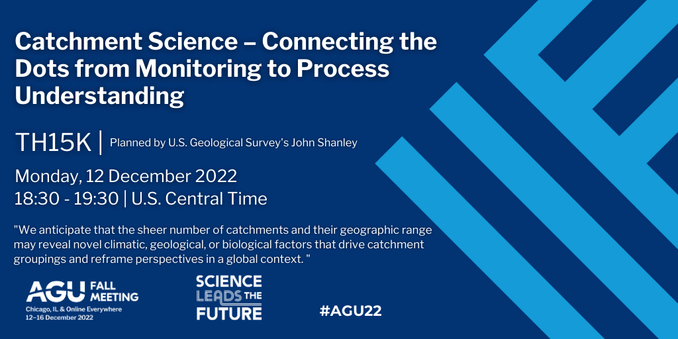
Catchment Science – Connecting the Dots from Monitoring to Process Understanding
The catchment community has recently organized its efforts to promote and sustain catchment science, showcasing the inherent scientific and societal value of more than 200 catchment studies that span the globe. This town hall builds on these recent efforts by facilitating an interactive discussion on how to carry out an effective collaborative data synthesis workshop. As a starting point for analysis, we will ask participants to craft a perceptual model of their catchment, led by examples from several catchments. We will conduct a brief collaborative analyses by computing and comparing monthly and annual precipitation – runoff (P-Q) budgets, for which virtually all sites have data. In a future workshop, we anticipate that the sheer number of catchments and their geographic range may reveal novel climatic, geological, or biological factors that drive catchment groupings and reframe perspectives in a global context. As an example, sub-groups of catchments with appropriate data may focus on computing catchment water storage and analyzing factors that shape differences in catchment storage over time and space. We welcome your participation and ideas on designing a future workshop.
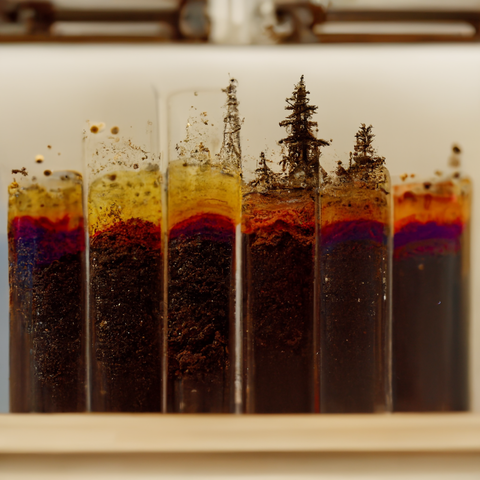
"Soil, gas, and water chemistry data" was the prompt for this illustration generated by #midjourney
The prompt is a quote from the abstract for the #AGU22 session "Impacts of Arid Land Agriculture and Flood Irrigation on Soil Quality, Water Dynamics, and Gas Transport".
📆 🔗 : https://bit.ly/CZNAGU22121208_1
#CriticalZone #biogeochemistry #AGU2022 #ScienceMastodon
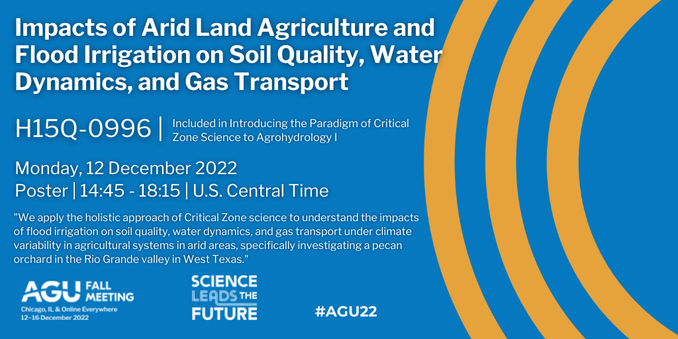
Impacts of Arid Land Agriculture and Flood Irrigation on Soil Quality, Water Dynamics, and Gas Transport
In this study, we apply the holistic approach of Critical Zone science to under...
Next Monday at #AGU22. "Seasonal and longitudinal variability in mercury concentrations in #Arctic rivers" includes collaborations between members of the #Dustˆ2 Cluster and the #BigData Cluster who are based at #BrighamYoungUniversity
📆 🔗 : https://bit.ly/CZNAGU22121211
#CriticalZone #biogeochemistry #hydrology #WaterScience #AGU2022 #ScienceMastodon
Seasonal and longitudinal variability in mercury concentrations in Arctic rivers
Permafrost regions with organic-rich substrate contain mercury (Hg) that accumu...
"Impacts of Arid Land Agriculture and Flood Irrigation on Soil Quality, Water Dynamics, and Gas Transport" includes collaborative research from the #BigDataCluster's Li Li, based at #PennState.
📆 🔗 : https://bit.ly/CZNAGU22121208_1
#CriticalZone #biogeochemistry #hydrology #WaterScience #AGU2022 #ScienceMastodon
Impacts of Arid Land Agriculture and Flood Irrigation on Soil Quality, Water Dynamics, and Gas Transport
In this study, we apply the holistic approach of Critical Zone science to under...
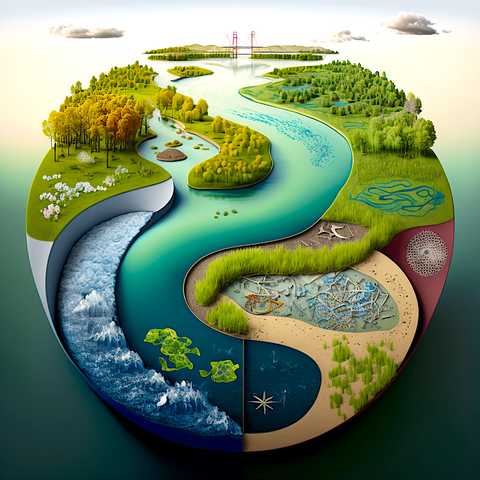
"The chemical, physical and biological condition of waterways" was the prompt for this illustration generated by #AI #midjourney.
The prompt is a quote from the abstract for the #AGU22 poster session "Frontiers in Water-Quality Science: Origins, Patterns, and Detection of Spatial and Temporal Variation III ".
📆 🔗 : https://bit.ly/CZNAGU22121208
#CriticalZone #CriticalZoneResearch #hydrology #biogeosciences #AGU2022 #ScienceIllustrations #ScienceMastodon
Frontiers in Water-Quality Science: Origins, Patterns, and Detection of Spatial and Temporal Variation III Poster
The chemical, physical and biological condition of waterways – “water quality” – is critical for ecological and human health. This session explores cutting-edge methods, novel synthesis products, and new models about water quality. We encourage submissions that use new tools and data sets to reveal spatio-temporal patterns in water quality across scales ranging from single catchment studies to cross-site syntheses. Wide-spread deployment of in-situ sensors has revolutionized our understanding of watershed dynamics over diel, storm, and seasonal timescales, highlighting the disproportionate impact of discrete events on annual export. Emerging capabilities for remote sensing of water quality, the explosion in synthesis opportunities, and improvements in water quality models enable new understanding of where, when, and why water quality varies, and new theories to explain these patterns. We solicit contributions that explore these water quality patterns in watersheds across the land use continuum, and particularly in systems experiencing the impacts of environmental change.
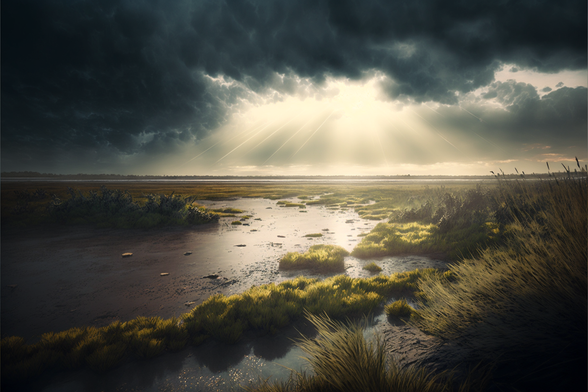
"Salt marshes" was the prompt for this illustration generated by #AI #midjourney.
The prompt is a quote from the abstract for the #AGU22 session "Identification of Hot Moments of Nutrient Processing in Coastal Systems Using High Frequency Sensors (Invited)" Cluster member Erin Seybold is one of the collaborators on this paper.
📆 🔗 : https://bit.ly/CZNAGU22121202_1
#CriticalZone #CriticalZoneResearch #hydrology #biogeosciences #AGU2022 #ScienceIllustrations #ScienceMastodon

Identification of Hot Moments of Nutrient Processing in Coastal Systems Using High Frequency Sensors
Salt marshes are critical hot spots of nutrient processing and retention and pl...
"Frontiers in #WaterQuality Science: Origins, Patterns, and Detection of Spatial and Temporal Variation III" is a Monday afternoon #AGU22 poster session. #BigDataCluster member Erin Seybold collaborated with researchers based at Roger Williams University and the Oak Ridge Institute for Science and Education as conveners for the session.
📆 🔗 : https://bit.ly/CZNAGU22121208
#CriticalZone #biogeochemistry #hydrology #WaterScience #AGU2022 #ScienceMastodon
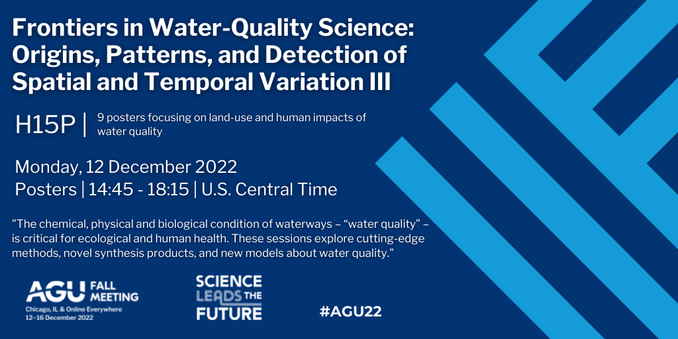
Frontiers in Water-Quality Science: Origins, Patterns, and Detection of Spatial and Temporal Variation III Poster
The chemical, physical and biological condition of waterways – “water quality” – is critical for ecological and human health. This session explores cutting-edge methods, novel synthesis products, and new models about water quality. We encourage submissions that use new tools and data sets to reveal spatio-temporal patterns in water quality across scales ranging from single catchment studies to cross-site syntheses. Wide-spread deployment of in-situ sensors has revolutionized our understanding of watershed dynamics over diel, storm, and seasonal timescales, highlighting the disproportionate impact of discrete events on annual export. Emerging capabilities for remote sensing of water quality, the explosion in synthesis opportunities, and improvements in water quality models enable new understanding of where, when, and why water quality varies, and new theories to explain these patterns. We solicit contributions that explore these water quality patterns in watersheds across the land use continuum, and particularly in systems experiencing the impacts of environmental change.
#AGU22 outtakes.
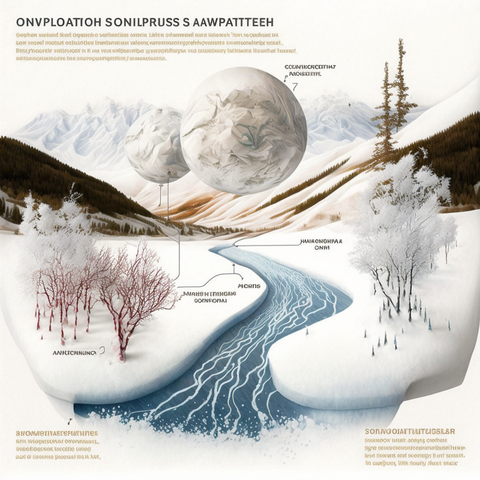
We're using #midjourney to generate illustrations for our #AGU2022 posts. Here's an outtake from the "complex dynamics between seasonal snow and ecohydrological processes" generation.
https://criticalzone.org/news-events/using-artificial-intelligence-generated-art-to-illustrate-critical-zone-research