Mark Crowley

448 Followers
337 Following
324 Posts

Ok, a confession about attending #NeurIPS2023. I was there for the cutting-edge AI/ML innovation and science, sure. But I was *also* there for the food, and to see old friends. But *also*, really maybe the first thing I thought of?

Jazz.

Saw a fantastic concert at Preservation Hall, lots of great music on Frenchman St. And I went to the Jazz museum, really nice.

What I wasn't expecting? Jazz museum is in the old Mint. Which had this very cool old calculator. #SeeImStillNerdy

Yep, that worked. You can even view your Mastodon posts on Flipboard once you link you account. On the phone it shows up fine. But hilariously, on the desktop browser it's just called 'Flipboard Section' @Flipboard

Oh my Gaaawd #neurips2023 people! How have we been eating fast food when this exists? wow. At Le Bayou on Bourbon Street.

wow

Our paper "Generative Causal Representation Learning for Out-of-Distribution Motion Forecasting" just got accepted to #ICML2023!

Congrats to my PhD student Shayan as well as postdoc
Zahra Gharaee for all their hard work on this collab with Oliver Schulte.

Arxiv link: https://arxiv.org/abs/2302.08635

Generative Causal Representation Learning for Out-of-Distribution Motion Forecasting

Conventional supervised learning methods typically assume i.i.d samples and are found to be sensitive to out-of-distribution (OOD) data. We propose Generative Causal Representation Learning (GCRL) which leverages causality to facilitate knowledge transfer under distribution shifts. While we evaluate the effectiveness of our proposed method in human trajectory prediction models, GCRL can be applied to other domains as well. First, we propose a novel causal model that explains the generative factors in motion forecasting datasets using features that are common across all environments and with features that are specific to each environment. Selection variables are used to determine which parts of the model can be directly transferred to a new environment without fine-tuning. Second, we propose an end-to-end variational learning paradigm to learn the causal mechanisms that generate observations from features. GCRL is supported by strong theoretical results that imply identifiability of the causal model under certain assumptions. Experimental results on synthetic and real-world motion forecasting datasets show the robustness and effectiveness of our proposed method for knowledge transfer under zero-shot and low-shot settings by substantially outperforming the prior motion forecasting models on out-of-distribution prediction.

arXiv.org
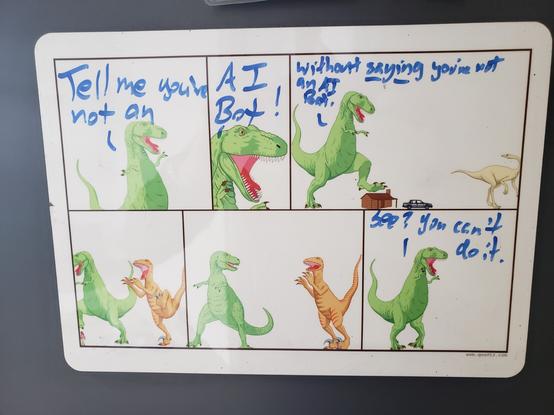
Dinosaur Comics board on my office door yesterday with a rare combo-joke from both courses I'm teaching this term and the last topics we were discussing in each. #computersciencejoks #machinelearningjoks #chatgpt #pequalsnp

Some joke advice for ChatGPT's trainers.

Its jokes while we wait are not funny, though I can see sometimes how it's trying to explore #JokeSpace, being mean to itself, saying (slightly) surprising things.

But I initially misread he message I saw today when #ChataGPT was once again too busy for me.

Slightly reworded to be 2 lies and 1 truth and this would be a great joke.

Ok, clearly I can get ChatGPT to teach my upcoming class then.

> Explain Dijkstra's algorithm, in the style of a Star Wars opening crawl.

The current #DinoComicsBoard on my office door with no comments yet.